



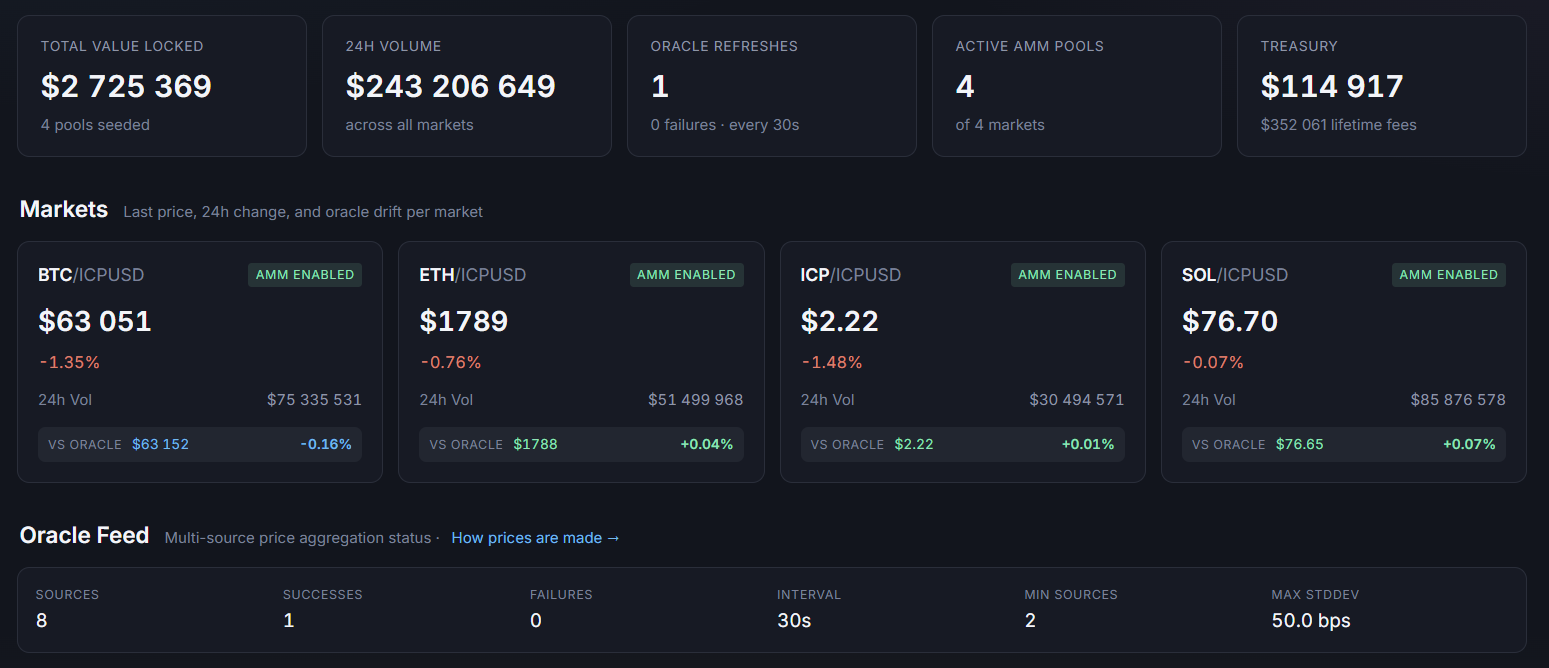
**DFINITY’s MULTI/DEX Hits $243 Million in Simulated Volume on ICP**
DFINITY has taken a bold step into the decentralized exchange (DEX) arena with the launch of **MULTI/DEX** on the Internet Computer (ICP). Operating in **Play Mode** since July 11, the fully onchain, multi-chain exchange has already demonstrated impressive engagement, with simulated trading volume surpassing **$243 million in 24 hours** by July 13. While no real funds are at risk—every balance is a dummy asset—the trial serves as a critical stress test. The community’s response during this phase could determine whether control of the platform transitions to the **Network Nervous System (NNS)**, ICP’s decentralized governance mechanism, enabling ownerless operation.
—
### What MULTI/DEX Brings to Internet Computer
MULTI/DEX is designed as a next-generation trading venue, merging the efficiency of a **central limit order book** with the liquidity depth of a **market-making automated market maker (AMM)**. Built entirely on ICP, it supports trading pairs between **Bitcoin (BTC), Ethereum (ETH), Solana (SOL), and ICP**, all quoted against an **ICPUSD** stablecoin asset.
Key features include:
* **Flexible Trading Strategies:** Users can place spot orders or open margin positions with up to **10x leverage**.
* **Risk Management:** An **insurance fund**, funded by 5% liquidation penalties, is designed to absorb bad debt and protect the system.
* **Transparent Auditing:** Every balance change is recorded on a **hash-chained public ledger**, allowing anyone to verify transactions directly in their browser.
Founder **Dominic Williams** framed the launch as a direct challenge to traditional, centralized exchanges, emphasizing its technological sophistication.
> “MULTI/DEX — the world’s most advanced DeFi — will be released in game mode later this week… *True* DeFi that mimics CEXs.”
### A Competitive Environment: Leaderboards and Incentives
To encourage participation, the platform operates as a competition where each player starts with **$100,000 in simulated assets**. A public leaderboard tracks performance, creating a high-stakes testing environment. The results from the first day were staggering:
* **Over $162 million** in trading volume.
* **More than $129,000** in generated fees.
This engagement caught the attention of the broader crypto community, with prominent figures like **BeInCrypto** and **@dfinity** highlighting the achievement on social media.
### The Path to Decentralization: The NNS Vote
The current Play Mode is a trial period. The ultimate governance decision rests with the **Network Nervous System (NNS)**. Following the creation of a specialized subnet with confidential computing capabilities, a proposal authorized the deployment of the exchange canisters. However, the critical vote to make MULTI/DEX **autonomous and ownerless** has not yet been scheduled.
If approved, the exchange will operate without direct DFINITY control, relying on the collective decisions of ICP holders.
### Market Context: High Engagement, Questionable Price Action
The launch has generated significant **on-chain activity**:
* **$243.2 million** in 24-hour volume (as of July 13).
* **$352,061** in lifetime fees.
* **$2.7 million** in Total Value Locked (TVL) across four initial pools.
Solana (SOL) was the most traded asset, followed by BTC, ETH, and ICP itself. While these numbers rival or exceed some DEX records (e.g., Robinhood Chain), it is essential to note that this volume is driven by **free play money**, not real economic deposits.
Despite the on-chain excitement, the **ICP token price** has remained subdued. Trading near **$2.22**, ICP declined 1.5% in 24 hours, sitting near its annual lows. This suggests that the market is cautious about the conversion of play-stage success into real-world value.
—
### FAQ Section
**Q: Is my money safe on MULTI/DEX during the Play Mode?**
**A:** Yes, in the sense that all assets are “dummy” or simulated. No real funds are deposited, so there is no financial risk of loss. However, users should be aware that this is a testing environment, and the smart contracts are undergoing live stress tests.
**Q: What determines the winner of the competition?**
**A:** Users are ranked on a public leaderboard based on their simulated trading performance and fee generation. The goal is to accumulate the highest volume and fees.
**Q: What happens after the Play Mode ends?**
**A:** The data and community engagement from the Play Mode will determine if the Network Nervous System (NNS) votes to adopt the exchange. If successful, it will transition to a fully autonomous, ownerless model governed by ICP token holders.
**Q: Why hasn’t the ICP price increased with the launch news?**
**A:** Price is influenced by a multitude of factors, including broader market sentiment and tokenomics. The current market seems to be differentiating between the excitement of the technology trial and the current valuation of the ICP asset itself.
**Q: Is real money trading available yet?**
**A:** Not yet. MULTI/DEX is currently in a simulated “Play Mode.” Real-money trading will only be enabled if the NNS governance proposal passes and the platform transitions out of the testing phase.
—
### Conclusion
DFINITY’s MULTI/DEX represents a significant experiment in onchain finance. By launching in Play Mode, the team has prioritized community stress-testing and transparency over immediate monetization. The platform has already achieved remarkable simulated volumes, demonstrating strong technical capability and user interest.
The next critical milestone is the **NNS vote**. If the community approves, MULTI/DEX could evolve from a high-profile testnet project into a truly decentralized, ownerless financial infrastructure on the Internet Computer. For now, the $243 million in simulated volume is a powerful proof of concept, but the journey from testnet to mainnet—and from dummy assets to real value—remains the defining challenge.
