



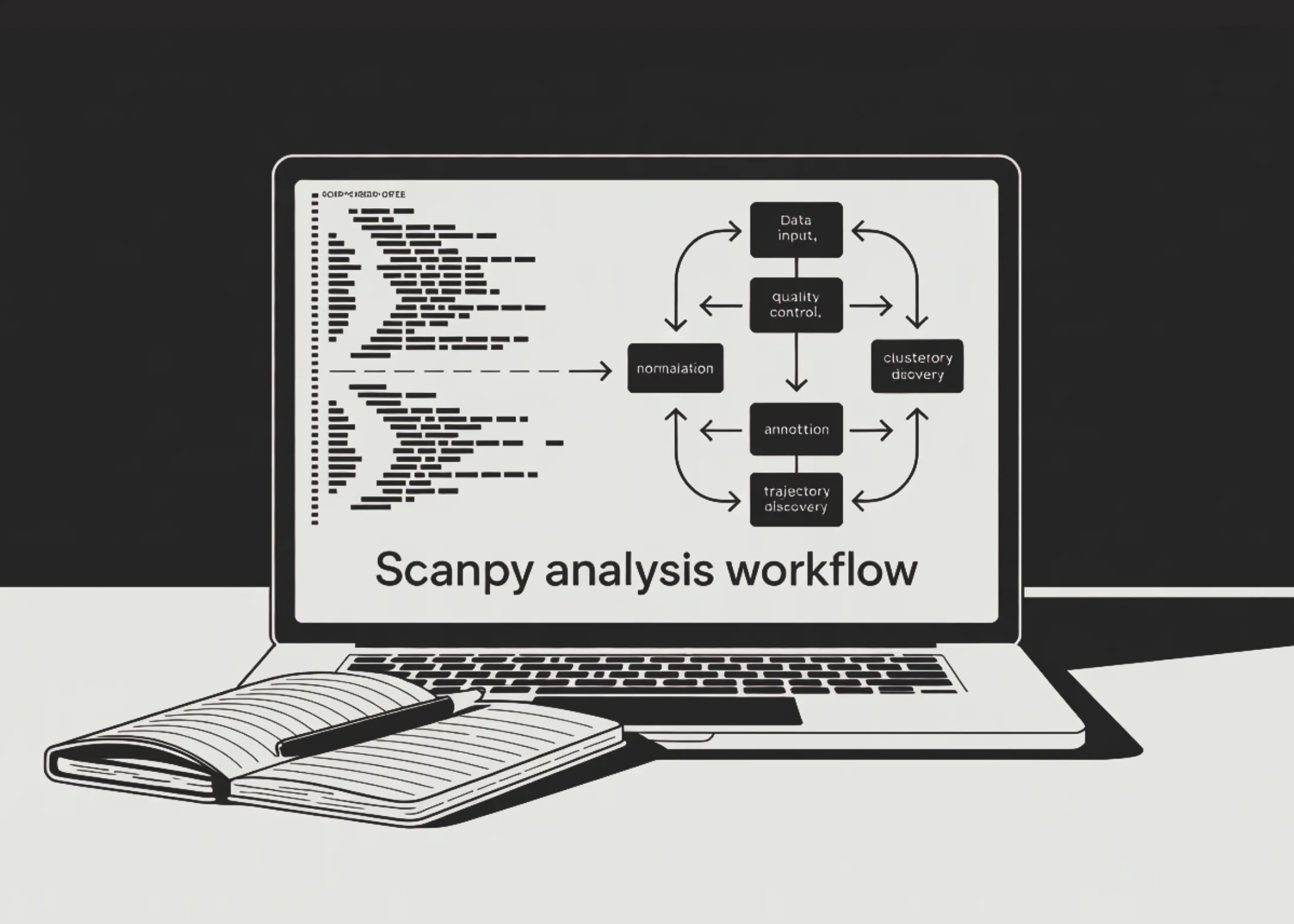
This tutorial walks you through a comprehensive single-cell RNA-seq analysis pipeline using Scanpy on the widely used PBMC-3k dataset. The workflow begins with data loading and structural inspection, followed by rigorous quality control assessments—including gene counts, total UMI counts, mitochondrial content, and ribosomal gene expression. Next, we remove low-quality cells and infrequently detected genes, flag and exclude potential doublets using Scrublet, normalize expression values, apply log transformation, and pinpoint highly variable genes for focused downstream analysis. We also assign cell-cycle phase scores, correct for technical noise, scale the data, and perform dimensionality reduction via PCA, UMAP, and t-SNE. Cell populations are clustered using the Leiden algorithm, marker genes are identified, and cell types are annotated based on well-established PBMC markers. Additionally, we infer developmental trajectories with PAGA and diffusion pseudotime, compute a custom interferon-response score, and save the fully processed AnnData object for later use.
!pip install -q scanpy leidenalg python-igraph scrublet

import scanpy as sc
import numpy as np
import pandas as pd
import matplotlib.pyplot as plt
import warnings
warnings.filterwarnings("ignore")

sc.settings.verbosity = 3
sc.settings.set_figure_params(dpi=80, facecolor="white", figsize=(5, 5))
sc.logging.print_header()

adata = sc.datasets.pbmc3k()
adata.var_names_make_unique()
print(adata)

adata.var["mt"]   = adata.var_names.str.startswith("MT-")
adata.var["ribo"] = adata.var_names.str.startswith(("RPS", "RPL"))
sc.pp.calculate_qc_metrics(
   adata, qc_vars=["mt", "ribo"], percent_top=None, log1p=False, inplace=True
)

sc.pl.violin(
   adata,
   ["n_genes_by_counts", "total_counts", "pct_counts_mt"],
   jitter=0.4, multi_panel=True,
)
sc.pl.scatter(adata, x="total_counts", y="pct_counts_mt")
sc.pl.scatter(adata, x="total_counts", y="n_genes_by_counts")
First, we install essential single-cell analysis packages and import key Python libraries: Scanpy for core analysis, NumPy and Pandas for data handling, Matplotlib for visualization, and warnings to suppress non-critical alerts. We then load the PBMC-3k dataset, ensure all gene names are unique, and examine the structure of the resulting AnnData object. Quality control metrics are computed for mitochondrial and ribosomal genes, and we visualize data quality using violin plots and scatter plots to assess distributions and potential outliers.
sc.pp.filter_cells(adata, min_genes=200)
sc.pp.filter_genes(adata, min_cells=3)
adata = adata[adata.obs.n_genes_by_counts < 2500, :].copy()
adata = adata[adata.obs.pct_counts_mt < 5, :].copy()

sc.pp.scrublet(adata)
print("Predicted doublets:", int(adata.obs["predicted_doublet"].sum()))
adata = adata[~adata.obs["predicted_doublet"], :].copy()

adata.layers["counts"] = adata.X.copy()
sc.pp.normalize_total(adata, target_sum=1e4)
sc.pp.log1p(adata)

sc.pp.highly_variable_genes(adata, min_mean=0.0125, max_mean=3, min_disp=0.5)
sc.pl.highly_variable_genes(adata)
adata.raw = adata
adata = adata[:, adata.var.highly_variable].copy()
To enhance data reliability, we eliminate cells with very few detected genes and genes observed in only a handful of cells. Using Scrublet integrated into Scanpy, we predict and remove likely doublets—artifacts where two cells are mistakenly captured as one. We preserve the original count matrix in a separate layer, normalize total counts per cell to 10,000, apply a log(1 + x) transformation, and select highly variable genes that drive biological heterogeneity. Only these informative genes are retained for subsequent steps.
s_genes = ["MCM5","PCNA","TYMS","FEN1","MCM2","MCM4","RRM1","UNG","GINS2",
          "MCM6","CDCA7","DTL","PRIM1","UHRF1","HELLS","RFC2","NASP",
          "RAD51AP1","GMNN","WDR76","SLBP","CCNE2","UBR7","POLD3","MSH2",
          "ATAD2","RAD51","RRM2","CDC45","CDC6","EXO1","TIPIN","DSCC1",
          "BLM","CASP8AP2","USP1","CLSPN","POLA1","CHAF1B","E2F8"]
g2m_genes = ["HMGB2","CDK1","NUSAP1","UBE2C","BIRC5","TPX2","TOP2A","NDC80",
            "CKS2","NUF2","CKS1B","MKI67","TMPO","CENPF","TACC3","SMC4",
            "CCNB2","CKAP2L","CKAP2","AURKB","BUB1","KIF11","ANP32E",
            "TUBB4B","GTSE1","KIF20B","HJURP","CDCA3","CDC20","TTK",
            "CDC25C","KIF2C","RANGAP1","NCAPD2","DLGAP5","CDCA2","CDCA8",
            "ECT2","KIF23","HMMR","AURKA","PSRC1","ANLN","LBR","CKAP5",
            "CENPE","NEK2","G2E3","CBX5","CENPA"]
s_genes   = [g for g in s_genes   if g in adata.var_names]
g2m_genes = [g for g in g2m_genes if g in adata.var_names]
sc.tl.score_genes_cell_cycle(adata, s_genes=s_genes, g2m_genes=g2m_genes)

sc.pp.regress_out(adata, ["total_counts", "pct_counts_mt"])
sc.pp.scale(adata, max_value=10)

sc.tl.pca(adata, svd_solver="arpack")
sc.pl.pca_variance_ratio(adata, log=True, n_pcs=50)

sc.pp.neighbors(adata, n_neighbors=10, n_pcs=40)
sc.tl.umap(adata)
sc.tl.tsne(adata, n_pcs=40)
We compile lists of known S-phase and G2/M-phase marker genes, keeping only those present in our dataset. Each cell is then assigned a score indicating its likely cell-cycle phase. To minimize technical bias, we regress out effects from total UMI counts and mitochondrial percentage, then scale the data so no single gene dominates due to high expression. Principal Component Analysis (PCA) is performed, and we inspect the variance explained by each component. Using the top principal components, we build a neighborhood graph and generate both UMAP and t-SNE embeddings for visualization.
sc.tl.leiden(adata, resolution=0.5, flavor="igraph", n_iterations=2, directed=False)
sc.pl.umap(adata, color="leiden", legend_loc="on data", title="Leiden clusters")
sc.pl.tsne(adata, color="leiden", legend_loc="on data", title="t-SNE clusters")sc.tl.rank_genes_groups(adata, "leiden", method="wilcoxon")
sc.pl.rank_genes_groups(adata, n_genes=20, sharey=False)
result = adata.uns["rank_genes_groups"]
groups = result["names"].dtype.names
top_df
We apply Leiden clustering to group cells based on the neighborhood graph and visualize the clusters on UMAP and t-SNE plots. We perform differential expression analysis using the Wilcoxon test to identify the top marker genes for each cluster. We then use canonical PBMC marker genes to support cell-type annotation through dot plots and stacked violin plots.
We run PAGA to model connectivity between Leiden clusters and reinitialize UMAP using the PAGA graph to obtain a clearer trajectory structure. We compute diffusion maps and diffusion pseudotime to explore possible progression patterns across cell states. We also calculate an interferon-response gene-set score, visualize it on UMAP, and save the final analyzed object as an .h5ad file.
In conclusion, we built an end-to-end Scanpy pipeline for single-cell RNA-seq analysis, transforming raw PBMC data into interpretable biological insights. We cleaned and preprocessed the dataset, removed noisy cells and doublets, selected informative genes, and generated meaningful embeddings to visualize cellular structure. We then used Leiden clustering and differential expression analysis to discover marker genes and connect clusters to known immune cell types. By adding PAGA, diffusion pseudotime, and custom gene-set scoring, we extended the workflow beyond basic clustering and showed how Scanpy supports deeper biological interpretation. At last, we had a saved .h5ad object that contains the processed data, annotations, scores, clusters, and visual analysis results, ready for downstream exploration or reporting.
Check out the Full Codes with Notebook here. Also, feel free to follow us on Twitter and don't forget to join our 150k+ ML SubReddit and Subscribe to our Newsletter. Wait! are you on telegram? now you can join us on telegram as well.
Need to partner with us for promoting your GitHub Repo OR Hugging Face Page OR Product Release OR Webinar etc.? Connect with us
The post How to Build a Single-Cell RNA-seq Analysis Pipeline with Scanpy for PBMC Clustering, Annotation, and Trajectory Discovery appeared first on MarkTechPost.
