



# The Hidden Cost of AI Adoption in Enterprise Security Operations
## A New Kind of Alert Is Reshaping SOC Workflows
Enterprise security operations centers (SOCs) are experiencing a dramatic shift in the nature of their alert streams. A previously negligible category of notifications — those triggered not by cyberattacks targeting AI systems, but by the everyday use of AI tools and agents within an organization — has surged in volume and now demands serious attention from security teams.
To understand the scale of this shift, consider two data points that anchor the entire picture. First, AI-related alerts represent a tiny fraction of total SOC activity: roughly 0.43% of all alerts generated. Second, that share is exploding upward, having increased by 685% over a five-month window in early-to-mid 2026. The implication is clear: what is currently a small slice of the alert landscape is simultaneously the fastest-growing slice, and its trajectory suggests that security teams need to prepare for a fundamentally different kind of operational reality.
—
## Understanding the Three-Tier Composition of AI Alerts
Not all AI-triggered alerts are created equal. When analysts examined the full population of AI-related activity across enterprise environments, they classified every alert into one of three categories. The distribution reveals a striking imbalance:
– **Noise:** 94.1% of AI alerts fall into this category — legitimate work by AI agents that happens to trigger detection rules originally written for a world without autonomous coding tools.
– **Genuine Security Risk:** 5.8% represent real exposures where an AI agent, acting exactly as instructed, creates a material security problem — such as disabling its own permission safeguards or opening tunnels to the internet.
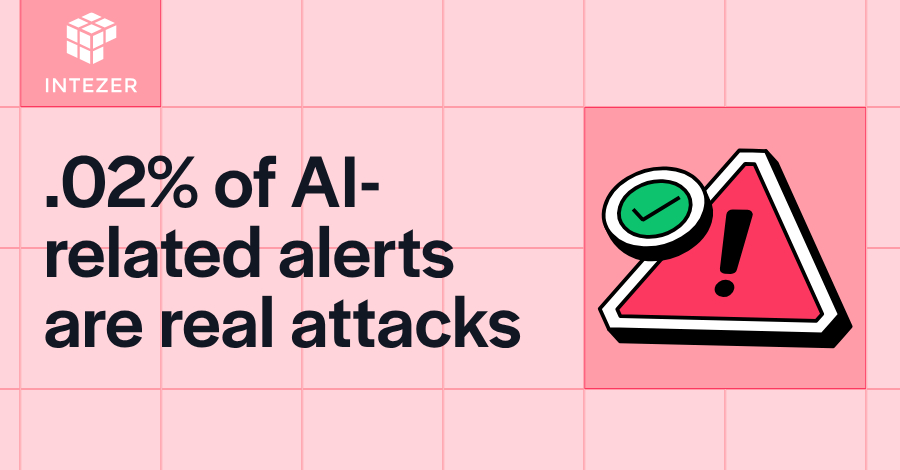
– **Real Attacks:** Just 0.02% — a tiny sliver — represents confirmed compromise or attacker activity that leverages AI adoption as a vector.
The critical takeaway is not that breaches are rampant; they are not. The operational burden comes from the enormous volume of noise that looks alarming on first glance and the quiet subset of genuine risks that those false alarms tend to obscure.
—
## The Two Faces of AI Adoption in the Enterprise
AI enters an organization through two fundamentally different pathways, and both produce alerts in the SOC.
The first is **technical adoption**: developers deploying coding agents that spawn shell processes, read credential stores, open network tunnels, download packages, and run security tooling — all as legitimate work. From a detection engine’s perspective, these behaviors are nearly identical to the early stages of a genuine intrusion. This is the loud half of AI adoption and it dominates the alert data.
The second is **consumer adoption**: employees signing into third-party AI applications, sharing corporate documents with generative-AI platforms, and granting OAuth permissions without always understanding what data is leaving the organization. This is the quiet half. It rarely triggers endpoint detection rules, yet it is precisely where corporate data exits the building.
Both halves converge in the SOC queue, and both look like potential threats at first glance. The job of the security team is to sort the real signal from the noise.
—
## Volume and Velocity: The Numbers Behind the Trend
Across approximately 16.9 million SOC alerts reviewed, roughly 73,000 — or 0.43% — were AI-related. That number sounds reassuring until you consider the growth rate: over a stable reporting window, monthly AI-related alert volume increased by 685%. The growth curve is monotonic, meaning every full month exceeds the previous one, and the acceleration has been particularly sharp in recent months.
What does this mean operationally? A SOC that sizes its AI-alert handling capacity based on today’s numbers will find itself under-provisioned within a single quarter. The current 0.43% figure should be understood as today’s floor, not a ceiling.
—
## Automated Triage and the Problem of Severity Labels
When AI-related alerts reach automated triage platforms, two separate decisions are made: a verdict on how dangerous the activity appears, and a response determining what happens next.
The results are revealing:
– **79.8%** of AI alerts receive a “benign” verdict.
– **81.7%** are automatically suppressed without any human ever seeing them.
– Only **5.4%** are escalated to a human analyst.
One instructive example illustrates why severity labels demand scrutiny: at a single customer, one detection accounted for 55% of all “critical” verdict alerts that flagged a Windows binary (Expand.exe) as a lateral-tool-transfer tool. Investigation revealed that a developer’s coding agent was simply setting up a shell environment — normal behavior for the work being done.
The lesson is unambiguous: severity labels applied to AI activity should be read with healthy skepticism, not accepted at face value.
—
## When AI Is the Attack Vector: Phishing Campaigns That Ride on Adoption
The confirmed real attacks identified in this analysis share a common pattern: none were carried out by an organization’s own AI agents. Instead, attackers are exploiting the trust employees have developed in AI brand names.
Phishing campaigns observed across multiple customers used subject lines that leveraged familiarity with major AI companies and products:
– **Brand impersonation via invoicing:** Emails referencing Anthropic used fake contract and invoice themes to make payment requests appear legitimate, with Anthropic serving as part of the pretext rather than the actual sender.
– **Fake Google/Gemini invitations:** Messages disguised as business workspace invitations directed recipients to a malicious domain (gemini-advertisers[.]com) that impersonated the legitimate Google ecosystem.
– **OpenAI impersonation:** Fraudulent “Partner Summit 2026” invitations originated from a Zoom infrastructure address (noreply-zoomevents@zoom.us), using legitimate domain infrastructure to lend false credibility to a registration flow designed to harvest credentials.
The attackers’ calculus is straightforward: AI adoption has made these brands familiar, and employees now routinely expect communications from these services. That expectation is precisely what makes the lures effective.
—
## The Risky Middle Ground: When Legitimate Agents Create Real Exposures
The 5.8% of alerts classified as genuine security risks deserve the most sustained attention from security teams — not because they represent active compromises, but because they represent standing exposures that are largely invisible to conventional alerting.
The most pervasive risk is the **permission-bypass flag**, a configuration option that allows an AI agent to execute commands without asking the user for approval first. Many users enable this for convenience, trusting the agent not to cause harm. Yet across every environment examined, agents running in this mode routinely attempted and succeeded in executing commands that exposed the organization to significant risk — including downloading reverse tunnels, dumping entire credential stores, and sending corporate data to third-party models.
Specific risky behaviors documented include:
– **Reverse tunnels:** An AI code editor spawning PowerShell, which then launched ngrok to open a named tunnel to the public internet using the user’s own authentication token. The intent was benign, but the exposure was real.
– **Credential store over-exposure:** An agent executing a command to dump an entire macOS keychain to a temporary file in order to retrieve a single stored token, briefly exposing every secret on the machine.
– **OAuth overreach:** Employees granting OAuth consent to AI applications across organizational tenants, creating surfaces where prompt injection or a compromised AI account could enable unauthorized data access.
A particularly important pattern emerged: the permission-bypass configuration is the single largest source of false positives in the AI alert population, and it is also the precondition exploited in a publicly documented supply-chain attack. The exposure is not about intent — it is that the safety rail is off, across many customers at scale, waiting for the moment when the code the agent executes is not benign.
—
## The Noise Problem: Legacy Detections in an AI World
The vast majority of AI-related alerts — 94.1% — are noise generated by detection rules that were written before autonomous AI agents existed. This is not a new phenomenon in SOC operations, but AI adoption has amplified it dramatically.
The most illustrative example involves the AI vendors’ own software. The legitimate Anthropic Claude Desktop installer, verified by its authentic code signature, triggered major endpoint detection and response (EDR) rules including “Ransomware Operations Detected” and “Encoded PowerShell Download and Run” across multiple customer environments. The installer is genuine. The detection vocabulary describes installer behavior using the language of malware.
Other documented noise patterns include:
– **Electron/Squirrel installer activity** triggering “Ransomware Operations” alerts during routine coding agent updates — signed, legitimate software packages exhibiting behavior that looks suspicious only because it was written before AI agents were part of the normal workflow.
– **Node.js-hosted CLI agents** with permission-bypass flags tripping ClickFix, DisableTools, and DLL-injection detections — all confirmed benign developer automation.
– **PowerShell orchestration** that appeared to be a reverse TCP shell but, upon inspection, was clear-text benign logic checking localhost ports, selecting available ports, starting Python scripts from project directories, and writing standard output to local log files.
The false-positive rates on the noisiest AI detections range from 77% to 99%. Several individual detection clusters misfire on AI-generated activity more than four times out of five. The sole exception is the ClickFix cluster, which leans genuinely severe at only 37% benign — and it does so precisely because it collides with the permission-bypass risk, firing on coding agents launched with aggressive flags. Even that genuinely severe signal traces back to legitimate AI use.
—
## Recommended Actions for Security Teams
Based on the analysis, several practical steps emerge for SOC teams navigating this new landscape.
### 1. Tune Legacy Detections Immediately
The single highest-value action available to most SOCs today is not building new detections — it is tuning the existing ones so that routine AI agent work does not generate maximum-severity alerts. The developers running coding agents should not be triggering ransomware or reverse-shell classifications as a matter of daily operation.
### 2. Define and Enforce AI Data Policies
Organizations need clear policies on what information can be shared with third-party AI platforms, treated the same as any other third-party service. Based on those policies, teams should proactively hunt for permission-bypass flags, unauthorized tunnels, and risky OAuth grants rather than waiting for alerts to surface them.
### 3. Rethink Triage Assumptions
AI tools execute commands on a user’s machine using the user’s credentials, essentially acting on the user’s behalf. This means alerts are triggered by actions attributed to the user, and in many cases the user was not aware those actions took place. Before the AI era, suspicious activity on a user’s machine without their knowledge was a strong indicator of compromise. Now, SOC analysts face an additional layer of complexity: determining whether the action in question was executed by an AI agent rather than by the user directly or by an attacker.
### 4. Isolate AI Tool Execution
To keep the user’s context separate from the agent’s and to prevent AI tools from accessing credentials and sensitive information they should not touch, organizations should consider running AI tools in constrained environments such as Docker containers or virtual machines. Isolation limits what the agent can reach and makes its behavior far easier to distinguish from the user’s own legitimate activity.
—
## Frequently Asked Questions (FAQ)
**Q: Are AI-powered cyberattacks the primary concern for SOCs right now?**
A: No. The confirmed attacks that ride on AI adoption — primarily phishing campaigns impersonating AI brands — account for only 0.02% of AI-related alerts. The far larger concern is the operational burden of noise and the quieter, standing exposures created by employees using AI tools unsafely.
**Q: Why do legitimate AI tools trigger ransomware and malware detections?**
A: Because detection rules were written before AI agents became common in enterprise workflows. An AI coding agent installing updates, spawning shell processes, or downloading packages performs actions that look identical to early-stage intrusion behavior — even when the activity is entirely legitimate.
**Q: What is the biggest risk of running an AI coding agent with permission-bypass enabled?**
A: The agent will execute dangerous commands without asking the user for approval. This can include opening reverse tunnels to the public internet, dumping entire credential stores to temporary files, or sending corporate data to third-party platforms — all without the user’s immediate knowledge.
**Q: How should SOC teams prepare for the growth in AI-related alerts?**
A: Teams should assume current volume is the floor, not the ceiling. With growth rates exceeding 600% over a five-month period, any capacity planning based on today’s numbers will be insufficient within a quarter. Investing in automated tuning of legacy detections and proactive hunting for risky configurations are the most impactful steps.
**Q: Is there a way to reduce false positives from AI agent activity without missing real threats?**
A: Yes. The approach involves two tracks: (1) tuning legacy detections that fire at high severity on routine agent behavior, and (2) building or adopting detection logic specifically designed to understand the context of AI tool usage — such as distinguishing a developer running a coding agent from an attacker executing a reverse shell. Running AI tools in isolated environments also helps by making agent behavior more distinguishable from user activity.
**Q: Do the attackers in these cases use the organization’s own AI agents against it?**
A: In every confirmed real attack examined, the organization’s own AI agents were not the attack vector. The threats came from outside — phishing lures that exploited employees’ trust in AI brand names and their familiarity with receiving notifications from these services.
—
## Conclusion
The emergence of AI-triggered alerts in enterprise SOCs represents one of the most significant operational shifts in cybersecurity in recent years. The data paints a nuanced picture that defies simple narratives. On one hand, AI-enabled breaches are not the crisis some might fear — confirmed attacks account for a negligible fraction of the AI alert population, and none originated from an organization’s own agents acting maliciously. On the other hand, the 685% growth rate in AI-related alerts over a matter of months signals that the operational impact of AI adoption on security workflows is real, urgent, and accelerating.
The dominant story is not one of attacks, but of noise and hidden exposure. The 94.1% noise ratio means that security teams are spending the vast majority of their time investigating alerts that turn out to be benign — developer tools doing exactly what they are supposed to do, just in ways that legacy detection rules were never designed to accommodate. Meanwhile, the 5.8% of genuine security risks — the disabled permission safeguards, the exposed credential stores, the OAuth grants sending corporate data into third-party AI platforms — remain largely invisible to conventional alerting and will persist until teams proactively hunt for them.
The organizations that will navigate this shift successfully are those that recognize a fundamental truth: the work ahead is less about building new AI-specific attack detections and more about teaching existing detection engines what normal AI behavior looks like. A SOC that adapts its tuning practices, rethinks its triage assumptions, and isolates AI tool execution will scale alongside AI adoption. A SOC that treats every agent action as a potential intrusion will drown in false positives and, in doing so, will be far less likely to notice the one or two real exposures that actually matter.
The AI era demands a new kind of security operations discipline — one that balances awareness of emerging threats with pragmatism about the overwhelming majority of AI activity that is simply the sound of work getting done.
Thank you for reading.
