



# How Custody and Settlement Models Are Reshaping Institutional Crypto Trading
### Infrastructure maturity is unlocking deeper institutional participation in digital assets — and custody arrangements are at the center of that shift.
—
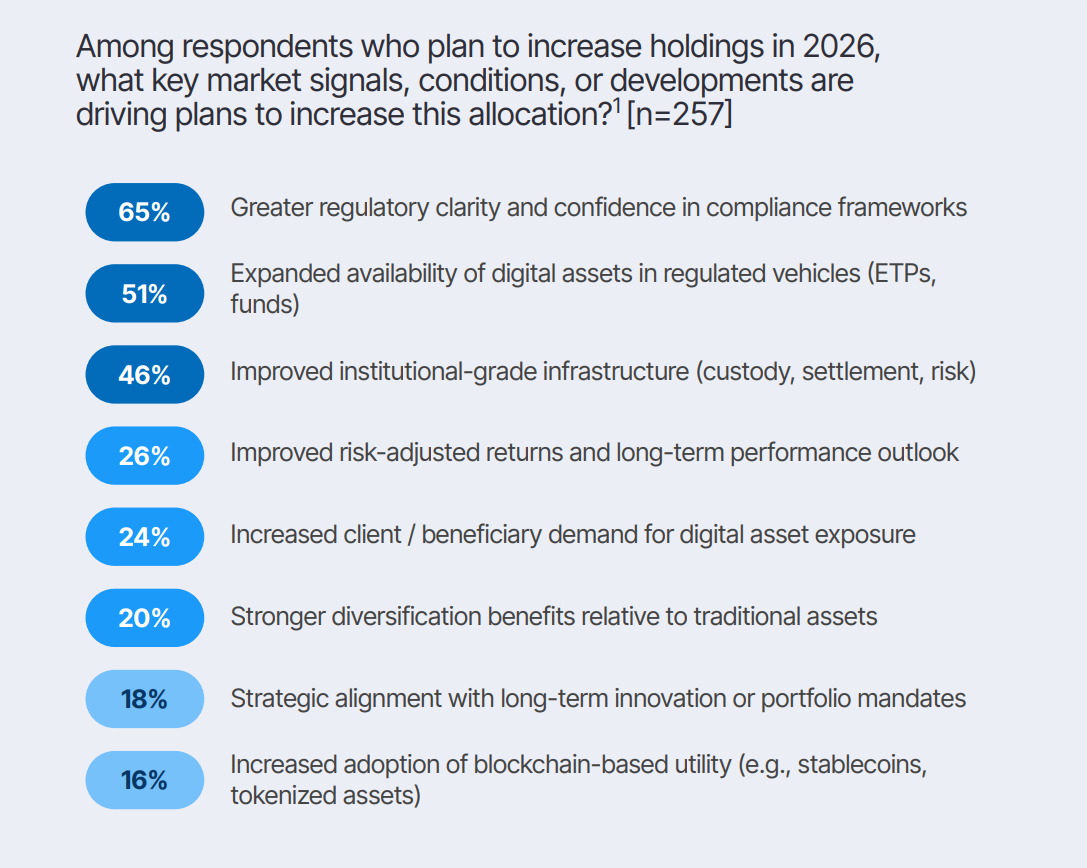
A landmark survey of 351 firms by Coinbase and EY-Parthenon found that nearly half of institutions planning to add crypto exposure in 2026 point to improved infrastructure as their primary motivation. Among the top factors, custody quality, settlement reliability, and risk controls stand out as the infrastructure pillars institutions care about most. This marks a turning point: the conversation has shifted from which tokens are available to how safely and efficiently capital can flow in and out of the market.
The digital asset industry is evolving its architecture to mirror frameworks that have long underpinned traditional equity markets — separating the role of the broker from the role of the custodian. Crypto exchanges that want to attract serious institutional capital are now rebuilding around that very split.
—
## Why Off-Exchange Settlement Matters
Off-exchange settlement decouples where assets are stored from where they are traded. In this model, a fund retains its holdings with an independent third-party custodian — names like Copper or Fireblocks are prominent in this space. The custodian then locks a defined portion of those assets and communicates the balance to the trading platform. The exchange treats that communicated balance as available trading credit, enabling the fund to execute buys and sells without ever transferring assets onto the exchange itself.
Profits and losses are subsequently netted out and settled between the custodian and the exchange on predetermined schedules. Copper’s ClearLoop settlement product, for example, processes transactions with connected venues on fixed cycles rather than in real time.
The numbers tell a compelling story. According to the 2025 AIMA and PwC Global Crypto Hedge Fund Report, 55% of traditional hedge funds held digital assets in 2025, a notable increase from 47% just a year before. Most of these allocations remain modest — below 2% of total assets — but a striking 71% of funds have plans to increase their exposure. As positions grow, the importance of robust custody, counterparty management, and execution reliability becomes impossible to ignore.
### The Appeal
The primary draw for institutions is capital efficiency combined with reduced direct exposure to exchange-level counterparty risk. Because eligible collateral remains in the custodian’s infrastructure rather than sitting on the exchange, the structure inherently limits the amount of client assets exposed to any single venue’s operational or financial health.
For firms that trade across multiple platforms, the model also eliminates the friction of moving collateral back and forth between exchanges — cutting both costs and operational complexity.
### What the Model Does Not Solve
It is important to understand that off-exchange settlement does not eliminate market risk. A losing position will still be liquidated regardless of where the underlying collateral sits. The custodian also becomes a counterparty in its own right, introducing a new layer of relationship risk. Between settlement cycles, profits owed by the exchange to the custodian exist as claims rather than confirmed, settled assets. This window — the gap between when a trade is marked and when it is fully settled — is where the model faces its greatest stress.
—
## Custody as a Customizable Service
Institutions are no longer willing to accept one-size-fits-all custody solutions. The Coinbase and EY-Parthenon survey revealed that 61% of firms already engaged in digital assets use more than one custodian, with risk diversification cited as the leading reason. An exchange that demands a single custody pathway is effectively asking those firms to dismantle a strategy they have carefully built.
Different types of institutional clients bring fundamentally different requirements to the table.
### Regulated Asset Managers
At one end of the spectrum sit regulated asset managers. Fiduciary obligations and strict asset segregation rules frequently mandate the use of an independent, regulated custodian before any trading relationship can even begin. For these firms, custody is not just a convenience — it is a regulatory prerequisite.
Platforms that work with regulated custody providers like Sygnum, and are actively pursuing relationships with entities such as Komainu — a regulated custodian co-founded by Nomura, CoinShares, and Ledger — position themselves to meet these institutional standards head-on.
### Market Makers and Quantitative Firms
At the other end are market makers and quantitative trading firms. These participants move capital rapidly across many venues and prioritize speed of collateral redeployment above almost everything else. For them, seamless connectivity between existing custodian infrastructure and trading platforms is essential. A well-established integration between a trading platform and Copper ClearLoop allows eligible clients to execute while their assets remain entirely within the custodian’s established infrastructure.
### Building a Multi-Route Approach
The most forward-looking platforms are building out portfolios of custody and settlement partnerships rather than relying on a single provider. This includes relationships with Cactus Custody Oasis, Fireblocks Off Exchange, OSL MirrorEX, and Bitfire PrimeMirror, among others. The philosophy behind this approach is straightforward: different types of professional capital should be able to access the same markets without being forced into a uniform custody arrangement. A client that already has an existing custodian can avoid the costs and operational burden of asset transfers altogether.
—
## Custody Choice as Both Advantage and Vulnerability
The race to offer the most custody options is not without its risks. Off-exchange settlement is no longer a niche innovation — it has become standard infrastructure. Copper’s ClearLoop connects to multiple venues including Coinbase International, Kraken MTF, and Deribit, while Fireblocks Off Exchange reaches several of the same platforms.
What now differentiates one exchange from another is the breadth of custody routes available and how many of those routes pass through regulated entities. As exchanges compete to court a wider investor base, expanding ties with regulated custodians becomes a strategic priority.
This competition is reshaping what an exchange fundamentally is. When clients keep their assets in external custody, the exchange competes on access, liquidity depth, and execution quality rather than on the custody of assets. It is a shift that changes the nature of risk in the system.
A small number of custodians and settlement networks now sit beneath many exchanges simultaneously. An outage, a solvency issue, or a regulatory action at one provider could cascade across the venues that depend on it. For the industry, the critical question ahead is how these increasingly interconnected custody and settlement models hold up under stressed market conditions — periods of extreme volatility, sharp drawdowns, or sudden liquidity freezes.
Diversifying custody relationships can reduce dependence on any single provider, but it also introduces a patchwork of different settlement arrangements that both venues and institutions must carefully manage. The firms that navigate this complexity most effectively will be the ones that set the standard for institutional participation going forward.
—
## FAQ
**Q1: What is off-exchange settlement in the context of crypto trading?**
Off-exchange settlement is a model where a fund’s digital assets remain with a third-party custodian rather than being deposited directly onto the exchange. The custodian reports the locked balance to the exchange, which then allows the fund to trade using that balance as credit. Profits and losses are settled between the custodian and the exchange at scheduled intervals.
**Q2: Why are institutions increasingly interested in crypto custody solutions?**
A major survey by Coinbase and EY-Parthenon found that nearly half of institutions planning crypto exposure in 2026 cite better infrastructure — particularly custody, settlement, and risk controls — as their reason. As allocations grow from small pilot positions to larger stakes, the need for professional-grade custody becomes essential.
**Q3: How does off-exchange settlement reduce counterparty risk?**
Because client assets remain with an independent custodian and are never held directly on the exchange, the structure limits the amount of client capital exposed to any single venue’s operational or financial vulnerabilities. This separation gives institutions greater confidence that their assets are not at the mercy of the exchange’s internal risk management.
**Q4: What types of institutional clients need different custody solutions?**
Regulated asset managers typically require regulated custodians to satisfy fiduciary and segregation rules. Market makers and quantitative firms prioritize speed and flexibility in collateral redeployment across multiple venues. A one-size-fits-all custody model fails to serve both groups effectively.
**Q5: What are the risks of relying on a small number of major custodians?**
When a few custodians and settlement networks sit beneath many exchanges, a failure at one provider — whether technical, financial, or regulatory — can have wide-reaching consequences across multiple trading platforms. This concentration risk is an area the industry is actively working to address.
**Q6: How has the percentage of hedge funds holding digital assets changed recently?**
According to the 2025 AIMA and PwC Global Crypto Hedge Fund Report, 55% of traditional hedge funds held digital assets in 2025, up from 47% the previous year. Furthermore, 71% of these funds plan to increase their crypto allocations.
—
## Conclusion
The institutionalization of crypto markets is no longer a question of if but how. Custody and settlement infrastructure have matured to the point where they are now the primary gatekeepers of institutional capital. The shift toward off-exchange settlement, multi-custody strategies, and regulated partnership networks reflects a market that is building the rails necessary for large-scale participation.
The coming years will test whether these interconnected systems can withstand the kind of extreme conditions that inevitably arise in volatile markets. Exchanges that invest in flexible, diversified custody infrastructure — and treat custody as one layer of a broader institutional ecosystem — are positioning themselves not just for growth in 2026, but for long-term relevance in a maturing asset class.
Thank you for reading
