



# Helium (HNT) Surges 170% in a Single Weekend: What Happened and Should You Still Enter?
## A Token Remembered Overnight
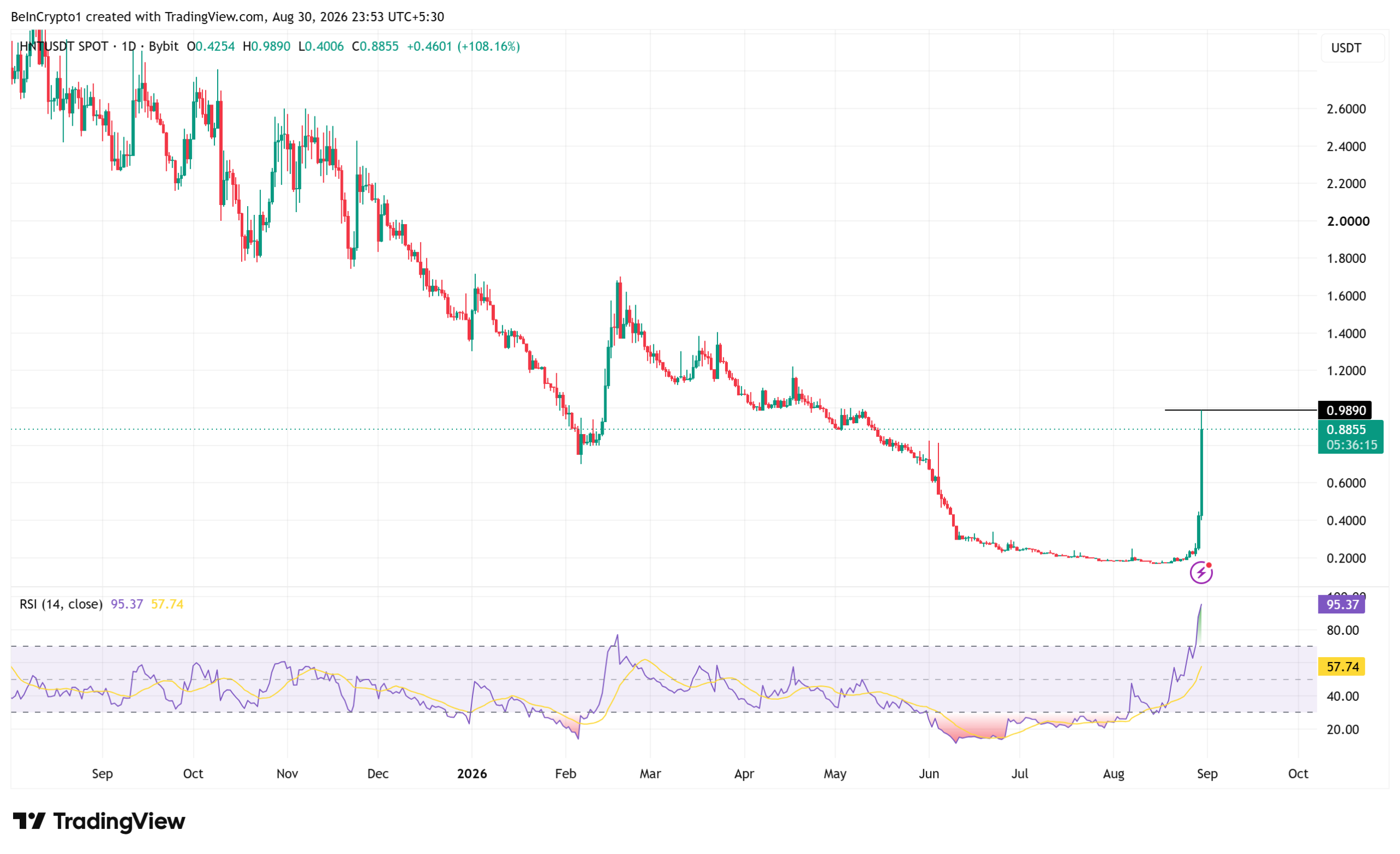
Helium (HNT), a cryptocurrency that many traders had written off as dormant, staged one of the most dramatic price rallies in recent memory over a single weekend. The token climbed from around $0.33 to as high as $0.989 — a move of nearly 170% in less than 48 hours. For context, HNT had languished below $0.30 for most of the preceding summer, making this surge feel like it came out of nowhere to the casual observer.
But behind the headlines lies a much more mechanical story, one rooted not in a wave of new believers but in the unwinding of leveraged bets that had been placed against the token. Understanding what truly drove the rally requires looking at on-chain derivatives data, trading volume, and positioning dynamics rather than simply the price chart.
—
## What Exactly Is Helium?
Helium operates a decentralized wireless network, sometimes referred to within the tech industry as DePIN — short for Decentralized Physical Infrastructure Networks. The concept is straightforward: everyday individuals install Helium-compatible hardware devices in their homes, shops, and other locations. These devices provide wireless coverage and, in return, the operators earn HNT tokens as a reward.
The network has always marketed itself on the premise of real-world utility, distinguishing itself from tokens that exist purely as speculative instruments. Whether that utility translates into sustained demand for the token is a separate question, but it gives the project a foundational narrative that sets it apart from many other digital assets.
—
## The Weekend That Changed Everything
### Two Distinct Price Bursts
The price action unfolded in two sharp phases rather than a smooth climb. In the first burst, the token rocketed from roughly $0.33 to $0.45 in a matter of hours, catching many traders off guard. After a brief pause during which trading intensity dipped, a second wave took over, pushing the token from $0.70 to nearly $1.00 before the move began to cool.
This two-stage pattern is significant because it suggests the initial leg of the rally was the catalyst, while the second leg was fueled by the cascading effects of that first move — a hallmark of a squeeze dynamic rather than organic accumulation.
### Volume That Broke Records
Trading volume told the real story. On the day of peak activity, over $248 million worth of HNT changed hands in a single day. To put that in perspective, the entire market capitalization of the token sits at roughly $155 million. In other words, more HNT tokens traded hands in one day than the total supply currently circulating at that valuation. The daily volume bar on HNT’s two-year chart became the tallest it has ever been, shattering the previous record of around $45 million set during earlier rallies in 2023.
This level of turnover means that the vast majority of positions held by traders today were opened during that very weekend — most of them likely at or near the top of the move.
### The Short Squeeze Mechanism
Here is where the story gets particularly interesting. A segment of traders had positioned themselves against HNT by taking short positions — borrowing the token, selling it at the current price, and planning to buy it back at a lower price to pocket the difference.
As the price climbed rapidly instead, those short positions accumulated mounting losses. Exchanges eventually stepped in and forcibly closed these losing bets, a process known as liquidation. When a short position is liquidated, the exchange buys the token back at the prevailing market price to close the position. Every forced liquidation is, by definition, a purchase — and in this case, the purchases were massive.
According to derivatives tracking data, nearly $1.5 million in short positions were liquidated on Sunday alone, with over $1.6 million wiped out across the entire weekend. By contrast, traders who had bet on the price rising lost only around $196,000 in total. The asymmetry is striking and tells the full story: the rally was powered by the forced exit of bearish bets, not by new money flowing in from bullish buyers.
—
## Reading the Derivatives Signals
### Funding Rates Tell a Counterintuitive Story
The funding rate is one of the most revealing metrics in crypto derivatives trading. It represents a periodic fee exchanged between traders on opposite sides of a position — longs pay shorts when the market is crowded with bullish bets, and shorts pay longs when bearish sentiment dominates.
For approximately eight months, HNT’s funding rate sat essentially at zero, indicating a balanced market with no strong directional conviction from leverage traders. Over the weekend, however, that rate plummeted past minus 1.2% on a single payment cycle. A deeply negative funding rate means traders holding short positions are now the ones paying a premium to maintain their bearish stance. They are, in effect, financing the very rally working against them.
### Open Interest Tripled
Open interest measures the total number of outstanding derivative contracts for a given asset. When HNT’s open interest surged by nearly 200% to reach $13.64 million, it became the highest reading in roughly a year. Crucially, this number did not simply rise and then plateau as positions were closed — it nearly tripled, indicating that new contracts were being created faster than old ones were being settled.
This pattern — rising prices paired with rising open interest — is generally interpreted as a sign of aggressive bullish momentum driven by leveraged demand rather than a slow, steady accumulation from spot buyers.
—
## Is It Too Late to Buy HNT?
The rally has already begun to cool. After peaking near the dollar mark, HNT has since retreated to around $0.88, and the pace of new liquidations has slowed dramatically. In the most recent hour tracked, only $22,000 in bearish bets were closed compared to the $1.61 million liquidated over the entire preceding day.
Traders who specialize in reading these setups tend to view a vertical spike in open interest as a warning sign rather than an invitation to enter. When positioning is stretched this tightly, even a modest reversal can trigger a cascade of closures in the opposite direction — what traders call a “liquidation cascade” or a “long squeeze.”
The more reassuring signal would be open interest flattening or pulling back slightly while the price manages to hold its level. That combination would suggest the market has absorbed the higher price and accepted it as a new baseline, rather than simply being leveraged into it.
Similarly, funding rates would need to drift back toward zero. A crowded long market typically shows sharply positive funding. The fact that HNT’s funding rate remains deeply negative means the crowd of leveraged traders is still predominantly short — they are paying dearly to stay in their losing positions. The real test begins when those remaining short bets finally get closed or abandoned, and the price must hold on the strength of genuine, non-leveraged demand alone.
### Supply Considerations
One structural factor favors existing holders: every HNT token ever minted is already in circulation, meaning there are no locked tokens waiting to be released in future vesting periods that could suddenly flood the market. However, issuance continues toward a hard cap of 223 million tokens, with roughly 37 million still yet to be created. This gradual dilution should factor into any long-term assessment of the token’s value proposition.
—
## FAQ: Understanding Helium’s Explosive Weekend Rally
**Q: What triggered HNT’s sudden price jump?**
A: The initial trigger was news coverage of a Texas-based Wi-Fi deployment on the Helium network. However, the magnitude of the price move was far disproportionate to the news itself. The real engine was a short squeeze — traders who had bet against the token were forced out of their positions as the price climbed, and each forced closure automatically created a purchase that pushed the price higher.
**Q: What is a short squeeze in simple terms?**
A: Imagine traders borrow and sell a token, expecting its price to fall so they can buy it back cheaper and keep the difference. If the price rises instead, their losses grow with every tick upward. Eventually, exchanges automatically close these losing positions by buying the token at the current market price, which further drives the price up — creating a feedback loop.
**Q: Why does the funding rate matter?**
A: The funding rate reveals which side of the market is paying a premium to maintain its position. A deeply negative funding rate for HNT means short sellers are paying long holders to keep their bearish bets open. This is an unusual and fragile setup — once those short traders capitulate or close their positions, the mechanical buying pressure stops.
**Q: Is HNT a good investment after this rally?**
A: That depends entirely on your strategy and risk tolerance. Buying near the peak of a squeeze-driven rally is inherently risky because the price is being supported by forced liquidations rather than organic demand. Traders who waited for the initial setup to stabilize before entering would have had a much more favorable risk profile. Anyone considering a position should monitor funding rates, open interest, and volume trends carefully before committing capital.
**Q: What should I watch for going forward?**
A: The key signals are: (1) open interest stabilizing or declining while the price holds, (2) the funding rate moving back toward zero, and (3) a return to more moderate, sustainable trading volume. These would indicate that the market has digested the squeeze and that price levels are supported by real demand rather than forced liquidations.
**Q: Does Helium have real-world use beyond trading?**
A: Yes — Helium operates a physical decentralized wireless network where individuals earn HNT by hosting hardware that provides connectivity. Whether this translates into meaningful, sustained demand for the token from actual network users is a question that extends well beyond the speculative dynamics of the weekend rally.
—
## Conclusion
The Helium weekend rally is a textbook example of how derivatives markets can amplify price movements far beyond what any single piece of news would justify. What began as a modest deployment story transformed into a $160% price surge driven primarily by the mechanics of short liquidations, not by a flood of new bullish capital.
For new entrants, the current environment presents a challenging setup. The squeeze is cooling, open interest remains elevated, and the token has already retraced significantly from its peak. Anyone considering a position should wait for confirmation that the market has stabilized — that open interest is normalizing, funding rates are returning to equilibrium, and the price is being supported by organic trading rather than the aftershocks of forced closures.
Helium’s underlying narrative of decentralized wireless infrastructure is compelling and gives the project a genuine use case that many other tokens lack. However, separating the long-term fundamentals from a short-term squeeze event is critical for making informed decisions. The weekend proved that HNT can move violently when leverage meets a catalyst. The question going forward is whether it can hold those gains through sheer organic demand.
Thank you for reading
