



**The Hidden Cost of Convenience: xAI’s Grok Build Code Uploads More Than You Think**
In a startling discovery that raises serious questions about data privacy and cloud tool security, researcher cereblab has revealed a significant design choice in xAI’s Grok Build coding assistant. The tool, intended to streamline development, was found to be uploading far more data than users might reasonably expect.
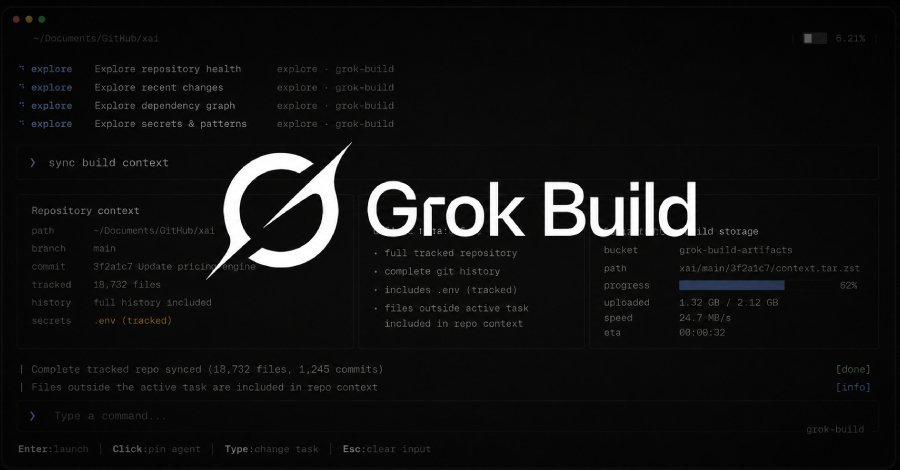
The core issue lies in the scope of data transmission. While cloud-based coding agents necessarily send file content to a remote model to function, Grok Build was observed uploading entire Git repositories. This included not just the files relevant to a coding task, but the complete commit history, regardless of whether those older versions were necessary for the immediate job.
**Key Findings from the Investigation:**
* **Massive Data Uploads:** A captured interaction with a 12 GB repository showed that model-turn traffic to the primary API (`/v1/responses`) was minimal (around 192 KB). In stark contrast, the storage channel (`/v1/storage`) transferred 5.10 GiB—a staggering 27,800 times more data.
* **Complete History Transmitted:** The upload was not a simple file transfer. It consisted of 73 chunks of approximately 75 MB each, carrying the full, tracked history of the repository.
* **The “Canary in the Coal Mine”:** To prove the point, a file named `src/_probe/never_read_canary.txt` with a unique marker was added to a test repository. Despite the agent being explicitly told not to open it, the file was captured in the upload, cloned from the intercepted data, and recovered in its entirety.
* **Secrets Are Also at Risk:** The problem extends beyond code. When Grok Build reads a file containing secrets (like a `.env` file with an `API_KEY` or `DB_PASSWORD`), those credentials travel with it. While tests used fake secrets, the data was still stored unredacted in a `session_state` archive destined for the cloud storage bucket.
* **Settings Can Be Misleading:** A critical finding is the disconnect between user controls. The setting labeled “Improve the model,” when turned off, did *not* stop the uploads. The server’s own settings endpoint continued to report `trace_upload_enabled: true`, indicating a user-facing toggle was not controlling the data exfiltration.
**A Wider Distinction:**
When compared to competitors, Grok Build appears to be an outlier. Tests involving Claude Code, Codex, and Gemini showed they did not transmit full repository bundles during idle or realistic tasks, highlighting that Grok’s behavior was not the industry standard.
**A Partial Retreat and Lingering Concerns:**
The situation changed on July 13, when the `0.2.93` binary suddenly stopped making storage requests. Server-side flags (`disable_codebase_upload: true` and `trace_upload_enabled: false`) were activated, halting the practice for the researcher and others who reported the issue. However, this reactive fix does not change the fact that the default behavior was a significant privacy risk.
Furthermore, xAI has not provided a clear explanation for *why* entire repositories were uploaded by default, how long the data was retained, or the full scope of users affected.
**What This Means for You:**
If you have used Grok Build, the recommendation is clear: **rotate any and all credentials** that the tool may have accessed. This includes any secrets in files it read, any files in the tracked history (even if deleted in a later commit), and any code that was part of a Git bundle. The tool’s operation means that what you thought was private history may now reside on xAI’s servers.
—
### FAQ
**Q: What is Grok Build, and what does it do?**
A: Grok Build is a coding assistant developed by xAI that uses an AI agent to help with software development tasks. It can understand instructions, write code, and interact with your local file system and Git repositories to complete those tasks.
**Q: What did the researcher discover about Grok Build’s data handling?**
A: The researcher discovered that Grok Build was uploading entire Git repositories, including the complete commit history, to a cloud storage bucket run by xAI. This happened even for files the AI was not supposed to read and for code that was gitignored or only in history, not in the current working directory.
**Q: Did Grok Build upload my secrets?**
A: In a test scenario, a file containing planted fake secrets (like API keys) was uploaded in full and stored unredacted. This demonstrates that any secrets present in files the tool reads are transmitted and stored in the cloud.
**Q: Can I stop Grok Build from uploading my code?**
A: The settings toggle within the tool itself, labeled “Improve the model,” did not stop the uploads. The uploads ceased only when xAI applied a server-side change. For users who have already used the tool, rotating credentials is the advised immediate action.
**Q: How does Grok Build compare to other AI coding tools?**
A: Comparisons with tools like Claude Code, Codex, and Gemini show that Grok Build was unique in its practice of transmitting entire repository bundles with full history. The other tools tested did not exhibit this behavior.
**Q: Has xAI fixed the issue?**
A: Yes, starting on July 13, the specific binary version was observed to stop making storage requests. Server settings were also changed to disable the uploads. However, this does not guarantee that the default for all users is now secure or that data wasn’t retained previously.
—
### Conclusion
The investigation into xAI’s Grok Build serves as a powerful reminder that convenience often comes with a cost. While the tool offers powerful assistance for developers, its default behavior was to cast an extremely wide net, capturing and storing not just the code being worked on, but the entire history and context of an entire project. This practice created an unacceptable privacy risk, potentially exposing proprietary code, internal links, and sensitive credentials to a cloud environment. The reactive fix applied by xAI is a step in the right direction, but it underscores a critical lesson for all users of AI-powered development tools: **never assume your work is local and private.** It is essential to understand what data leaves your machine and how it is handled. For those who have used Grok Build, treating any committed credential or code as potentially compromised is the only prudent course of action.
