



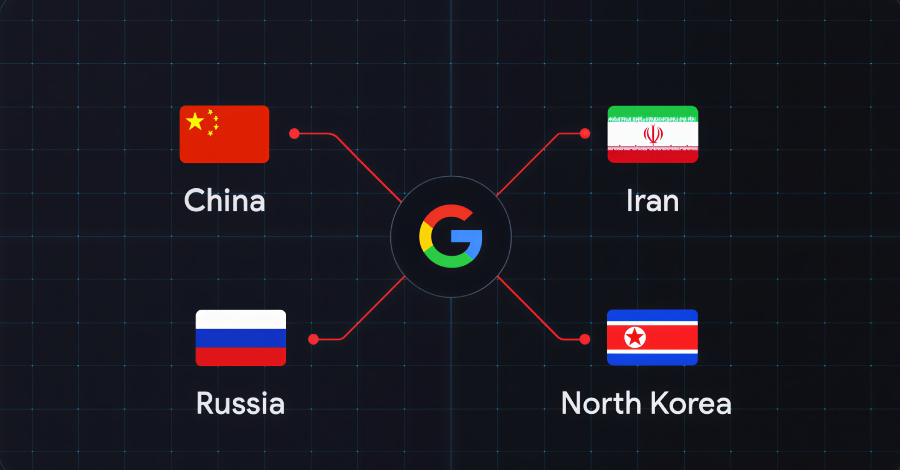
A number of state-sponsored actors, hacktivist entities, and legal teams from China, Iran, North Korea, and Russia have educated their sights on the protection industrial base (DIB) sector, in keeping with findings from Google Menace Intelligence Group (GTIG).
The tech large’s risk intelligence division stated the adversarial concentrating on of the sector is centered round 4 key themes: putting protection entities deploying applied sciences on the battlefield within the Russia-Ukraine Warfare, straight approaching staff and exploitation of the hiring course of by North Korean and Iranian actors, use of edge units and home equipment as preliminary entry pathways for China-nexus teams, and provide chain danger stemming from the breach of the manufacturing sector.
“Many of the chief state-sponsors of cyber espionage and hacktivist actors have shown an interest in autonomous vehicles and drones, as these platforms play an increasing role in modern warfare,” GTIG stated. “Further, the ‘evasion of detection’ trend […] continues, as actors focus on single endpoints and individuals, or carry out intrusions in a manner that seeks to avoid endpoint detection and response (EDR) tools altogether.”
Among the notable risk actors which have participated within the exercise embrace –
- APT44 (aka Sandworm) has tried to exfiltrate info from Telegram and Sign encrypted messaging functions, probably after securing bodily entry to units obtained throughout on-ground operations in Ukraine. This consists of using a Home windows batch script known as WAVESIGN to decrypt and exfiltrate information from Sign’s desktop app.
- TEMP.Vermin (aka UAC-0020) has used malware like VERMONSTER, SPECTRUM (aka SPECTR), and FIRMACHAGENT utilizing lure content material revolving round drone manufacturing and improvement, anti-drone protection techniques, and video surveillance safety techniques.
- UNC5125 (aka FlyingYeti and UAC-0149) has carried out extremely focused campaigns specializing in frontline drone models. It has used a questionnaire hosted on Google Types to conduct reconnaissance in opposition to potential drone operators, and distributed by way of messaging apps malware like MESSYFORK (aka COOKBOX) to an Unmanned Aerial Car (UAV) operator based mostly in Ukraine.
- UNC5125 can also be stated to have leveraged an Android malware known as GREYBATTLE, a bespoke model of the Hydra banking trojan, to steal credentials and information by distributing it by way of a web site spoofing a Ukrainian navy synthetic intelligence firm.
- UNC5792 (aka UAC-0195) has exploited safe messaging apps to focus on Ukrainian navy and authorities entities, in addition to people and organizations in Moldova, Georgia, France, and the U.S. The risk actor is notable for weaponizing Sign’s gadget linking characteristic to hijack sufferer accounts.
- UNC4221 (aka UAC-0185) has additionally focused safe messaging apps utilized by Ukrainian navy personnel, utilizing techniques much like UNC5792. The risk actor has additionally leveraged an Android malware known as STALECOOKIE that mimics Ukraine’s battlefield administration platform DELTA to steal browser cookies. One other tactic employed by the group is using ClickFix to ship the TINYWHALE downloader that, in flip, drops the MeshAgent distant administration software program.
- UNC5976, a Russian espionage cluster that has carried out a phishing marketing campaign delivering malicious RDP connection information which might be configured to speak with actor-controlled domains mimicking a Ukrainian telecommunications firm.
- UNC6096, a Russian espionage cluster that has carried out malware supply operations by way of WhatsApp utilizing DELTA-related themes to ship a malicious LNK shortcut inside an archive file that downloads a secondary payload. Assaults aimed toward Android units have been discovered to ship malware known as GALLGRAB that collects regionally saved information, contact info, and doubtlessly encrypted consumer information from specialised battlefield functions.
- UNC5114, a suspected Russian espionage cluster that has delivered a variant of an off-the-shelf Android malware known as CraxsRAT by masquerading it as an replace for Kropyva, a fight management system utilized in Ukraine.
- APT45 (aka Andariel) has focused South Korean protection, semiconductor, and automotive manufacturing entities with SmallTiger malware.
- APT43 (aka Kimsuky) has probably leveraged infrastructure mimicking German and U.S. defense-related entities to deploy a backdoor known as THINWAVE.
- UNC2970 (aka Lazarus Group) has carried out the Operation Dream Job marketing campaign to focus on aerospace, protection, and vitality sectors, along with counting on synthetic intelligence (AI) instruments to conduct reconnaissance on its targets.
- UNC1549 (aka Nimbus Manticore) has focused aerospace, aviation, and protection industries within the Center East with malware households like MINIBIKE, TWOSTROKE, DEEPROOT, and CRASHPAD. The group is thought to orchestrate Lazarus Group-style Dream Job campaigns to trick customers into executing malware or giving up credentials below the guise of reliable employment alternatives.
- UNC6446, an Iranian-nexus risk actor that has used resume builder and character check functions to distribute customized malware to targets within the aerospace and protection vertical throughout the U.S. and the Center East.
- APT5 (aka Keyhole Panda and Mulberry Storm) has focused present and former staff of main aerospace and protection contractors with tailor-made phishing lures.
- UNC3236 (aka Volt Storm) has carried out reconnaissance exercise in opposition to publicly hosted login portals of North American navy and protection contractors, whereas utilizing the ARCMAZE obfuscation framework to hide its origin.
- UNC6508, a China-nexus risk cluster that focused a U.S.-based analysis establishment in late 2023 by leveraging a REDCap exploit to drop a customized malware named INFINITERED that is able to persistent distant entry and credential theft after intercepting the applying’s software program improve course of.
As well as, Google stated it has additionally noticed China-nexus risk teams using operational relay field (ORB) networks for reconnaissance in opposition to protection industrial targets, thereby complicating detection and attribution efforts.
“While specific risks vary by geographic footprint and sub-sector specialization, the broader trend is clear: the defense industrial base is under a state of constant, multi-vector siege,” Google stated. “Financially motivated actors carry out extortion against this sector and the broader manufacturing base, like many of the other verticals they target for monetary gain.”
“The campaigns against defense contractors in Ukraine, threats to or exploitation of defense personnel, the persistent volume of intrusions by China-nexus actors, and the hack, leak, and disruption of the manufacturing base are some of the leading threats to this industry today.”
