



**Former U.S. Army Soldier Attacks Manhattan Federal Building, Injuring Three**
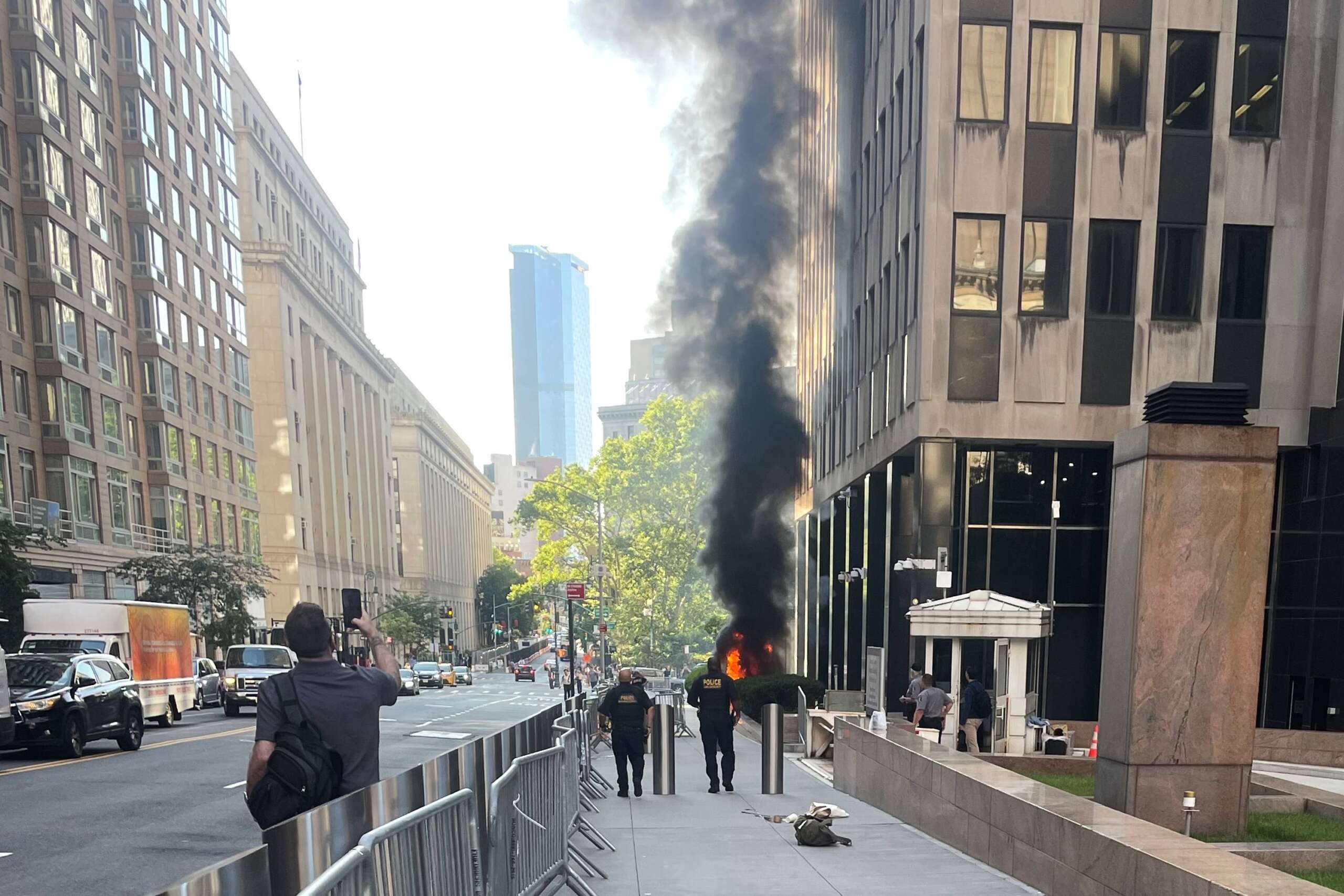
In a disturbing incident on Monday morning, a former U.S. Army soldier armed with an anti-ICE sign ignited fireworks, started a fire, and discharged a pellet gun outside a Manhattan federal office building. The attack injured three individuals before security officers successfully subdued the suspect. The incident has raised concerns about security at federal facilities and the ongoing tensions surrounding immigration policies.
**The Incident**
Andrew Arrabaca, 43, approached the iconic 26 Federal Plaza building in Lower Manhattan with what authorities describe as “bad intentions.” The building, which houses offices for U.S. Immigration and Customs Enforcement (ICE), the FBI, and other federal agencies, has been a frequent target of protests related to immigration enforcement.
According to James Barnacle, assistant director in charge of the FBI’s New York field office, Arrabaca made “anti-government and anti-American statements” during his arrest and claimed he “didn’t care if he killed people.” Surveillance footage and witness accounts painted a detailed picture of the chaotic morning.
New York City Police Commissioner Jessica Tisch explained that Arrabaca arrived at the scene wearing a military-style helmet and pulling a cart displaying a sign that read “ICE Off Our Streets.” He proceeded to pour gasoline on the ground near an employee entrance and ignited it using a lighter and a large firework. As the fire took hold, he retrieved an airsoft rifle and fired five to seven pellets at the building before being apprehended by Federal Protective Service officers and a security contractor.
**Injuries and Aftermath**
The attack resulted in three injuries. Among them was a person who had an immigration court hearing at the building at the time of the incident. Two government employees and a civilian were also hurt. According to the Department of Homeland Security, a bystander was grazed by fireworks, while a security officer who tackled Arrabaca sustained minor injuries. The New York City Fire Department reported that one victim was transported to a hospital with non-life-threatening injuries.
The incident began around 8:30 a.m., with a 911 caller reporting an active shooter. Subsequent calls mentioned explosions and fireworks. In addition to the pellet gun, authorities found two axes, three fixed-blade knives, a hammer, and a machete in Arrabaca’s possession.
**Background and Context**
26 Federal Plaza has historically been a focal point for immigration protests. Security at the building was heightened in the 1990s following intelligence that it was targeted for bombings by followers of Egyptian sheikh Omar Abdel-Rahman. Measures such as a bulletproof security booth and restricted vehicular access were implemented in response to those threats.
The suspect, Arrabaca, served in the U.S. Army from 2001 to 2005, where he repaired Patriot missile systems. Authorities noted that he expressed anti-American sentiments and used derogatory language toward ICE during his arrest.
**FAQ**
**Q: Who was the suspect in the attack?**
A: The suspect was Andrew Arrabaca, a 43-year-old former U.S. Army soldier.
**Q: Where did the incident take place?**
A: The attack occurred outside 26 Federal Plaza in Lower Manhattan, New York City. The building houses federal agencies, including ICE and the FBI.
**Q: How many people were injured, and what were their conditions?**
A: Three people were injured. Injuries included a person attending an immigration court hearing, a government employee, and a civilian. A security officer who tackled the suspect also sustained minor injuries. All injuries were non-life-threatening.
**Q: What weapons did the suspect use?**
A: Arrabaca used fireworks, an airsoft rifle, and had additional weapons including two axes, three fixed-blade knives, a hammer, and a machete.
**Q: Was the attack classified as terrorism?**
A: As of the latest reports, the FBI’s Joint Terrorism Task Force was investigating the incident, but authorities had not officially classified it as an act of terrorism.
**Conclusion**
The attack on 26 Federal Plaza underscores the volatile intersection of political discourse, immigration debates, and public safety. While the injuries were not fatal, the incident has prompted federal authorities to reassess security protocols at government buildings. As the investigation continues, the case highlights the increasing tension surrounding immigration policies and the potential for extremism in societal conflicts. This event serves as a stark reminder of the challenges faced by law enforcement in protecting federal institutions and individuals amidst a politically charged climate.
