



# Why Touch Matters for the Next Generation of Robots
Robots today can see, hear, and process language — but when it comes to physical touch, most still struggle. A camera can identify an object, but it can’t tell a robotic hand whether that object is slipping, too soft, or improperly seated. As robots move into more complex real-world tasks, the need for a sense of touch becomes critical.
## The Problem With Vision Alone
Vision-based systems have powered remarkable progress in robotics. Cameras allow robots to recognize objects, navigate spaces, and even perform precise movements. Yet vision has a fundamental blind spot: it cannot detect contact forces, surface textures, or subtle changes in grip. When a robot handles something flexible, fragile, or unexpected, visual information often isn’t enough.
Think about inserting a USB plug, folding a piece of fabric, or threading a string through a small opening. Humans rely heavily on touch for these tasks. Robots that lack equivalent sensing mechanisms are left guessing — and guessing leads to mistakes.
## Building the Data Backbone for Robotic Touch
One of the biggest hurdles in giving robots a sense of touch is data. Unlike photographs, which are cheap and easy to capture at scale, tactile information requires physical contact with real objects under varying conditions. Every material bends differently. Every surface responds uniquely to pressure. And every task changes how forces distribute across a robot’s gripper.
Companies working in this space are building end-to-end pipelines that do more than just collect sensor readings. They’re designing systems that capture tactile feedback at high speed, pair it with visual and environmental data, and feed it into both real-world training and simulated environments. The goal is to create a rich dataset that teaches robotic systems how to respond to physical interactions with increasing accuracy.
Some teams are aiming to collect thousands of hours of touch data, with longer-term ambitions stretching into millions of hours. The idea is that the more varied and extensive the data, the better robots can generalize what they learn to unfamiliar objects and situations.
## Bridging the Gap Between Simulation and Reality
Simulation offers a powerful shortcut. Training a robot in a virtual environment is faster, cheaper, and safer than running experiments on physical hardware every time. But simulations of touch are notoriously difficult to get right. Friction, elasticity, and deformation are notoriously hard to model accurately.
The most promising approaches start with real-world measurements and use those to calibrate virtual environments. By grounding simulations in physical data, developers can narrow the gap between what a robot learns in simulation and what actually works on a factory floor or in a warehouse. Even so, experts in the field acknowledge that current simulation tools still fall short of perfectly replicating the complexity of real physical interactions.
## From Lab Demos to Real Work
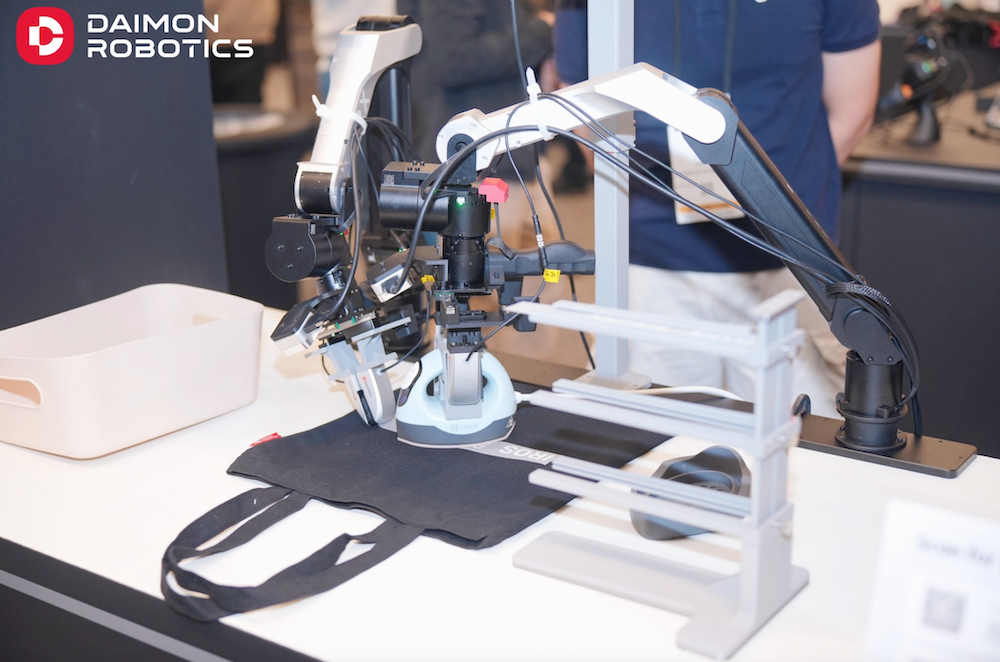
Tactile-enabled robots have been demonstrated performing a range of hands-on tasks. These include carefully handling delicate objects, detecting when something shifts in a grip, sorting broken materials, and assembling small components. What makes these demonstrations meaningful is that the underlying models were trained across many different scenarios, not just one narrow task.
In industrial settings, this kind of adaptability matters enormously. Production lines deal with constant variation — different shapes, sizes, weights, and materials. A robot that can only follow a fixed program breaks down when anything changes. A robot that can feel its way through a task, adjusting in real time, stands a much better chance of handling the unexpected.
## A Partnership-First Approach
Rather than trying to build a single all-purpose robotic brain, some players in the tactile-intelligence space are focusing on becoming infrastructure providers. The idea is to develop the sensors, software, data platforms, and evaluation tools that other robotics companies can plug into. This partnership model lets specialized developers focus on their own applications while relying on a shared foundation for touch-based perception and learning.
Collaboration across industries and geographies plays a big role here. By working with companies that build robotic systems for different use cases, infrastructure developers can learn what their customers actually need — and refine their tools accordingly.
## What’s Still Hard
Despite significant progress, major challenges remain. Current models still struggle to generalize beyond the specific conditions they were trained on. A system that performs well with one type of material may fail with another. High-speed tactile feedback — operating at rates fast enough to support real-time adjustments — requires both advanced hardware and efficient software.
Experts in the field are also honest about the limitations of today’s AI models for physical intelligence. Even large datasets don’t guarantee that a robot will handle every new situation gracefully. There’s a long road ahead from promising demonstrations to dependable, day-to-day industrial deployment.
—
## Frequently Asked Questions (FAQ)
**Why can’t robots use cameras alone to handle physical tasks?**
Cameras provide excellent visual information, but they can’t measure forces, detect slippage, or sense how an object deforms under pressure. Many manipulation tasks require this kind of feedback to succeed reliably.
**How is tactile data different from visual data?**
Tactile data depends on direct physical contact and varies with the object’s material, shape, the force applied, and the specific task. It’s also harder to collect at scale because it requires real-world interactions, not just recordings from fixed setups.
**What role does simulation play in training robots with touch?**
Simulation allows developers to train robotic systems in virtual environments, which is faster and less expensive than physical testing. However, accurately simulating touch properties like friction and softness remains a significant technical challenge.
**What does “generalization” mean in this context?**
Generalization refers to a robot’s ability to apply what it learned in one situation to new, unfamiliar situations. A highly generalized tactile system could handle a wide variety of objects and tasks without needing to be retrained from scratch each time.
**How fast does tactile feedback need to be for robots to respond in real time?**
For tasks that involve rapid contact and adjustment, feedback rates of around 30 cycles per second (30 Hz) or higher are typically needed. This allows the robot to detect and react to changes almost instantly.
**What kinds of industries could benefit most from tactile robots?**
Assembly, packaging, warehousing, electronics manufacturing, and recycling are among the industries where the ability to sense and respond to physical contact could dramatically improve reliability and versatility.
**Is this technology ready for everyday commercial use?**
While progress has been significant, most experts agree we’re still in the research and pilot phase for widespread commercial deployment. The focus right now is on improving reliability, generalization, and scalability.
—
## Conclusion
Giving robots a reliable sense of touch is one of the most important frontiers in robotics today. Vision and AI have taken machines a long way, but the physical world demands more than what eyes alone can provide. By investing in tactile sensing, data infrastructure, and simulation, the robotics community is laying the groundwork for machines that don’t just see the world — they feel it. The journey from lab prototypes to dependable industrial systems is far from over, but the progress being made suggests that touch-enabled robots will play an increasingly central role in how we work and live.
Thank you for reading
