




Ransomware’s Actual-World Impression Throughout Industries
In February 2026, the College of Mississippi Medical Heart (UMMC) fell sufferer to a ransomware assault. The incident took the Epic digital well being document system offline throughout 35 clinics and greater than 200 telehealth websites, forcing the cancellation of chemotherapy appointments and the postponement of non-emergency surgical procedures. Medical workers had been required to revert to paper-based workflows, leaving numerous sufferers to bear the results.
UMMC is way from an remoted case. Based on latest knowledge, 93% of U.S. healthcare organizations skilled no less than one cyberattack in 2025, and 72% of respondents reported that no less than one incident immediately disrupted affected person care.
The manufacturing and monetary sectors are equally uncovered. In February 2026, fee processing community BridgePay suffered a ransomware assault that took its APIs, digital terminals, and fee pages fully offline. Throughout all industries, publicly disclosed ransomware assaults surged 49% year-over-year in 2025, reaching 1,174 confirmed incidents.
As hospitals halt remedies, monetary establishments freeze transactions, and producers shut down manufacturing strains, ransomware has firmly established itself as a direct enterprise threat with tangible operational penalties.
The Evolution of Ransomware: Double Extortion
Early ransomware operated on a simple premise: infiltrate a system, encrypt information, and demand fee in change for the decryption key. As organizations started countering this tactic by restoring from backups slightly than paying ransoms, risk actors responded by creating a extra profitable mannequin — double extortion.
In a double extortion assault, adversaries first exfiltrate delicate information — corresponding to affected person information and billing knowledge — earlier than encrypting the goal system. Victims are then pressured on two fronts: pay to obtain the decryption key, or face public publicity of the stolen knowledge.
Backups alone are inadequate in opposition to this mannequin. Since attackers already possess the information, refusing to pay the ransom may end up in the general public launch of delicate information, exposing organizations to vital enterprise losses and regulatory penalties.
The risk panorama has continued to escalate, with triple extortion circumstances on the rise — a tactic by which attackers immediately contact a sufferer group’s clients or companions to use further stress.
As of 2025, 124 lively ransomware teams have been recognized, 73 of that are newly emerged.
The proliferation of AI-powered instruments has lowered the barrier to entry for cybercrime, making ransomware capabilities more and more accessible to much less subtle actors.
D.AMO makes stolen knowledge unreadable.
See how D.AMO defends in opposition to each stage of a ransomware assault.
Study Extra
A Protection Structure for Multi-Extortion Threats
The rise of multi-extortion ransomware essentially modifications the assumptions underlying conventional protection methods. Perimeter-based prevention alone is not enough.
Organizations want a safety posture that protects knowledge from being weaponized after a breach — rendering exfiltrated knowledge unreadable, blocking ransomware from accessing information within the first place, and enabling speedy restoration even when an assault succeeds.
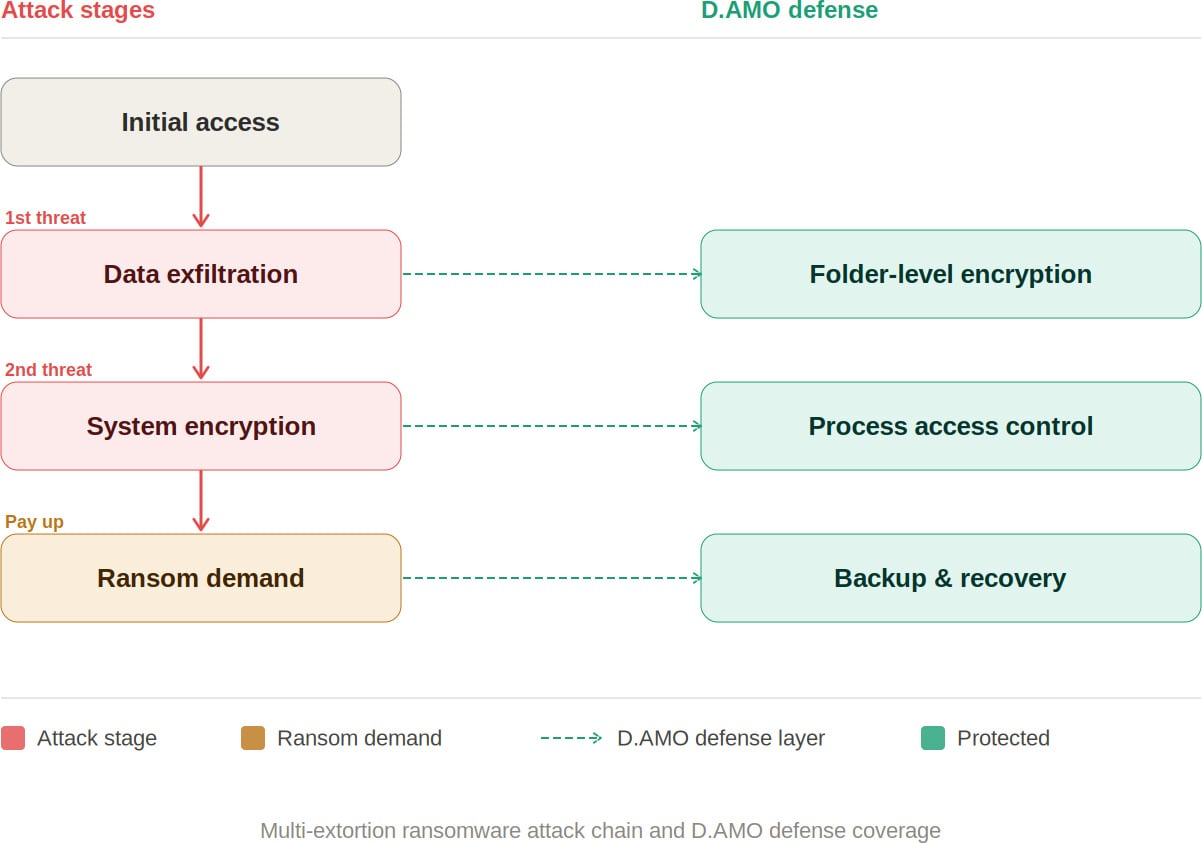
D.AMO: Blocking Each Stage of a Ransomware Assault
D.AMO, developed by Penta Safety, is an encryption-based knowledge safety platform designed to handle each section of a multi-extortion ransomware assault. It delivers built-in encryption, entry management, and backup restoration throughout on-premises and cloud environments.
By making use of file encryption and process-based entry management applied sciences, D.AMO protects important knowledge saved on servers and PCs — safeguarding delicate data in opposition to malicious packages by way of strong entry enforcement. D.AMO’s key capabilities are as follows:
Folder-Stage File Encryption
D.AMO KE encrypts all information inside administrator-designated folders on the OS stage. Deployable by way of an installer with out supply code modification, it operates utilizing kernel-level encryption expertise, enabling quick and safe encryption on present programs with no disruption to the person expertise.
Encryption insurance policies are utilized on the folder stage, making certain constant safety with minimal operational overhead. Critically, even when an attacker exfiltrates delicate knowledge, the information stay encrypted — neutralizing the information publicity risk that’s central to double extortion.
Entry Management
D.AMO KE enforces strict entry management over processes and OS customers, allowing solely explicitly licensed entry. Ransomware and different malicious functions are mechanically blocked from accessing encrypted folders, stopping unauthorized file manipulation.
All blocked exercise is recorded by way of an audit log operate and will be reviewed centrally by way of D.AMO Management Heart.
Backup and Restoration
Even within the occasion of a profitable assault, organizations can resume operations by way of an independently managed restoration system. With D.AMO in place, the flexibility to revive from backup considerably reduces dependence on decryption key negotiations with risk actors.
As multi-extortion techniques turn out to be the norm, neutralizing the information attackers search to take advantage of has turn out to be a strategic precedence. Organizations want the flexibility to render exfiltrated knowledge unreadable, forestall ransomware from accessing information, and recuperate quickly when incidents happen.
D.AMO addresses every stage of a ransomware assault inside a single built-in platform — combining encryption, process-based entry management, and backup restoration right into a unified line of protection.
Wish to study extra? Obtain the D.AMO Knowledge Sheet.
Sponsored and written by Penta Safety.
