



## Understanding Context Management in AI Workflows
The context window is a fundamental component of modern AI models, especially those used in agentic workflows and coding assistance. It serves as the model’s memory during a session, consisting of the system prompt, user inputs, model responses, and tool outputs. However, not all context is created equal—how it is managed directly impacts performance, reliability, and the overall success of AI-assisted tasks.
### What Is Context Rot?
Over time, AI sessions can suffer from a phenomenon known as **context rot**, where the quality of output degrades as irrelevant, outdated, or contradictory information accumulates in the context window. This degradation stems from two primary sources:
– **Intrinsic rot**: A natural limitation of the model’s architecture. Even perfectly relevant information can lose potency as attention mechanisms distribute focus across thousands of tokens. Important details may still be retrievable, but their influence diminishes due to dilution.
– **Content rot**: The buildup of stale, incorrect, or unnecessary data—such as outdated notes, misdirected tool calls, or unverified assumptions—that actively interferes with reasoning.
While intrinsic rot cannot be eliminated, content rot is manageable. Recognizing and controlling it is key to maintaining sharp, efficient AI collaboration.
### How Context Degrades: Technical Insights
AI models process the entire context window as a single token sequence. Each token the model generates attends to every preceding token, but not all attention is equal. Due to constraints like softmax normalization, no token receives zero attention—even irrelevant ones compete for focus. As context length increases, the meaningful signal becomes thinner, and retrieval accuracy declines.
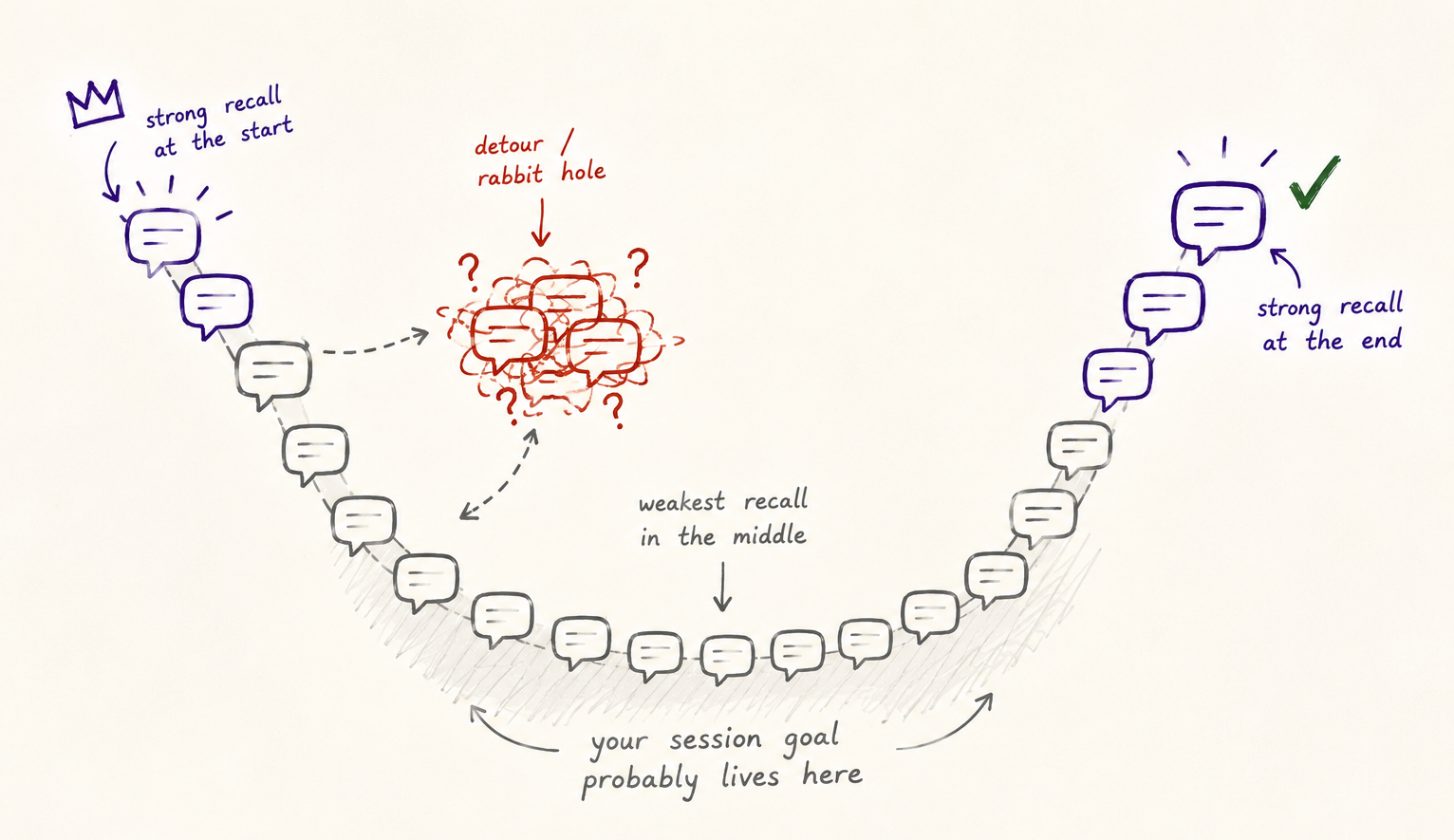
This effect is particularly evident in the middle sections of long conversations, where information is most likely to be lost. Even models with large context windows experience performance drops well before reaching the theoretical limit, especially during multi-step reasoning tasks.
### The Four Sources of Content Rot
Understanding how context fails helps us prevent it:
1. **Confusion**: Overloading the session with too many tools, roles, or instructions. Each added tool consumes attention, even when unused.
2. **Clash**: Prematurely committing to a hypothesis and forcing new evidence to fit an outdated narrative.
3. **Distraction**: Pulling in irrelevant or loosely related information during searches, which crowds out the actual target data.
4. **Poisoning**: Letting incorrect notes or assumptions persist across sessions, where they are reloaded as if they were facts.
These issues compound. One mistake leads to another, and soon the session behaves as if it were grounded in reality—even when it isn’t.
### Managing Context Effectively
Effective context management is less about saving tokens and more about curating high-signal input. Below are practical strategies organized by workflow phase.
#### Before Starting: Curate the Context
– Start fresh when possible. A clean session is faster than a repaired one.
– Use files like `CLAUDE.md` to provide concise, essential project information.
– Only include what cannot be inferred or looked up on demand.
– Disable unnecessary tools or skills to reduce background noise.
– Seed the session with specific file paths or boundaries rather than vague topics.
#### While Working: Maintain Clarity
– Refresh the objective regularly, especially during long sessions.
– Offload complex or verbose work to subagents or separate processes.
– Externalize persistent state into files, but update or remove stale data.
– Verify information against real sources—run commands, check tests, review files.
#### When Things Go Wrong: Reset Strategically
– Two corrections on the same issue signal it’s time to reset.
– If possible, pause and redirect before continuing.
– Don’t try to salvage a bad chain of reasoning—regenerate in a clean session when necessary.
– Distinguish between sessions that should be compacted (healthy) versus discarded (rotten).
For long or parallel tasks:
– Break work into verifiable checkpoints.
– Use isolated subagents or forks for exploratory or messy work.
– Merge conclusions back into the main session—never the full transcript.
### A Workflow Inspired by Version Control
Treating context like a git branch offers a powerful mental model:
– The main conversation remains focused and clean.
– Detours or investigations happen in forks—disposable branches that protect the main thread.
– At the end of a fork, extract the lesson or result, then merge it back.
– This keeps the central context lean, reusable, and intentional.
### The Role of the Human in Context Governance
AI models cannot self-correct context rot. They will not warn you when attention is diluted or when a note is outdated. That responsibility falls to the human in the loop—someone who must curate inputs, verify outputs, and reset when necessary.
Governing context is not about controlling the model. It’s about managing what reaches the model and ensuring that session memory supports progress rather than undermining it.
—
## Frequently Asked Questions
**What is context rot?**
Context rot refers to the decline in AI reasoning quality over a session due to interference from irrelevant, outdated, or contradictory information stored in the context window.
**What causes context rot?**
It results from two factors:
– *Intrinsic rot*: Built-in limitations in how models attend to information over long contexts.
– *Content rot*: Accumulation of unverified or useless data introduced during the session.
**Can intrinsic rot be fixed?**
Not directly. It is a structural limitation of current AI architectures. However, understanding it helps us design workflows that minimize its impact.
**What is the best way to avoid content rot?**
Curate context aggressively, verify information actively, reset sessions when needed, and externalize durable knowledge properly.
**How often should I clear the context?**
Clear it whenever the task changes significantly, when repeated corrections occur, or when the session begins to feel unreliable.
**Do more tokens always mean better performance?**
No. Beyond a certain point, adding more context reduces signal-to-noise ratio and harms reasoning quality.
**Should I use subagents or forks for messy work?**
Use subagents for parallel, independent tasks. Use forks for deep, sequential investigations that must be isolated from the main session.
**How can I improve long-term context hygiene?**
Treat context like versioned documentation. Write concise notes, update them regularly, and reintroduce them only when verified.
—
## Conclusion
Context is the scaffolding of AI-assisted work. Without intentional design, even rich context becomes a liability rather than an asset. Models like Claude rely on what we feed them—and what we allow to persist.
Successful AI workflows do not chase maximum context. They追求 governed context: clean, verified, and purpose-built for the task at hand. By curating inputs, isolating messy work, and resetting when necessary, we turn context from a fragile limitation into a durable advantage.
Ultimately, the most powerful technique is not better prompting or larger windows—it is a disciplined, human-led process of context stewardship.
