



# Power Architecture in Swarm Robotics: Centralized vs. Decentralized Approaches
## Why Energy Distribution Matters in Multi-Agent Systems
In swarm robotics, the way robotic agents share and manage energy has a direct impact on how well the entire fleet performs. Power architecture is not merely an engineering footnote — it is a foundational design layer that shapes how effectively robots coordinate, adapt, and sustain operations over time.
When dozens or thousands of autonomous agents work together, the strategy for distributing electrical power influences everything from response times to the system’s ability to recover from individual unit failures. Understanding the core trade-offs between centralized and decentralized power models is essential for robotics engineers, AI researchers, and industrial automation teams designing the next generation of multi-robot systems.
—
## The Role of Power Topology in Swarm Coordination
Swarm intelligence depends on how individual agents communicate, make decisions, and allocate shared resources. Power topology sits at the center of this equation because it determines how energy data and control signals flow between robots.
In dynamic environments, robotic nodes often shift position or change their communication range. If the energy management infrastructure cannot account for these shifts, the result can be broken connections, uneven battery drain, and loss of coordination. This is especially critical in aerial drone swarms and mobile ground-based fleets operating in warehouses or outdoor terrain.
Recognizing power architecture as a first-order design variable — rather than an afterthought — allows teams to build systems that remain responsive and resilient as conditions evolve.
—
## Centralized Power Management in Swarm Fleets
A centralized power model places all energy distribution and charging decisions under a single control layer. This approach is common in structured industrial settings such as automated fulfillment centers and assembly plants, where floor layouts are predictable and workflows follow repeatable patterns.
### How It Works
A central orchestration platform monitors the state of charge across every robot in the fleet, schedules charging cycles, and assigns energy-aware task allocations. Robots execute commands from this top-level controller without making independent power-management decisions.
### Strengths
– **Synchronization precision:** Because all decisions flow through one system, the fleet can maintain tight coordination, minimizing idle time and optimizing task sequencing.
– **Simplified diagnostics:** A single control plane makes it easier to monitor fleet health, predict maintenance needs, and generate performance reports.
– **Predictable throughput:** In stable environments, centralized energy management can sustain high and consistent operational output.
### Limitations
– **Single point of failure:** If the central controller experiences a malfunction, the entire fleet may be impacted.
– **Scalability constraints:** As the number of robots grows, the communication overhead and computational load on the central system can become a bottleneck.
– **Reduced adaptability:** The system may struggle to respond quickly to unexpected disruptions or changes in the operational environment.
—
## Decentralized Power Models for Autonomous Swarms
Decentralized power architectures distribute energy management and operational decision-making to each individual robot. Instead of relying on a single coordinator, every agent evaluates its own power state and makes local decisions about charging, task prioritization, and communication.
### How It Works
Each robotic unit runs its own energy-management logic, exchanging status updates with neighboring agents as needed. There is no master controller dictating when or how each unit should recharge — robots self-organize based on local information and peer-to-peer communication.
### Strengths
– **Fault tolerance:** The loss of one or several units does not cripple the rest of the swarm. Individual robots continue operating independently.
– **Scalability:** Adding more robots does not overload a central system, since coordination is spread across the fleet.
– **Adaptability:** Local decision-making allows the swarm to respond quickly to environmental changes or sudden disruptions.
### Limitations
– **Communication congestion:** As swarm size increases, the volume of routing updates and coordination messages grows significantly, potentially slowing real-time responsiveness.
– **Energy imbalance:** Without a global view of the fleet, some regions of the swarm may experience uneven power distribution or localized energy shortages.
– **Complexity of local logic:** Each robot requires sufficient onboard intelligence to make autonomous energy and task decisions, which can increase per-unit hardware costs.
—
## Hybrid Architectures: Combining the Best of Both Worlds
A growing trend in swarm robotics is the adoption of hybrid frameworks that blend centralized oversight with decentralized autonomy. These systems aim to capture the coordination benefits of centralized control while preserving the resilience and scalability of decentralized decision-making.
### Key Characteristics
– **Edge AI processing:** Individual robots use localized intelligence to handle immediate power and task decisions, reducing the burden on a central system.
– **Hierarchical oversight:** A higher-level controller monitors fleet-wide performance and intervenes only when necessary, rather than micromanaging every robot.
– **Distributed battery intelligence:** Robots share energy-state data with peers and nearby infrastructure, enabling smarter routing around low-power zones.
### Real-World Impact
Hybrid architectures are particularly well-suited for large-scale deployments where environments are complex and constantly changing. By reducing communication bottlenecks and enabling autonomous energy management at the edge, these systems can maintain synchronization and operational continuity even as the swarm scales.
—
## Industry Applications: Swarm Robotics in Logistics
### Amazon Robotics
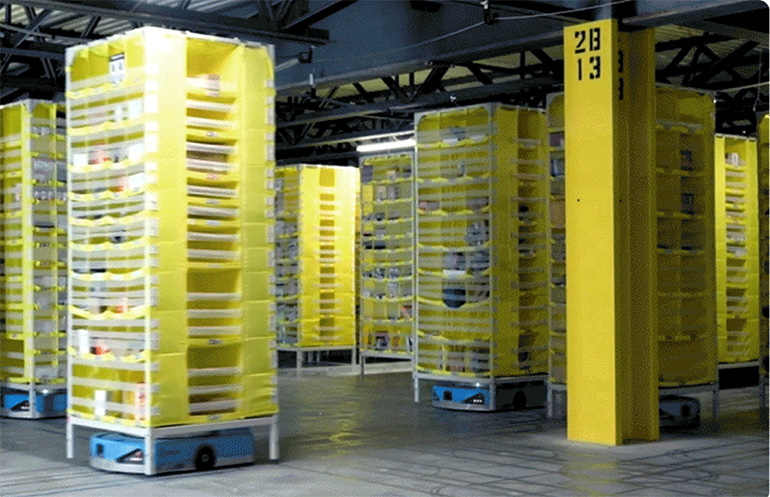
Amazon deploys over one million autonomous robots across its fulfillment network. The company uses a centralized fleet orchestration layer combined with AI-driven traffic management to coordinate robot movements in high-density warehouse environments. Mobile shelving units bring inventory directly to human pickers, while centralized control platforms continuously optimize routing and congestion patterns to sustain predictable throughput.
### Ocado Technology
Ocado operates grid-based swarm fulfillment systems in which thousands of robots navigate automated storage and retrieval environments. A centralized coordination layer manages robotic movement, order sequencing, and energy allocation in real time. The system supports high-speed grocery fulfillment — achieving rapid basket completion — while maintaining consistent throughput and minimizing congestion across the distribution floor.
—
## The Future of Power Architecture in Swarm Robotics
As autonomous warehouse systems and industrial robotics grow more complex, power topology will continue to be a decisive factor in system design. Several developments are poised to shape the next generation of swarm deployments:
– **Smarter energy routing:** Swarm-aware algorithms will dynamically reroute tasks and charging schedules based on real-time energy conditions across the fleet.
– **Autonomous docking:** Advanced self-docking systems will allow robots to recharge independently without human intervention or centralized guidance, improving fleet uptime.
– **AI-driven adaptation:** Machine learning models will enable robotic fleets to learn from operational patterns and optimize power usage over time.
– **Resilient communication protocols:** New networking standards will reduce latency and packet loss in large-scale decentralized swarms, addressing the communication congestion challenge.
Engineering teams should treat power architecture as a strategic design consideration — one that directly influences fault tolerance, scalability, and operational performance — rather than a secondary infrastructure detail.
—
## Frequently Asked Questions (FAQ)
**What is swarm robotics?**
Swarm robotics is a field of robotics in which a large number of relatively simple robotic agents work together to accomplish tasks through local interactions and coordination. The approach is inspired by the collective behavior of biological swarms such as ant colonies and bee hives.
**Why does power architecture matter in swarm systems?**
Power architecture determines how energy is distributed, managed, and monitored across the fleet. It affects coordination efficiency, fault tolerance, communication stability, and the system’s ability to scale. Poor power design can lead to uneven battery drain, connectivity loss, and degraded swarm performance.
**What is the main difference between centralized and decentralized power models?**
In a centralized model, a single control layer manages all energy distribution and scheduling decisions. In a decentralized model, individual robots make their own power-management decisions based on local information and peer communication.
**Are hybrid architectures becoming the industry standard?**
Hybrid frameworks are gaining traction because they combine the coordination benefits of centralized control with the resilience and scalability of decentralized autonomy. While not yet universal, they are increasingly adopted in large-scale logistics and manufacturing deployments.
**How do companies like Amazon manage energy across over a million robots?**
Amazon uses a centralized fleet orchestration platform with AI-driven traffic management to continuously monitor and optimize robot movements, routing, and energy usage across its fulfillment centers.
**Can decentralized swarms suffer from communication problems?**
Yes. As swarm size increases, the volume of inter-robot messages can grow rapidly, leading to congestion that reduces real-time responsiveness and may cause coordination delays.
**What role does edge computing play in hybrid swarm architectures?**
Edge computing allows individual robots to process data and make energy-management decisions locally, reducing dependence on a central controller and lowering communication overhead across the network.
**Is power architecture only relevant for warehouse robotics?**
No. Power architecture is important for any multi-agent robotic system, including agricultural drones, autonomous vehicle convoys, search-and-rescue swarms, and industrial manufacturing robots.
—
## Conclusion
The choice between centralized, decentralized, and hybrid power architectures is one of the most consequential decisions in swarm robotics design. Each approach carries distinct trade-offs in terms of coordination precision, fault tolerance, scalability, and communication efficiency. Centralized models excel in structured, predictable environments, while decentralized models offer resilience and adaptability in complex, dynamic settings. Hybrid frameworks are emerging as a compelling middle ground, leveraging edge intelligence and hierarchical oversight to deliver both strategic coordination and local autonomy.
As robotic fleets grow larger and operate in increasingly demanding environments, treating power topology as a core design priority will be essential for building systems that are efficient, reliable, and ready to scale.
Thank you for reading
