



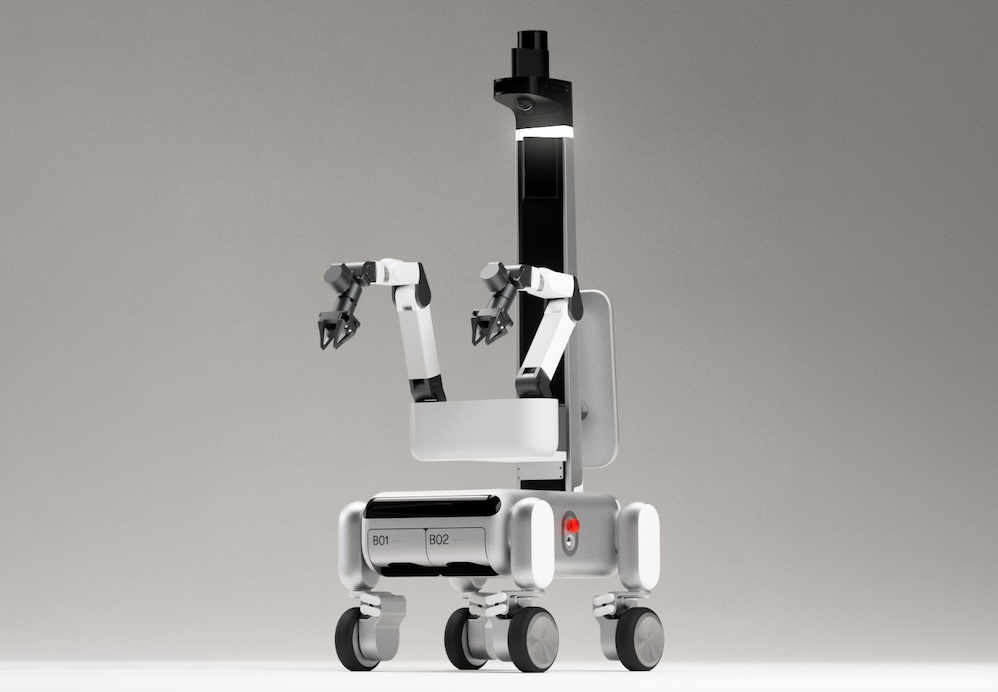
Collaborative Robotics’ Proxie 2.0 features two-handed manipulation and autonomous task handling. | Image: Collaborative Robotics
Collaborative Robotics (Cobot) has launched the next version of its Proxie mobile robot. The upgraded model offers higher payload capacity, batteries that swap themselves, the ability to identify tasks on its own, and an optional two-armed configuration. The company aims to grow its presence in healthcare, logistics, and manufacturing.
The Santa Clara, California-based firm debuted Proxie Gen 2 at Automate 2026, presenting it as a mobile manipulator proven in real-world production settings.
“For years, companies had to pick between robots that could move around and robots that could handle objects skillfully, and both always needed custom software to work,” said Brad Porter, founder and CEO of Collaborative Robotics. “Our new-generation Proxie combines everything into a single platform we built from scratch.”
Real-world experience drives Proxie Gen 2 design
Over the last two years, Cobot has been quietly collecting data from robots in the field. The company reports that 28 Proxie units have logged close to 13,000 hours of operation, covered more than 22,000 miles, transported over 154,000 carts, and saved workers millions of steps. These robots have been working in hospitals, labs, factories, and warehouses.
Porter explained that the company deliberately chose to focus on real deployments rather than publicity.
“Our approach has been to get robots out in the field and rack up hours,” he told The Robot Report. “You need to go through several hardware generations to make it truly robust. Until you hit real production numbers, you can’t predict where things will wear out or break.”
One key deployment has taken place at the Mayo Clinic, where Proxie moves materials across the facility, assisting with lab operations, food services, and medical equipment transport.
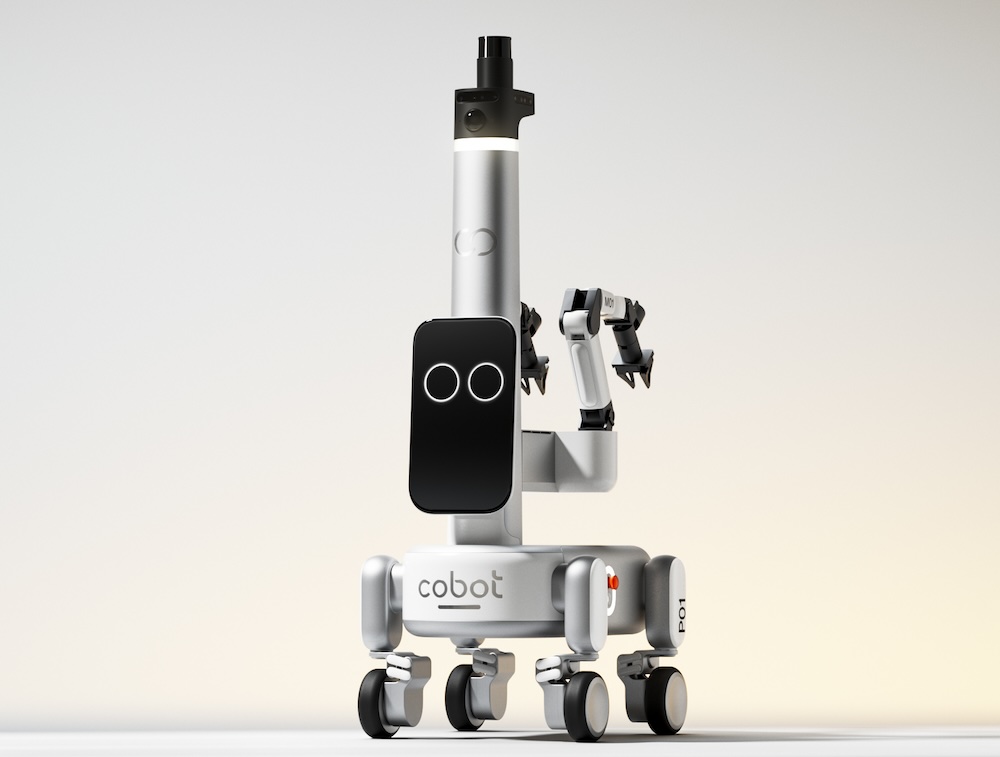
That experience produced more than 500 design improvements that shaped the overhaul of nearly every subsystem in Gen 2. While core features like the elevated sensor array, vertical spine, swerve drive, and battery-swapping system remain, Porter said the team rebuilt the entire platform to boost reliability and ease of manufacturing.
The outcome is a robot with 40% fewer components, a more compact body for fitting through narrow hallways and elevators, and increased strength. Gen 2 can haul carts up to 1,500 lb. and lift as much as 220 lb. along its vertical spine.
The company also enhanced the sensor package with extra lidar functionality aimed at supporting future safety certification work.
 Submit your session idea for the 2026 RoboBusiness
AI powers autonomous task discovery
The biggest leap forward may be Proxie’s growing ability to figure out work on its own. Cobot refers to this as “autotasking.” Instead of depending on connections to warehouse management systems, hospital software, or human operators, Proxie constructs what the company describes as a real-time model of its surroundings.
After mapping a building using standard SLAM methods, the robot keeps watching carts, bins, and workstations. It can tell when items are ready to be moved, figure where they need to go, and generate tasks without any human input. At a facility run by shipping company Maersk, Porter said workers simply wrote destination details on small whiteboards fixed to carts.
“Multimodal AI models are remarkable,” he said. “The robot reads the writing on the whiteboard and knows exactly where to take the cart.”
Porter noted that about 95% of cart movements at that site during a recent measurement window were started without a person assigning the task or any link to a warehouse management system. The company believes this method significantly cuts down on deployment complexity.
“We need to move past discussions about system integration and complexity and start focusing on intelligence,” Porter said.
Proxie steps into mobile manipulation
Gen 2 also marks Cobot’s entry into mobile manipulation. The company is rolling out an optional dual-arm setup built to carry out two-handed tasks in healthcare, logistics, life sciences, and factory settings.
This move comes as progress in vision-language-action (VLA) models, diffusion policies, and world models is speeding up advances in robotic manipulation. Porter said Cobot deliberately held off on adding arms until the mobile base was thoroughly tested.
“Manipulation is a tough, wide-open problem,” he said. “We wanted to log over 10,000 hours and make the mobile base rock-solid before tackling manipulation in real-world conditions.”
The company is currently using research-grade arms but plans to release industrial-strength versions later this year. Porter pointed out that recent AI improvements have greatly reduced the training data needed to teach robots new skills.
“We don’t yet have the ‘manipulate anything’ models we’re aiming for,” he said. “But the AI we have today is good enough to put into service.”
Cobot is deepening its partnerships with NVIDIA and Amazon Web Services. The robot relies on NVIDIA Jetson modules for on-board AI processing, allowing perception, planning, and task reasoning to happen locally without needing the cloud. The company is also collaborating with NVIDIA Robotics on Isaac Sim and Omniverse NuRec to build digital twins and simulation environments grounded in actual deployment data.
AWS supplies the cloud backbone for the company’s Vista fleet-management platform and supports training for the AI models behind Autotasking. Vista gives real-time insight into fleet activity, letting users track tasks, robot status, and operational slowdowns across multiple sites.
Making robots simpler to adopt
Porter said the industry’s greatest hurdle may not be hardware performance but how easy the technology is to adopt. He compared today’s robotics landscape to the early days of personal computers before they became mainstream.
“Steve Jobs’ brilliance was stripping away the complexity,” Porter said. “People found computers intimidating, and he was relentless about making them simpler. Our mission is to keep making robots easier and easier to use.”
Cobot said Proxie Gen 2 is available for order now, with deployments starting this year at a starting price of $5,000 per month. The company is showcasing the platform at Automate 2026 in Chicago.
