



When NASA launched the Artemis II space vehicle in early April, a 25-year-old software framework was quietly powering many of its critical systems.
But don’t mistake this for some outdated relic that the space agency simply forgot to replace. On the contrary, Artemis II leaned on the core Flight System (cFS) to manage everything from telescope operations and avionics to command and control — because software engineers have been steadily refining and improving cFS since the early 2000s.
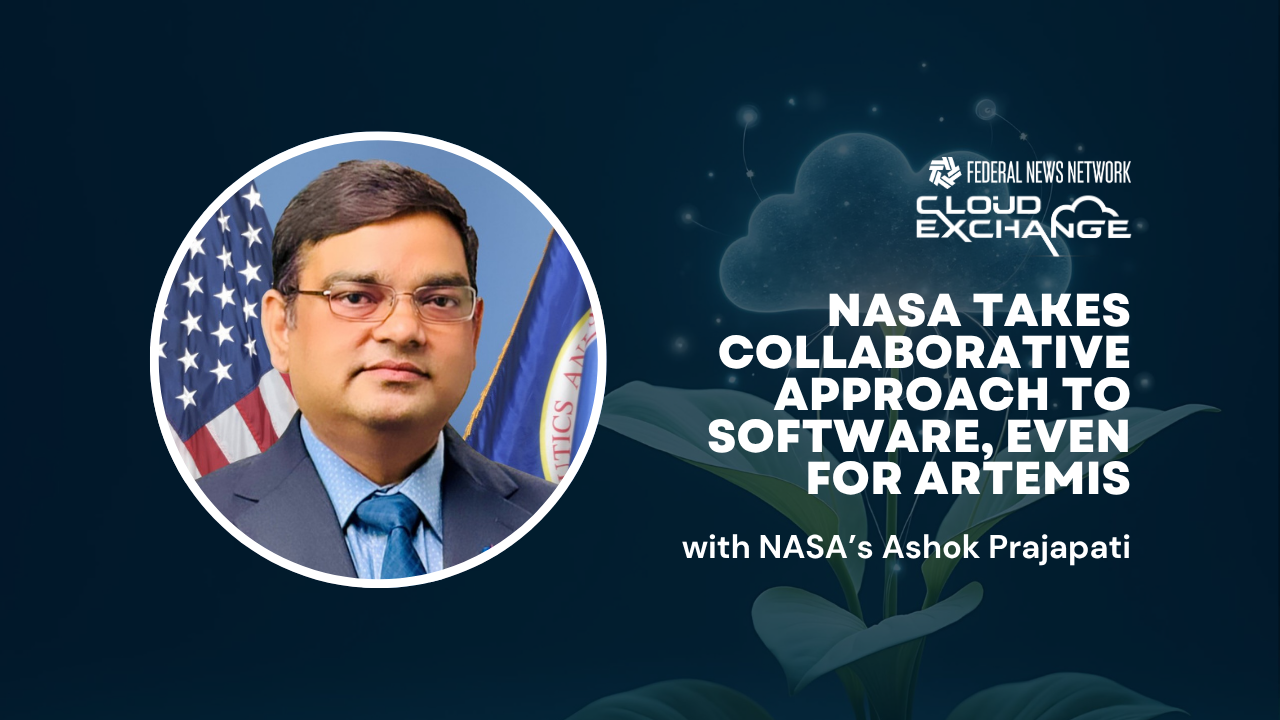
NASA develops and sustains cFS through an open source platform and counts on the wider space community to keep the architecture, tools and foundational components up to date, according to Ashok Prajapati, core Flight Systems program manager and chairman of the NASA cFS Steering Committee.
“This is an incredibly flexible package. It essentially evolved into a layered, modular architecture with a shared core, a set of standardized interfaces, and a mission-specific layer,” he explained during Federal News Network’s Cloud Exchange 2026.
“Everything beneath the mission-specific layer became highly standardized, and cFS essentially became one of the most widely adopted flight software frameworks in existence. It’s been deployed on a huge number of missions. It’s NASA’s default framework — whether that’s Artemis, Mars Sample Return, or scientific instruments like the Roman Space Telescope, which runs on cFS.”
Reaching for the stars — and beyond
And NASA isn’t the only organization that depends on cFS. Private aerospace companies also leverage the open source framework as a foundation when developing components for their own rockets and spacecraft.
Prajapati noted that cFS’s cross-platform compatibility and demonstrated reliability have led NASA to deploy the software framework on more than 100 missions over the past two decades.
“It’s fully reusable, highly modular, and — because it’s community-driven — open source. Many community members contribute back to the project. So if someone develops a new feature they’d like to share, it gets merged into the main cFS codebase and becomes available for everyone else to reuse,” he said.
“Certain components, like the core engine, are open source. Other applications are open source too — for instance, the Platform Support Package. If anyone needs to integrate a new operating system or new avionics hardware, they’re free to do so. The guiding philosophy was to share the minimum foundational layer that isn’t tied to any specific proprietary system, so that collaborative development within the community could get off the ground more easily.”
Cloud services streamline NASA’s update process
The underlying concept behind cFS is that NASA, other government agencies and private sector organizations can all begin from a common baseline when building their applications. Then, Prajapati explained, community members can layer on their own proprietary enhancements to address their unique mission needs. He emphasized that cFS itself isn’t flight-ready out of the box.
“It’s highly reusable across many different segments. It can be used for scientific instruments, for controlling hardware — it’s essentially the brain behind all operations. We refer to it as the Command and Telemetry Framework, meaning you can use cFS to send commands to a spacecraft,” he said. “There are two sides to it: the ground segment and the flight segment. cFS runs on the spacecraft itself, and there’s a corresponding ground-side counterpart — various software packages that let you issue commands, receive telemetry and perform whatever operations you need.”
In recent years, modernizing applications built on cFS has become significantly more efficient thanks to cloud services.
Prajapati explained that when NASA or one of its partners writes new code, it enters the development pipeline, undergoes testing, and is then incorporated into the baseline.
“We leverage our on-premises cloud infrastructure for our continuous integration and continuous delivery pipeline. We also use cloud platforms for software development, enabling collaboration across the agency and with external partners and customers beyond NASA. It works the same way distributed teams coordinate — some of our team members work with others to make contributions happen, and we use the cloud to exchange data,” he said.
“If you’re working on a particular feature or a mission-specific component, you’d normally have to set up an entire infrastructure locally. That takes a long time, and time is money. With cloud services, we’ve essentially pre-configured all the testing infrastructure for people. Your job is to write your piece of code and submit it. It goes through all the necessary steps — even if it runs overnight — and by the next morning you have all the results ready to review, analyze and fix. This represents an enormous time savings, and naturally that has a direct impact on mission costs.”
At the same time, the adaptability of cFS means NASA can also apply the framework to hardware systems like avionics. He noted that this is done in laboratory settings and validated through real-world testing exercises.
To ensure cFS continues to deliver value for NASA and its partners while maximizing collaboration, Prajapati spearheaded the creation of the cFS Steering Committee, which he currently chairs. The committee brings together experts from both the public and private sectors and serves as the governing decision-making body for cFS, he said.
A new NASA cybersecurity tool is on the horizon
As part of that ongoing initiative, the steering committee broadened its community engagement efforts and hosted the inaugural NASA cFS Symposium in 2024.
“This year marked the second edition, and it was a resounding success. We had participants from at least 120 different organizations spanning government, commercial industry, international partners and academia. Our goal was to be as inclusive as possible — reaching every government agency working on space missions with cFS, all the industry partners building on cFS, and we also saw tremendous interest from the academic community,” he said.
“There was an overwhelming eagerness from the community to come together, and honestly that surprised me. Why didn’t this happen sooner? There are plenty of conferences out there focused on flight software, space exploration or hardware. But there’s no dedicated focus on the underlying software — even though software issues rank among the top five reasons missions get delayed or fail.”
NASA also provides training programs and certification courses around cFS, along with access to 15 different applications and a suite of tools and interfaces.
The newest product to emerge from the space community is the Airlock Security Manager, which will assist users with security encryption, decryption and inter-application communications.
“You could view it as a meaningful step toward a zero trust architecture. We’ve also deployed a security manager that handles configuration policies and security policies. This means any standard cybersecurity professional who’s familiar with security policy frameworks can configure the security settings for a spacecraft or telescope to meet their specific requirements,” Prajapati said.
“The next major development is high-performance space computing, which delivers substantial processing power on avionics and will be co-developed with Microchip Technology and NASA. Up to this point we’ve been working with various hardware components. My team is currently focused on porting cFS to the HPSC hardware platform, which will unlock a range of advanced capabilities with many built-in features.”
HPSC incorporates hardware-level security support, post-quantum cryptography, artificial intelligence capabilities and extensive vector processing power, he said.
“You’ll be able to run AI models directly on board and make real-time decisions to capture events that were previously impossible to detect. That’s going to be a real game changer.”
Explore more articles and videos now on the Cloud Exchange event page.
Copyright © 2026 Federal News Network. All rights reserved. This website is not intended for users located within the European Economic Area.
