



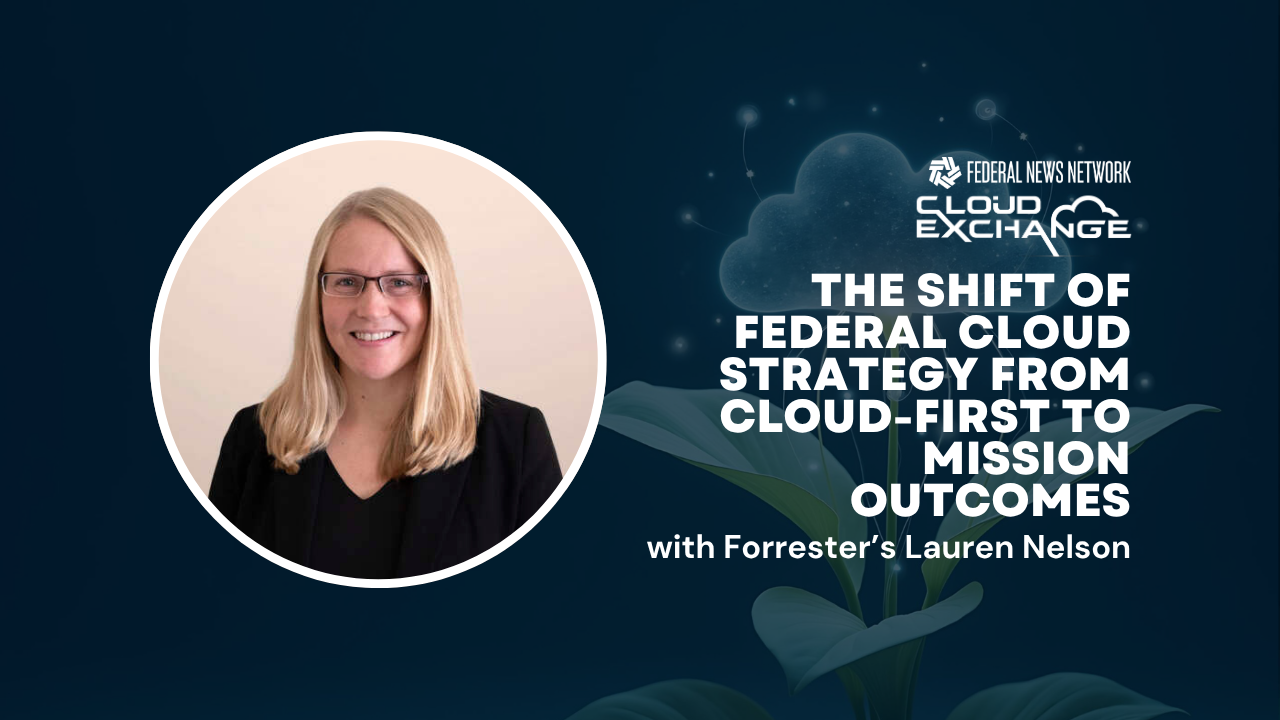
Ten years ago, “cloud first” was considered cutting-edge and novel. Government agencies were working to demonstrate they could transition workloads away from outdated infrastructure and into something more adaptable and forward-looking. The discussion was primarily focused on the technology: Which systems could migrate to the cloud, and how quickly could it happen?
Lauren Nelson, vice president and senior research director at Forrester, recalls that period as one marked by trial and error—and, in some cases, overambition.
Engineers were given a fresh toolkit and encouraged to push boundaries. Yet too frequently, they found themselves simply reorganizing those tools rather than constructing solutions that truly advanced the mission, Nelson explained during Federal News Network’s Cloud Exchange 2026.
The analogy was straightforward: imagine being handed a bucket of Legos with no blueprint. Teams kept swapping parts in and out, fiddling with the framework instead of concentrating on what they were actually trying to build, she noted.
Shifting from cloud-first to mission-first
Today’s federal technology dialogue centers on what systems actually accomplish, not where they’re hosted. Agencies are now structuring themselves around mission results and only afterward determining how technology serves that objective. That evolution has fundamentally changed how systems are architected and rolled out, Nelson explained.
Rather than crafting custom environments locked to a single platform, agencies are gravitating toward portable solutions—capabilities that aren’t tied to one location. Containerization has emerged as a core strategy because it addresses a real-world challenge, she said, and because it enables applications to operate wherever they’re most effective.
That “where” is becoming increasingly flexible. Workloads might reside in the cloud, on local servers, or at the edge, depending on performance requirements, timing, or mission demands. The choice isn’t made upfront and set in stone. Instead, it adapts as both the mission and the technology evolve, Nelson said.
The demand for portability is transforming the federal IT mindset. Rather than locking into a specific vendor or infrastructure early on, agencies can now build systems that flex as needs shift. They’re moving away from rigid architectures toward frameworks designed to grow and adjust over the long term.
The tougher challenge: Actually making it work
In this context, cloud is no longer the endgame. It’s simply one tool within a larger ecosystem built to deliver results, Nelson observed. But while the architecture is becoming more nimble, the execution side is growing more complex, she added.
The first pressure point is leadership. Nelson emphasized that agencies need leaders who view capabilities not as one-and-done projects but as living products that mature over time. That means overseeing full lifecycles, investing on an ongoing basis, and—crucially—knowing when to cut losses. Walking away from efforts that aren’t delivering value becomes an essential practice, redirecting resources toward the next wave of innovation, she recommended.
The second hurdle is governance. Federal systems operate under multiple tiers of policy, oversight, and risk management designed for a bygone era. Those controls need to be reshaped for today’s environment.
Nelson characterized the emerging approach as “wide streets and high curbs.” The concept is straightforward: give teams room to move fast and experiment, but make it hard to veer outside safe parameters. That equilibrium enables innovation without relinquishing oversight, she said.
In practical terms, it also means standardizing more of the underlying platform. Developers shouldn’t have to reconstruct foundational elements each time they kick off a new initiative. Those components should be reusable, dependable, and governed, allowing teams to concentrate on what genuinely moves the mission forward, Nelson said.
The third obstacle is procurement. Speed is critical, and acquisition timelines haven’t always kept up with the urgency to move from pilot to full-scale deployment.
Nelson outlined both the problem and the emerging remedy. “We’re beginning to see far more streamlined approaches to how we think about technology acquisition and deployment, which is challenging,” she said. “There’s a lot of governance and siloed structures across different groups, making it a genuinely difficult challenge to break away from that modular mindset, away from those technology-specific decisions, and start thinking about it more as scaling our innovation practice efficiently.”
And then there’s the question of cost.
Controlling cloud and AI expenses in federal IT
Cost management has grown more intricate as architectures have become more spread out and as artificial intelligence becomes part of the equation.
“One of the difficulties with AI is that it introduces costs at every level. It’s embedded in enterprise applications, in licensing fees, in workplace productivity tools, in using the actual models themselves and handling token management,” Nelson said. “It’s in building and running models on top of your public cloud platforms—it’s everywhere. That makes it an incredibly multidimensional problem to get a handle on.”
This creates a constantly shifting target for budgeting and forecasting. Agencies are countering by tightening financial oversight practices, she said. But even with those safeguards, surprises are inevitable. Usage can surge unexpectedly. Pricing structures can change. Costs can ripple across interconnected systems in ways that are hard to anticipate.
That’s precisely why governance and cost control are becoming more intertwined. The same “high curbs” guiding technical choices are also being applied to set usage boundaries—limiting exposure and preventing unintended consequences before they spiral, Nelson explained.
What federal IT leaders should prioritize right now
For agencies working through these decisions, Nelson offered four concrete recommendations.
- Lead with outcomes: “Before you even mention the cloud, start with your outcomes or start with the mission you’re trying to fulfill. That’s what it comes down to. It will always come down to that.”
- Architect for scale and longevity: One-off breakthroughs can’t withstand operational pressures. Investing in shared platforms and reusable capabilities is the only way to move fast without creating disjointed systems.
- Make space for experimentation: Innovation can’t flourish in overly restrictive settings. Leaders need to carve out room for creative exploration while preserving guardrails that keep work aligned and on track.
- And seek support: “You’re not doing this in isolation. There’s a higher level of expertise out there, and other organizations are navigating the same challenges. You can draw on the broader community to help push things forward.”
The transformation underway is just as much about culture as it is about technology, Nelson pointed out. That means leaders must be equipped to manage products across their full lifecycle, strike the right balance between risk and speed, and recognize when it’s time to redirect energy. It also demands environments where teams feel empowered to question assumptions and continuously refine systems.
Explore more articles and videos now on the Cloud Exchange event page.
Copyright
© 2026 Federal News Network. All rights reserved. This website is not intended for users located within the European Economic Area.
