




Hackers are more and more exploiting newly disclosed vulnerabilities in third-party software program to achieve preliminary entry to cloud environments, with the window for assaults shrinking from weeks to simply days.
On the similar time, the usage of weak credentials or misconfigurations has dropped considerably within the second half of 2025, Google notes in a report highlighting the developments on threats to cloud customers.
In accordance with the report, incident responders decided that bug exploits have been the first entry vector in 44.5% of the investigated intrusions, whereas credentials have been liable for 27% of the breaches.

Supply: Google
Essentially the most frequent vulnerability kind exploited in assaults is distant code execution (RCE), the highlights being React2Shell (CVE-2025-55182) and the XWiki flaw tracked as CVE-2025-24893, leveraged in RondoDox botnet assaults.
Google believes this shift in focus was doubtless resulting from elevated safety measures for accounts and credentials.
“We assess that this change in behavior from threat actors is potentially due to Google’s secure-by-default strategy and enhanced credential protections successfully closing traditional, more easily exploitable paths, raising the barrier to entry for threat actors,” Google says.
The exploitation window has collapsed from weeks to some days, as Google noticed cryptominers deployed inside 48 hours of vulnerability disclosure, indicating that hackers are extremely able to weaponize new flaws and incorporate them into their assault flows.
Each state-sponsored actors and financially-motivated hackers largely leveraged compromised identities, through phishing and vishing impersonating IT assist desk employees, to acquire entry to a goal group’s cloud platform.
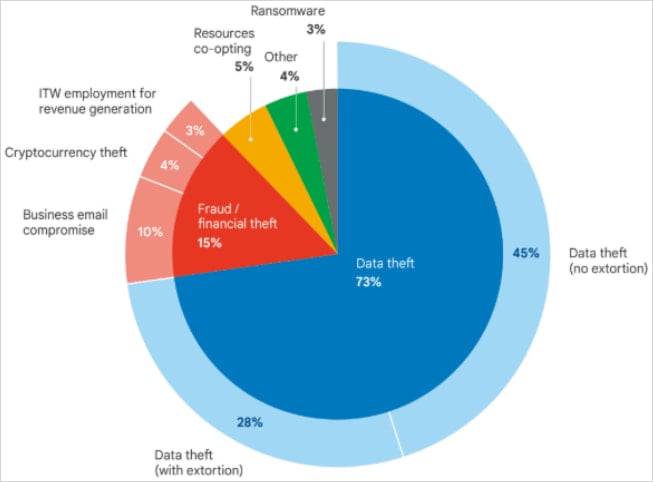
In many of the investigated assaults, the actor’s goal was silent exfiltration of excessive volumes of information with out speedy extortion and long-term persistence.
Supply: Google
Google highlights some espionage campaigns from actors linked to Iran and China, who maintained entry to the sufferer atmosphere effectively over a 12 months and a half.
For greater than two years, Iran-linked menace actor UNC1549 had entry to a goal atmosphere utilizing stolen VPN credentials and the MiniBike malware. This allowed the hackers to steal from the sufferer almost one terabyte of proprietary knowledge.
In one other instance, the China-sponsored actor UNC5221 used the BrickStorm malware to maintain entry to a sufferer’s VMware vCenter servers for not less than 18 months and steal supply code.
North Korean hackers stealing thousands and thousands
Google attributes 3% of the intrusions analyzed within the second half of 2025 to North Korean IT employees (UNC5267) utilizing fraudulent identities to acquire a job and generate income for the federal government.
One other North Korean menace actor tracked as UNC4899 compromised cloud environments particularly to steal digital property. In a single case, UNC4899 stole thousands and thousands of U.S. {dollars} in cryptocurrency after tricking a developer into downloading a malicious archive underneath the pretext of an open-source undertaking collaboration.
The developer then used the Airdrop service to switch the file from the private pc to the company workstation and open it in an AI-assisted built-in improvement atmosphere (IDE).
Contained in the archive was malicious Python code that deployed a binary posing as a Kubernetes command-line instrument.
“The binary beaconed out to UNC4899-controlled domains and served as the backdoor that gave the threat actors access to the victim’s workstation, effectively granting them a foothold into the corporate network” – Google
Within the subsequent phases, UNC4899 pivoted to the cloud atmosphere and carried out reconnaissance actions, which included exploring particular pods within the Kubernetes cluster, established persistence, and “obtained a token for a high-privileged CI/CD service account.”
This allowed them to maneuver laterally to extra delicate methods, reminiscent of a pod liable for imposing community insurance policies that allowed them to interrupt out of the container and plant a backdoor.
After extra reconnaissance, UNC4899 moved to a system that dealt with buyer data (identities, account safety, cryptocurrency pockets knowledge) and hosted database credentials saved insecurely.
This knowledge was sufficient for the menace actor to compromise consumer accounts and steal a number of million {dollars} in cryptocurrency.
OpenID Join Abuse
In an assault leveraging a compromised npm bundle identify referred to as QuietVault, the attacker stole a developer’s GitHub token and used it to create a brand new admin account within the cloud atmosphere by abusing the GitHub-to-AWS OpenID Join (OIDC) belief.
In simply three days from the preliminary compromise, QuietVault obtained the developer’s GitHub and NPM API keys by leveraging AI prompts with native AI command-line interface instruments, abused the CI/CD pipeline to get the group’s AWS API keys, stole knowledge from the S3 storage, after which destroyed it in manufacturing and cloud environments.
The incident was a part of the “s1ngularity” supply-chain assault in August 2025, when an attacker printed compromised npm packages of the Nx open-source construct system and monorepo administration instrument.
In the course of the assault, delicate data (GitHub tokens, SSH keys, configuration recordsdata, npm tokens) from 2,180 accounts and seven,200 repositories have been uncovered after the menace actor leaked them in public GitHub repositories that included the identify “s1ngularity.”
Malicious insiders like cloud companies
Though electronic mail and moveable storage units have been primarily used for knowledge exfiltration, the researchers seen that insiders are more and more utilizing Amazon Net Providers (AWS), Google Cloud, Microsoft Azure, Google Drive, Apple iCloud, Dropbox, and Microsoft OneDrive.
The conclusion comes after an evaluation of 1,002 insider knowledge theft incidents, which revealed that 771 of them occurred whereas the insider was nonetheless employed and 255 occurred after their employment was terminated.
Google says that the menace is important sufficient for corporations to implement knowledge safety mechanisms towards each inner and exterior threats. An worker, contractor, or marketing consultant could generally violate belief and find yourself stealing company knowledge.
The tech large says that development evaluation signifies that cloud companies will quickly change electronic mail as the popular methodology to exfiltrate data.
The researchers report that, in a rising variety of instances, attackers delete backups, take away log recordsdata, and wipe forensic artifacts to make the restoration of proof and knowledge tougher.
Google underscores that cloud assault speeds at the moment are too quick for guide response schemes, generally leading to payload deployment inside one hour of a brand new occasion’s creation, making the implementation of automated incident response pressing.
For the developments that would form cloud safety this 12 months, Google expects menace exercise to extend, as geopolitical conflicts, the FIFA World Cup, and U.S. midterm elections will act as magnets for malicious operations.
Malware is getting smarter. The Crimson Report 2026 reveals how new threats use math to detect sandboxes and conceal in plain sight.
Obtain our evaluation of 1.1 million malicious samples to uncover the highest 10 strategies and see in case your safety stack is blinded.
