



Follow ZDNET: Add us as a preferred source on Google.
There’s a well-known joke among tech enthusiasts: we tend to hoard way too much electronic clutter. We stash away boxes full of outdated cables and adapters that really should have been thrown out ages ago, clinging to them like safety nets because “they might come in handy… someday.” True, it’s been ages since anyone needed a VGA-to-HDMI adapter, but—just humor me—what if my Auntie Jackie’s neighbor’s cat sitter suddenly needs to borrow one?
On a more serious note, I’m currently embracing a minimalist lifestyle. While I’m far from reaching a state of perfect Feng Shui harmony, I’ve been clearing out a lot of belongings. One category I’m reevaluating is my collection of cables, adapters, and dongles.
Also: This Bluetti power station with wheels has spoiled the way I charge my tools and devices
As I pack boxes to send off to the recycling center (where the local seagulls can pick through them), I realize there are certain cords and adapters I must hold onto. Not for that one-in-a-million cat-sitter scenario, but because they remain genuinely useful even though they’re technically outdated.
Of course, just because something is old doesn’t automatically make it worthless. At least, not yet. As I sort through drawers and boxes of gear, I’m choosing to keep a select few items. It’s a tiny fraction of the total pile, but these pieces are still important—or at least might still be needed.
Here’s what I’m keeping.
USB-A-to-USB-C cables
Industry experts promised us that USB-C would simplify everything—one cable and charger for all our devices. But you’d be shocked how many gadgets with a USB-C port refuse to charge when you plug in a USB-C-to-USB-C cable connected to a USB-C charger. This usually happens because the devices lack the internal circuitry needed to communicate with and activate the charger.
Also: These MagSafe wireless chargers are so much better than cords – and they’re on sale
The clearest sign of this issue is that the product ships with a USB-A-to-USB-C cable. Another red flag is that nothing happens when you try to charge the device using your regular smartphone charging cable.
This is exactly why it’s still smart to keep a reliable USB-A-to-USB-C cable on hand. Oh, and don’t forget a charger that has a USB-A port to plug it into.
The microUSB cable
Once again, this is a connector that simply refuses to disappear. Plenty of budget-friendly devices still rely on this port—cheap power banks from Temu and eBay, for instance, use it regularly.
The microUSB is still around.
Adrian Kingsley-Hughes/ZDNET
Even though the connection is frustrating, dated, and prone to breaking, having a USB-A-to-microUSB charge cable is still a worthwhile investment.
Power cords
As our dependence on USB-powered charging grows, traditional power cords are gradually fading from the scene. But don’t toss out all your old ones just yet. I’d recommend holding onto one C7 (the two-pin “figure of eight” style) and one three-pin grounded C13.
C13 power cord connector (left) and C8 (right).
Adrian Kingsley-Hughes/ZDNET
Ethernet cable
Wireless connectivity may dominate today, but wired connections still serve an important purpose. Just the other day, I needed an Ethernet cable to set up a security camera, and then used the same cable to connect the camera’s base station to my router.
Also: I used a $4 timer to reboot my router, and it actually made my internet faster
The takeaway? Keep a handful of Ethernet cables in different lengths (one, three, and six feet) within easy reach. If you’re feeling especially ambitious, grab a reel of cable, some connectors, and an RJ45 crimping tool to make custom-length cables yourself. It’s a surprisingly satisfying process.
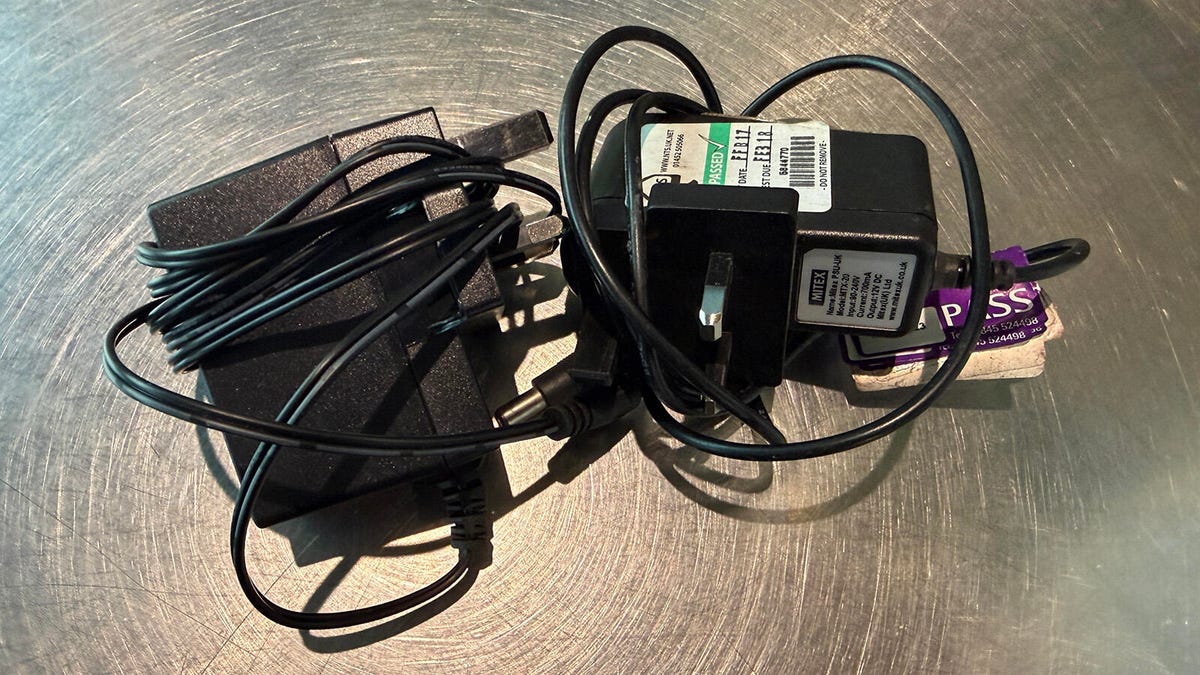
Those DC wall warts
While USB chargers have largely taken over from DC adapters, these older power bricks still have a role to play for cordless handsets, routers, and other devices.
I have too many wall warts.
Adrian Kingsley-Hughes/ZDNET
If you’d rather not deal with a drawer full of mismatched chargers, pick up a universal adapter.
USB dock
My Mac has an SD card reader, but it lacks a microSD slot, an Ethernet port, and a USB-A port. That’s precisely why I always keep a USB dock nearby—it’s the Swiss Army Knife of connectivity. Over the years, I’ve accumulated a small collection of docks, and while I won’t be keeping every single one, I’ll hold onto a couple “just in case.”
Other useful bits and bobs
There are also a few extras you can add to your tech utility belt. These items punch well above their weight in terms of usefulness relative to their size and cost:
- USB-C boost modules: These boost modules are fantastic. USB-C power goes in one end, and up to 20V DC comes out the other. Simply toggle a few switches to select the voltage you need. (You’ll also need a USB-C charger capable of handling the required output power.)
These USB-C boost modules are great for converting non-USB devices into USB. All you need is a bit of know-how.
Adrian Kingsley-Hughes/ZDNET
- Multi-charging cables: These market themselves as the “one cable to rule them all,” and while they’re incredibly handy, they do come with some limitations (for instance, the connector ends can be a bit bulkyHere’s the paraphrased version:
- USB adapters: Small dongles that switch between USB-C and USB-A connections are incredibly useful and can save you in a pinch. These little gadgets are the kind of thing you don’t realize you need until you’re stuck without them.
- USB power meter: This device helps you confirm whether power is actually flowing through your cable. A basic USB power meter that costs just a few dollars has saved me countless hours of frustration over the years.
My power meter has been through a lot of use, but it still works perfectly.
Adrian Kingsley-Hughes/ZDNET
Of course, I still have that lingering worry that the moment I throw away a cable or adapter, some rare, once-in-a-lifetime situation will come up where I desperately need it. But honestly? If some random person shows up needing a specific cable, they’re on their own.
