



Here is a new article based on the provided post content:
—
## Choosing Between Tools and Subagents in AI Agent Design
When building AI agents, one of the most important architectural decisions is determining how to delegate work. Should a capability be implemented as a **tool**, or does it require a full **subagent**? Understanding the distinction—and the tradeoffs—helps teams avoid unnecessary complexity while building systems that are both powerful and maintainable.
This article explains what tools and subagents are, when each is appropriate, and how to apply a simple decision framework to prevent overengineering your agent architecture.
### What Are Tools?
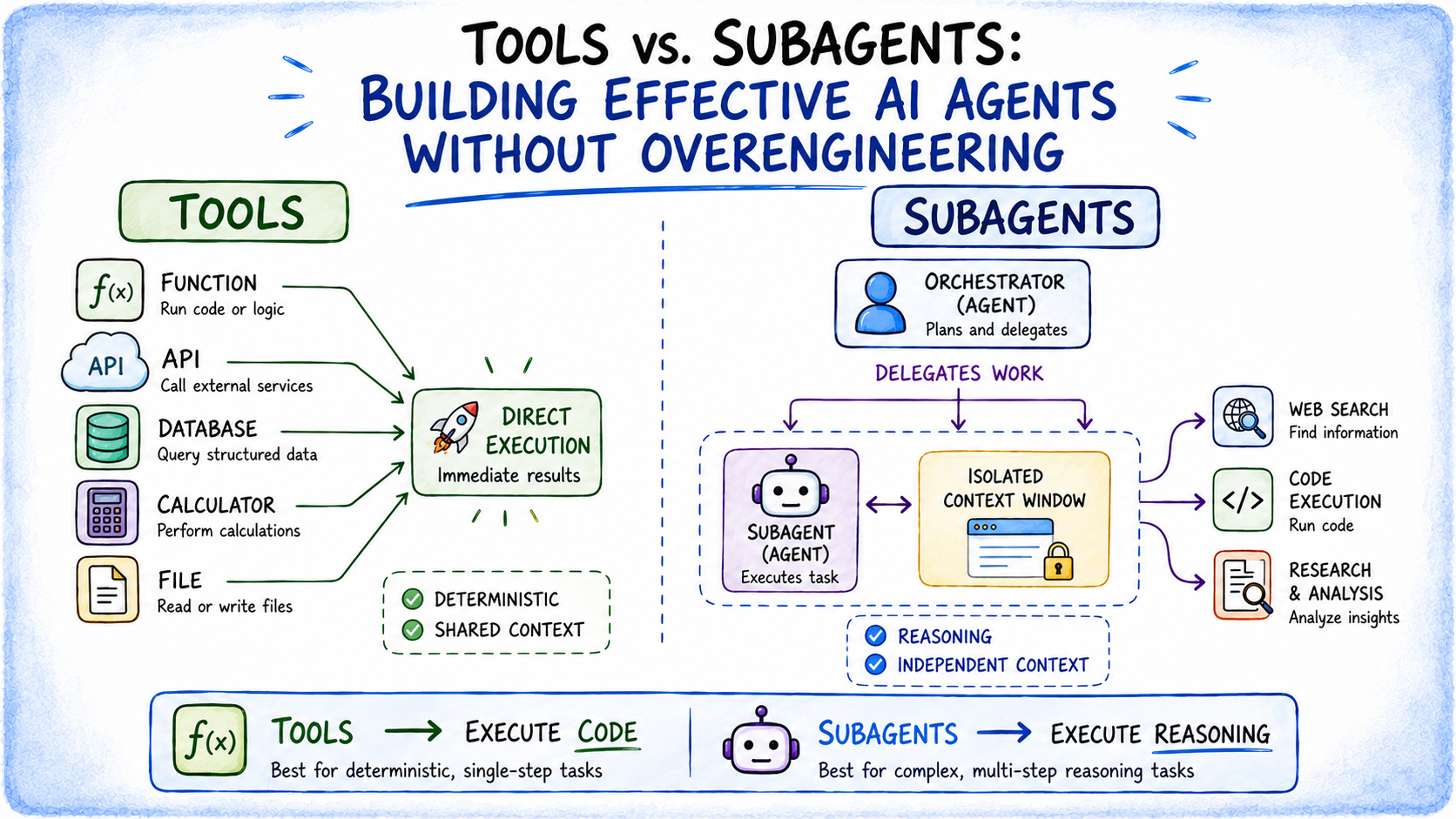
Tools are capabilities an agent uses to interact with external systems and perform actions beyond the model’s built-in knowledge. In practice, tools are usually functions, API calls, database queries, searches, file operations, or other executable code exposed to the model through a defined interface.
A typical tool interaction works like this:
– The model decides that external information or an action is needed.
– It generates a structured tool call with the required arguments.
– Your application executes the tool and returns a result.
– The result is fed back into the conversation so the model can continue reasoning.
Tools do not perform reasoning themselves—they execute predefined operations and return data. The model handles all planning and decision-making around those operations. Because tools run deterministic code rather than another LLM, they are typically fast, low-latency, and inexpensive.
### What Are Subagents?
A subagent is a separate LLM call—often a distinct agent instance—with its own system prompt, context window, and possibly its own set of tools. It receives a task, works through it independently, and returns a result to the orchestrating agent.
From the orchestrator’s perspective, calling a subagent looks similar to calling a tool: send a task, get a result. The difference is what happens in between. A subagent runs its own multi-step reasoning loop, potentially making its own tool calls and managing its own state. The orchestrator only sees a summary at the end.
### Tools vs. Subagents: Key Differences
| Aspect | Tools | Subagents |
|——–|——-|———–|
| What runs | Your code | Another LLM |
| Context window | Shared with orchestrator | Separate, isolated |
| Reasoning | None; deterministic execution | Full multi-step reasoning loop |
| Error handling | Structured returns, retry in same loop | Handled internally or surfaced to orchestrator |
| Cost | Execution cost only | Additional LLM call(s) |
| Latency | Low; one function call | Higher; full inference cycle |
| Visibility | Full; result visible in orchestrator’s context | Partial; orchestrator sees summary only |
| When it breaks | Bad schema, API failure, wrong arguments | Hallucination, lost context, coordination failure |
Because tools share context with the orchestrator, they are ideal when intermediate results need to be immediately visible and usable. Subagents, with isolated contexts, are better suited when work must be fully encapsulated.
### When to Use a Tool
Use a tool when the operation is well-defined, deterministic, and does not require multi-step reasoning.
– **Calling an external API**, such as fetching a user record, posting to Slack, or querying a database.
– **Transforming or validating data**, like running a regex, formatting a date, or calculating a hash.
– **Reading or writing files**, such as opening, writing, or checking existence.
– **Running a search**, like semantic search over a vector database or a SQL query.
Practical rule of thumb: *If you can write the behavior as a Python function with typed inputs and outputs, and it doesn’t need to reason through multiple steps, it should be a tool.*
### When to Use a Subagent
Use a subagent when the task requires multi-step reasoning, when intermediate work would clutter the orchestrator’s context, or when tasks can run in parallel.
– **The task has non-obvious intermediate steps**, such as researching a competitive landscape, which involves planning searches, reading results, deciding next steps, and synthesizing findings.
– **The work can be parallelized**. Independent subagents can process multiple documents or topics concurrently, often more efficiently than sequential processing.
– **The subtask needs its own tool set**. Research, code writing, and analysis often require different capabilities; isolating tools per subagent reduces orchestrator complexity.
– **Context isolation improves reliability**. A separate context window prevents distractions from the orchestrator’s accumulated history, improving consistency for complex tasks.
### A Simple Three-Question Decision Framework
Most decisions come down to three questions:
1. **Is the task primarily execution or reasoning?**
– Execution → Tool
– Multi-step reasoning → Subagent
2. **Does the intermediate work matter to the orchestrator?**
– Small, actionable outputs → Tool
– Large, intermediate-heavy workflows → Subagent
3. **Can the task run independently?**
– Tightly coupled steps → Tool
– Parallelizable or self-contained work → Subagent
Tools are best for deterministic tasks like database queries, calculations, transformations, and file operations. Subagents excel at research, complex content creation, and parallel processing.
### The Overengineering Trap
The most common mistake is introducing subagents before they are truly needed. While subagents can clean up an architecture, they also add significant complexity—extra context windows, additional reasoning loops, and more handoffs. That means higher latency, greater cost, and more moving parts to debug.
Start with a single agent and a small set of well-designed tools. Only introduce subagents when they solve a concrete problem that tools cannot address cleanly, such as:
– Isolating large amounts of intermediate work,
– Enabling parallel execution,
– Providing dedicated reasoning space for complex tasks.
A useful question to ask: *“What does the subagent actually buy me?”*
– If the answer is minimal processing before returning a result, a tool is likely enough.
– If the answer involves independent reasoning, context isolation, specialized capabilities, or parallel execution, a subagent is probably justified.
As a rule of thumb: **Tools should be default. Subagents should be introduced only when they provide a clear architectural advantage.**
### What Adding Subagents Actually Costs
Calling a tool is straightforward: provide inputs, get a result. Delegating to a subagent is different because you are also handing off part of the reasoning process.
That means the orchestrator must define the task clearly enough for the subagent to work independently. The subagent does not automatically inherit the orchestrator’s goals or full conversation history—it only knows what it is given.
Effective subagent architectures depend on clean handoffs:
– The orchestrator sends a focused, self-contained task.
– The subagent performs its own reasoning and tool use.
– The subagent returns a concise result the orchestrator can use.
For example, a research subagent might return: “Identified three competitors, along with their pricing models and key differentiators,” rather than every search query, document excerpt, and intermediate observation.
Keeping the boundary clean prevents the orchestrator’s context from filling with unnecessary intermediate work and makes the system easier to understand and debug.
A useful guideline: **Pass tasks down; pass conclusions back up**. Clean task in, clean summary out is the contract that keeps multi-agent systems manageable.
### Summary
Choosing between tools and subagents is a key architectural decision in agentic systems. While both help accomplish tasks, they differ significantly in execution model, reasoning capabilities, cost, and operational complexity.
The following comparison highlights when each approach is most appropriate:
| Concept | Tools | Subagents |
|———|——-|———–|
| What runs | Your code | Another LLM with its own reasoning loop |
| Best for | Deterministic execution: API calls, searches, calculations, file ops | Complex reasoning: research, code generation, parallel processing |
| Context | Shared with orchestrator | Isolated; fresh context window per task |
| Cost | Execution cost only | One or more additional LLM calls |
| Latency | Low | Higher |
| Debuggability | High; result visible in orchestrator’s context | Lower; internal steps are opaque |
| When to reach for it | Task can be written as a deterministic function | Task needs multi-step reasoning, parallelism, or tool isolation |
| Overengineering risk | Low | High; adds coordination overhead if used prematurely |
| Communication contract | Typed function input → structured output return | Self-contained task string → summary string |
| Start here | Yes; default to tools first | Only when tools hit a concrete limit |
By favoring tools by default and introducing subagents only when they provide clear benefits, teams can keep systems simple, reliable, and scalable.
—
**Original source:**
*“Tools vs. Subagents: Building Effective AI Agents Without Overengineering.”* Machine Learning Mastery. Retrieved from https://machinelearningmastery.com/wp-content/uploads/2026/06/mlm-tools-vs-subagents.png
