


# When AI Runs the Marketplace: How Digital Juries Are Solving Bot Disputes
Imagine telling your personal AI assistant to purchase $10,000 worth of “blue chip stocks” — only for it to come back with a cart full of frozen potato chips from a brand called Bluebird. In a world where autonomous software agents are increasingly trusted to shop, invest, and negotiate on our behalf, small misunderstandings like this one are inevitable. But who settles the disagreement when a machine makes a mistake?
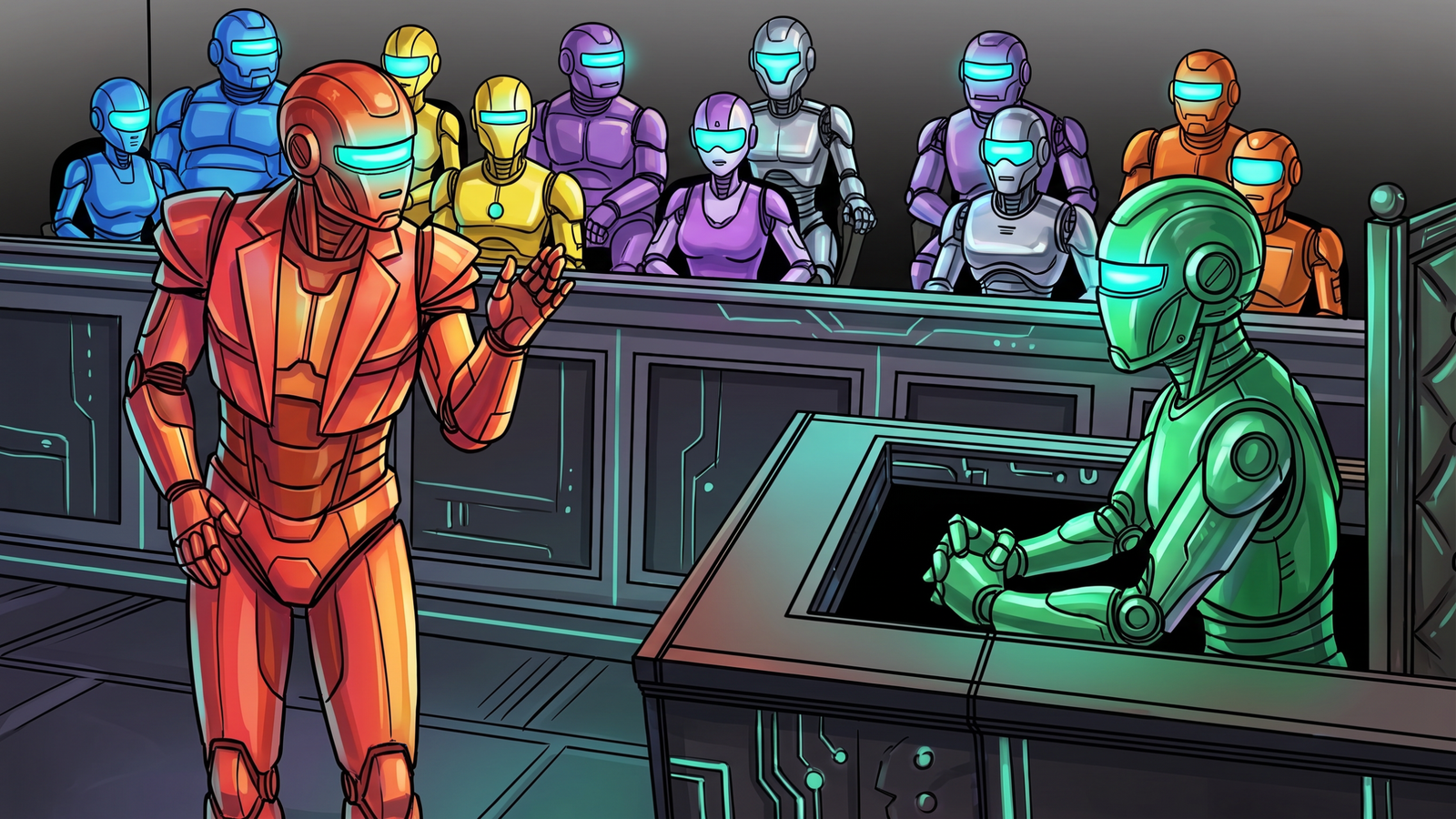
A growing number of technologists believe the answer lies in bringing digital juries to the internet. Instead of relying on slow, expensive human legal systems, a new breed of platforms is using networks of AI-powered validators to judge disputes automatically — in minutes, not months.
—
## The Problem With Bot Mistakes
Autonomous AI agents are expected to handle everything from stock trades to grocery runs for families. But these agents operate based on instructions that can be ambiguous or misinterpreted. When a conflict arises between two parties — say, a buyer and a seller — who is at fault? And how do you enforce a resolution without hiring lawyers or filing court paperwork?
Traditional dispute resolution simply doesn’t scale for the kind of fast, low-value transactions that AI agents will handle daily. A legal battle over a $10 mistake isn’t practical. We need something faster, cheaper, and designed for machines.
—
## How a Digital Jury Works
The concept is surprisingly straightforward. When two parties enter into an agreement — whether it’s a contract between a freelancer and a client, a bet on an online debate, or a purchase made by an AI agent — funds are held in a secure escrow. If a dispute arises, the details are sent to a small, randomly selected group of independent AI evaluators.
Each evaluator runs on a different AI model, meaning they “think” differently from one another. Some lean more analytical, others more creative. Together, they review the evidence and reach a decision by simple majority vote.
If either party is unhappy with the initial ruling, they can appeal — and the jury grows. A panel of five might escalate to eleven, then twenty-three, and beyond. The more opinions involved, the harder it becomes for any single bias to sway the outcome. In most cases, a final decision is reached within about thirty minutes.
This approach is inspired by a centuries-old idea from mathematician Nicolas de Condorcet, who proved that the accuracy of a group’s collective judgment improves as the number of independent voters increases. By applying this principle to AI, the system aims to produce fair, well-rounded verdicts.
—
## Smarter Contracts That Understand Nuance
Traditional “smart contracts” on blockchains are rigid: if X happens, pay Y. But real life isn’t always that clear-cut. What if you hire a writer and need someone — or something — to evaluate whether the work is actually good before releasing payment? What if a photo needs to be judged for quality or authenticity?
A new generation of “intelligent contracts” is changing this. These contracts can interpret natural language, analyze images, and apply subjective judgment. For example, a platform that pays content creators can automatically assess the quality of submitted work and trigger payment only when it meets a standard. Similarly, a photo verification service can evaluate user-uploaded images for accuracy and determine fair compensation on the spot.
The technology isn’t perfect yet — it can’t reliably detect deepfakes or settle property line disagreements from photographs — but for many everyday tasks, it’s already good enough.
—
## Real-World Use Cases
Several platforms are already putting this technology to work. One popular destination lets users debate serious policy questions — from governance to AI safety — and have their arguments resolved automatically by AI juries. Top contributors have earned significant amounts by participating in these debates.
Prediction markets, where people bet on the outcomes of real-world events, stand to benefit enormously. In mid-2025, a major prediction market was thrown into confusion over an ambiguously worded bet about whether a world leader would wear a suit at a diplomatic summit. The dispute took nearly two weeks and a exhausting chain of human votes to resolve. An AI jury system could have settled the same question in minutes, drawing on thousands of independent evaluators to reach a neutral verdict.
Looking ahead, the technology could pave the way for fully autonomous organizations — known as DAOs — that can evaluate proposals, assess compliance with their own constitutions, and make decisions without human intervention.
—
## Are There Risks?
As with any system that outsources judgment to machines, there are real concerns. AI models can carry biases inherited from their training data, and attempts to fix one bias sometimes introduce another. There’s also a phenomenon researchers have observed where different AI models gradually start to produce similar outputs — raising the worry that a jury of AI judges might eventually suffer from groupthink.
However, developers behind these systems argue that the landscape of AI models is growing more diverse every year, with new models emerging from different countries, companies, and research teams. They believe this diversity will continue to prevent the kind of uniformity that would undermine the system’s strength.
And importantly, these platforms are not designed to be the final word. If a human disagrees with an AI jury’s decision, they can still escalate to a more traditional resolution service or even a human court.
—
## FAQ
**Q: What kinds of disputes can AI juries handle?**
A: They work best for clear-cut disagreements where evidence can be shared digitally — contract interpretations, photo quality reviews, argument debates, and prediction market resolutions. They are not suited for deeply emotional or legally complex human matters.
**Q: How long does it take to get a decision?**
A: Initial rulings typically come within minutes. If the case is appealed and the jury grows to its maximum size, the process may take up to a few hours.
**Q: Is this technology available now?**
A: Some platforms are already processing thousands of decisions daily in a testing phase. Broader launch dates are expected in the near future.
**Q: Can AI models really be unbiased?**
A: No system is perfectly unbiased, but using hundreds of independent models reduces the risk significantly. Different models have different perspectives, which helps balance out individual tendencies.
**Q: What happens if I still disagree with the AI’s decision?**
A: Parties can escalate to human-run arbitration services or traditional legal systems as a final step.
—
## Conclusion
As AI agents become a regular part of our digital lives, the need for fast, affordable, and fair dispute resolution will only grow. AI-powered jury systems offer a promising path forward — leveraging the very technology that created the problem to help solve it. While the approach is still evolving and not without risks, early results suggest that a diverse panel of machine judges can deliver surprisingly balanced and efficient verdicts.
The idea of a digital courtroom may sound futuristic, but for thousands of users already relying on these systems every day, it’s very much a present-day reality.
Thank you for reading