



If you follow Bitcoin, you may have come across “Nostr” — an odd, almost unpronounceable term that stands for “Notes and Other Stuff Transmitted by Relay.” This acronym has fascinated Bitcoin tech enthusiasts for years, and for good reason. Its core concept is straightforward: you don’t need to be tied to a major social media platform to communicate with your friends.
Created at the onset of the COVID-19 pandemic by Fiatjaff in March 2020, the Nostr protocol now powers an ever-growing number of purpose-built websites. High-profile figures like Edward Snowden and Jack Dorsey are among its most visible users.
Unlike today’s conventional internet and social media landscape, Nostr empowers users to carry their followers and content seamlessly from one website to another, from one app to another, however they choose. Algorithms are placed squarely in users’ hands, enabling maximum personal control, diversity, and resistance to censorship — qualities that have largely disappeared from the mainstream big-tech web.
A Vehicle for Bitcoin Adoption
Constructed using Bitcoin-native technology, Nostr has supported Bitcoin micropayments known as “zaps” almost from the very beginning. Its authentication system resembles a Bitcoin wallet far more than any traditional login method, resulting in a refreshingly different web experience.
Creative professionals have begun gravitating toward this unique corner of the internet, cultivating their brands within international communities that tip in Bitcoin — not merely to reward great art, but to make a statement. It demonstrates that no matter where you are on the planet, Bitcoin can reach you directly.
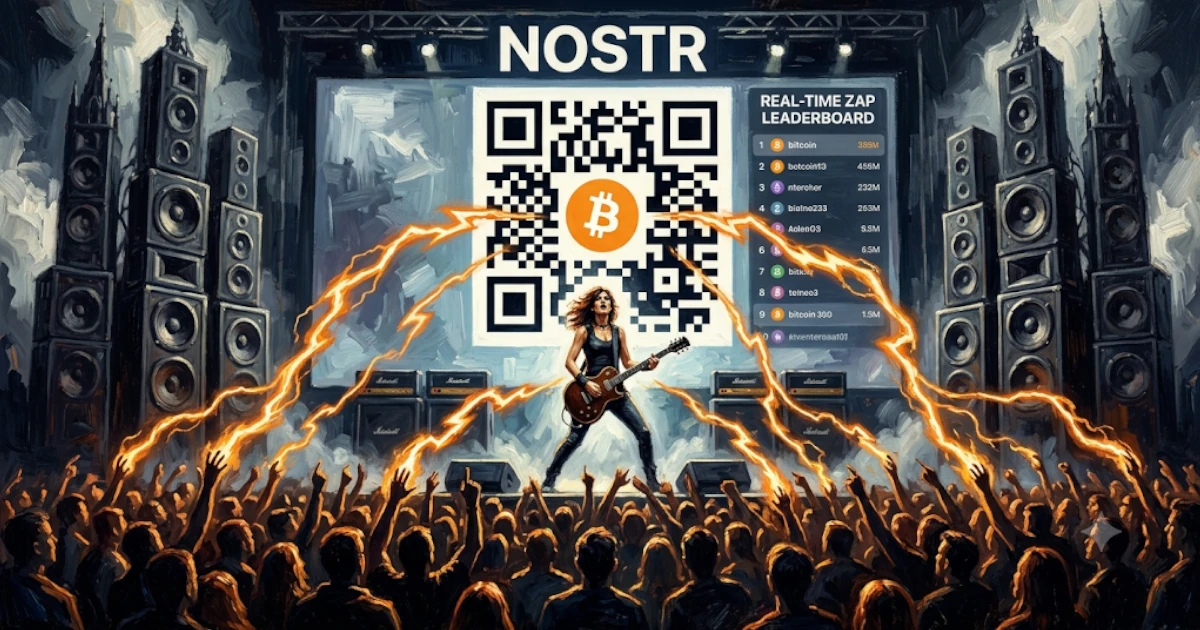
Consider Pubpay, for instance — a Nostr-driven music platform designed to elevate musicians not only online but during live performances. I witnessed this application in action at a Bitcoin event in Las Vegas just a few weeks ago. Displayed on a massive screen, the site showcased the performing artist alongside a large QR code and a Zap leaderboard, ranking the smallest Bitcoin donations routed to the artist through the Lightning Network. The top donors earned bragging rights, while the artist collected the sats.
Take a look at the trending section of Wavlake, for example — another music-focused Nostr platform featuring a polished design and instant access to surprisingly high-quality tracks.
Tales of onboarding newcomers to Bitcoin through Nostr-based social media apps like Primal are commonplace at Bitcoin meetups and conferences. Primal is essentially a Twitter alternative built from scratch around Nostr, and it is arguably the quickest way to dive into this social media niche, begin building an audience, and start earning sats by sharing compelling content.
Unlike the uninspired, payment-only Bitcoin wallets whose design philosophies are now over 15 years old, Nostr apps feel modern and offer a direct stream of engaging content that can be delivered to newcomers when executed well, keeping them diving deeper down the Bitcoin rabbit hole.
Nostr Basics Made Simple
Leveraging Bitcoin-native cryptography, Nostr uses public addresses and private keys to verify its users, just like Bitcoin wallets. Nostr public addresses begin with “npub,” while private keys begin with “nsec.” Users sign the posts or messages they wish to broadcast to the Nostr network using their private key. Those signed posts can then be discovered through the same user’s public address. Much like conventional social media platforms, users can follow and mute one another across the entire Nostr ecosystem.
Information about who follows whom, and what each person has published, is stored on relays — specialized servers that users can operate themselves, and which synchronize with other relays to varying degrees, similar to how Bitcoin nodes function.
Interfaces and applications can be developed on top of Nostr, allowing users to experience their social network in a variety of ways. Many different approaches already exist, ranging from Twitter-style clones like Primal and Amathyst, to blogging platforms, music services, and even micro-video sites like Divine. Essentially, any website can integrate with Nostr as long as it makes its users’ identities Nostr-compatible, making user-generated content accessible through relays.
If you ever grow tired of one app or feel it isn’t treating you well, you can simply take your nsec and switch to another. The new app will look up your npub, retrieve all your friends, notes, and preferences, and let you continue interacting with them without any hassle. In short, the network effects built on Nostr apps belong to you and are controlled by you — not by the platform. This is the fundamental vision behind Nostr, and it explains why so many Bitcoin enthusiasts are passionate about it.
Far More Than Just Social Media
It’s worth emphasizing that Nostr isn’t merely a social networking protocol — it is, in fact, an open-source and continuously evolving information protocol capable of transmitting virtually any type of data. Devices can communicate with each other over Nostr without you ever needing to see it happening. Indeed, a broad spectrum of applications has already been developed to relay data through Nostr, and many of these can be found in one of the ecosystem’s most vital hubs: the Zapstore.
That’s correct — Nostr has its own dedicated app store, and it’s quite remarkable. Spearheaded by a developer known as Franzaps, this open-source, Nostr-powered
The app store provides direct and frequently early access to more than 150 applications within the Nostr ecosystem. These apps are published straight to the store by their developers and are cryptographically signed with their Nostr keys for verification.
However, Zapstore extends well beyond the Nostr space. It also allows you to download a broad selection of popular apps that are published to GitHub. According to Fran, who spoke with Bitcoin Magazine in an exclusive interview, the store features over 3,000 of the most widely used apps. Apps like Mullvad VPN and the Brave browser are available on Zapstore, among many others. For users who prioritize privacy, it could readily serve as a replacement for the Play Store and App Store, sidestepping the control point that Google and Apple have embedded within mobile devices.
Zapstore takes extensive measures to cryptographically verify the authenticity of every app. Fran explained that “Android relies on the APK format. Every APK carries a developer signature, and this is what Android verifies during updates.” While Google now effectively requires identity verification from its app developers, Nostr operates in a decentralized manner. To confirm whether an app was genuinely published by its developer, Nostr leverages social proof. “Nostr is a *social* protocol where keys carry social credibility, so once Zeus has signed their wallet, you can be confident it’s the legitimate one.”

This idea of Nostr social proof is historically referred to as a Web of Trust. When you log into Zapstore using your Nostr keys, you can see whether anyone you follow has interacted with an app’s publishers — an early trust-based approach to addressing security and authenticity in a decentralized environment.
Fran estimates that Zapstore sees roughly 4,000 daily users, with about half of them installing or updating at least one app. These figures are approximations — he clarified that “because we prioritize privacy, the client has no tracking at all, so we have to estimate based on relay and Blossom server data.”
Digital Identity on Hard Mode
Since Nostr authentication relies on Bitcoin-style private-public key pairs, the security practices for protecting your identity are comparable. Instead of emails, passwords, and password resets, Nostr requires you to take careful steps to ensure your nsec (private key) isn’t compromised. If it somehow ends up on the dark web, there’s little you can do to recover it, and your identity and data cannot be migrated to a new key pair — the attacker gains full control. I’ve criticized this design for years, and while a protocol-level solution for password resets in Nostr hasn’t gained widespread adoption, alternative approaches have emerged, such as remote signers.
Amber, an app built by Greenart7c3, a well-known Nostr developer, can generate and sign Nostr events remotely. This gives you complete control over your nsec without exposing it to every website you interact with. The technology works quite effectively and has seen broad adoption. It leverages NIP-46 — an open-source Nostr improvement proposal created specifically for this use case.
If you’ve never had a Nostr account, Amber is an excellent starting point. Have it generate your Nostr keys and use it exclusively for logging into Nostr applications.
Zap Zap Zap!
The most viral and groundbreaking feature of Nostr — described by some as “the moat” of Nostr apps — is, of course, the Zap. These small Bitcoin tips can be as tiny as 1 satoshi, though they can also be much larger. A new Nostr site has been built specifically around onchain Zaps, setting the minimum viable amount at over 1,500 sats. Zaps can deliver an outsized rush of dopamine to recipients relative to their cost — essentially a reinvention of the Facebook “like,” backed by the hardest form of money in existence. The Zap ties approval and value to something that can’t be faked by fake accounts on social media. If you want to artificially inflate a post’s popularity, you have to put money behind it.
The full potential of Zaps is likely still in its early stages, but they may eventually serve as a novel form of advertising — ultimately paying consumers to engage with content — or simply as a genuine expression of gratitude from Nostr users toward a piece of content and its creator.
Setting up Zaps on your Nostr account could be simpler, though. There are two sides to getting Zaps working: sending and receiving. For both, you need the right kind of Bitcoin wallet. Not all Bitcoin wallets are created equal, as you may know. Most are designed for onchain transactions, which generally aren’t compatible with Zaps. You need a Lightning wallet that supports NIP-57, which gives you an email-like nym, such as [email protected] — a human-readable address capable of receiving Lightning payments. You’ll also need the ability to send Zaps from a Lightning wallet, which doesn’t have to be the same one you receive them on.
By far the easiest way to get started is through Primal.net, likely the most popular Nostr social media client available today. Primal offers an extensive suite of tools for Nostr users and often serves as the entry point into the ecosystem. It includes a built-in wallet that manages to stay on the self-custodial side of the regulatory line while also being a low-effort, low-cost Lightning wallet. It achieves this by using Spark, a layer-2 protocol similar to Lightning.
Most importantly, Primal’s wallet supports Nostr Wallet Connect (NWC) — a powerful and widely adopted standard under NIP-47. This allows you to connect Nostr-enabled websites to a wallet for Zaps without giving every website custody of your satoshis.
Other options include running an Alby Lightning node, which costs around $12 per month in server fees — quite steep in my opinion, though a solid choice for advanced users. Alternatively, you could run an Electrum Lightning wallet from a home computer and ensure it stays open and online. Beyond that, there’s a wide variety of Lightning node software that enthusiasts can configure to work with NWC and Nostr Zaps.
A Glimpse of the Nostr Ecosystem
Including all the tools mentioned above, here are some of the most noteworthy Nostr sites and tools I came across during my deep exploration of the Nostr ecosystem, listed in no particular order.
Social media apps:
Web of trust tools:
Bitcoin Wallets + Nostr:
Remote Signing and Key Management:
Other:
