Low-code and no-code platforms have evolved well beyond basic drag-and-drop interfaces into AI-powered development environments. By 2026, the majority of these platforms come equipped with a built-in AI assistant capable of transforming a simple text description into a functional app, agent, or automated workflow. This guide highlights 21 tools that AI practitioners rely on today, organized by their core strengths. Each tool name links to its official website so you can check pricing and features firsthand.
App and UI Builders
These platforms empower non-developers to create and ship working applications, often from just a single prompt.
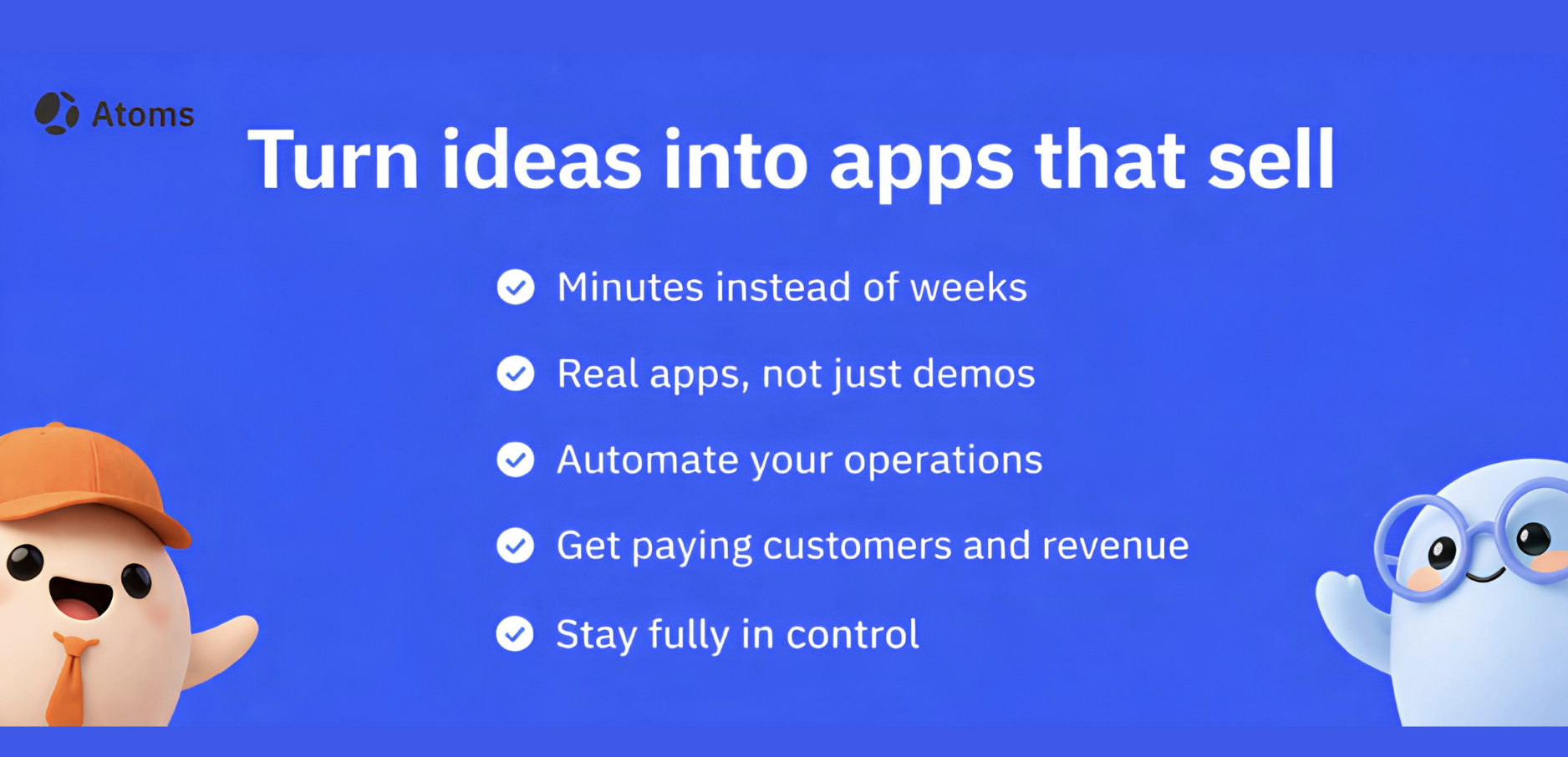
1. Atoms* (10% discount with code MARKTECHPOST10) is a no-code AI platform that enables anyone to build and launch a fully functional product without writing any code at all. It goes past traditional drag-and-drop tools by deploying a team of AI agents that manage every phase of development — from conducting in-depth market research to validate your idea, to constructing the backend, deploying the application, and fine-tuning it for search engines. With built-in user authentication, database management, Stripe payment integration, and one-click hosting, you can go from a rough concept to a live, revenue-generating product in minutes. Atoms is designed for entrepreneurs, small teams, and anyone with a great idea but no development team behind them.
2. Bubble continues to be the most mature visual web app builder on the market. You design the user interface, set up the database, and define workflows — all without code. Its AI capabilities can generate page layouts and logic from text descriptions, which you can then fine-tune by hand.
3. Adalo is tailored for non-developers building native mobile and web apps. Its AI assistant, Ada, constructs an app from a text prompt, while Magic Add lets you introduce new features using plain language. It produces binaries that are ready for the App Store right out of the box.
4. Glide converts spreadsheets and databases into polished applications. Simply connect a data source, and Glide automatically generates an interface along with AI-powered tables and actions. It’s a great fit for internal tools and customer-facing apps built on top of data you already have.
5. Softr creates client portals, internal tools, and websites on top of Airtable, Google Sheets, or its own built-in database. Its AI app generator builds a working product from a text description — no coding skills needed.
6. Lovable produces full-stack web applications from natural language descriptions. It generates an entire codebase — frontend, backend, database, and authentication — and deploys everything with a single click. Built on React, Vite, and Tailwind, it also offers two-way GitHub synchronization.
7. Bolt.new is a prompt-to-app builder created by StackBlitz. It supports multiple JavaScript frameworks and keeps the generated code fully visible. You can click on UI elements to request changes or edit the source directly, while AI agents handle most of the heavy lifting.
8. Replit combines a browser-based IDE with Replit Agent, one of the more autonomous app-building tools available. It can scaffold, build, and deploy applications with a wide range of built-in integrations — ideal for founders who want a working product as quickly as possible.
9. v0 by Vercel focuses on front-end generation. It produces Next.js applications with polished UI and built-in database support, making it a popular starting point for product and design teams.
10. Appy Pie provides a comprehensive no-code suite for building apps, chatbots, and automations. Its AI assistant supports both drag-and-drop building and natural language prompts, targeting small businesses and first-time creators.
Workflow Automation and AI Agents
These platforms connect different applications, trigger actions, and increasingly support autonomous AI agents.
11. Zapier is the most widely adopted no-code automation tool. It connects thousands of SaaS applications and now includes AI agents and a copilot that builds workflows from plain-English descriptions. It’s perfect for straightforward trigger-and-action automations across teams.
12. Make is a visual workflow builder with advanced branching and logic capabilities. Its canvas is ideal for multi-step automations that require conditional paths, and it lets you integrate AI models into flows for tasks like classification and content generation.
13. n8n is an open-source, low-code automation platform with a self-hosting option. It’s a strong choice for teams that want full control over their data and infrastructure, and it supports AI agent nodes for building LLM-driven workflows.
14. Microsoft Power Automate manages automation across the Microsoft 365 ecosystem. It connects Office apps, Dynamics, and external services, with AI features that generate flows from descriptions. It’s a natural default for organizations deeply invested in the Microsoft stack.
15. Lindy builds no-code AI agents for operations and small teams. These agents handle judgment-based tasks like email triage, research compilation, and meeting preparation, operating across connected tools rather than following rigid trigger chains.
16. Airtable blends a flexible database with apps and automations. Its AI layer summarizes records, generates content, and categorizes data within tables. Many teams use it as both a data backbone and a low-code application layer.
Machine Learning and Model Platforms
These tools let you build, train, or deploy machine learning models with minimal or no code.
17. Google Vertex AI offers no-code AutoML alongside full model development capabilities. Non-technical users can train classification, regression, and vision models from their data, while engineers can extend pipelines with custom code. It sits at the intersection of no-code and low-code.
18. Amazon SageMaker is AWS’s machine learning platform. SageMaker Canvas provides a no-code interface for building and deploying models from data, while the broader platform supports large-scale training and tuning for technical teams.
19. Microsoft Foundry (formerly Azure AI Foundry) is a unified platform for building AI applications and agents. Its portal lets you deploy models, test prompts, and create prompt agents through configuration alone — no application code needed for basic use cases.
20. Teachable Machine by Google is a free, browser-based tool for training image, sound, and pose recognition models. It requires no code and no account, making it a practical entry point for prototyping and teaching machine learning concepts.
21. Jotform AI extends a form builder with an AI layer woven throughout the platform. It generates forms from prompts, adds conditional logic automatically, and supports AI agents that handle responses — useful for surveys, intake forms, and workflow automation.
How to Choose
The best tool for you depends on what you’re building and the technology stack you already use. Here are a few practical guidelines:
- A complete product solution with zero development team: Atoms* is built to handle everything — from validating an initial idea to setting up backend infrastructure, processing payment, and managing hosting — all within a single platform.
- Build mobile or customer-facing apps without writing a single line of code: Platforms such as Adalo, Glide, and Softr require zero programming knowledge and still let you produce fully deployable applications.
- Turn a prompt into a full-stack web app: Tools like Lovable, Bolt.new, v0, and Replit fall into the “vibe coding” space. Each one produces functional code, though most still require you to set up external services for things like databases or authentication.
- Link applications and automate repetitive tasks: Zapier and Make are ideal for simple “when X happens, trigger Y” workflows. n8n goes further by offering self-hosting and greater control over your data. Power Automate is the natural fit if you’re already working within the Microsoft ecosystem.
- AI agents capable of making autonomous decisions: Lindy is designed for judgment-driven tasks that span across your existing tools — a fundamentally different approach compared to rigid, pre-defined automation chains.
- Train custom models using your own data: Vertex AI, SageMaker, and Microsoft Foundry cater to teams that need to train specialized models or manage production-grade AI infrastructure. For the quickest, no-signup entry point into building simple classifiers, Teachable Machine is the easiest place to start.
Key Takeaways
- End-to-end app builders such as Atoms*, Bubble, Adalo, and Glide let you ship complete products without writing any code.
- Prompt-to-app platforms — Lovable, Bolt.new, v0, and Replit — generate functional web applications from a text description.
- For no-code workflow automation, Zapier, Make, n8n, and Power Automate are the go-to options; Lindy brings AI-powered decision-making agents into the mix.
- Vertex AI, Amazon SageMaker, and Microsoft Foundry span the spectrum from no-code to low-code for building and deploying custom models.
- Pick the right tool for each job and combine several — no single platform excels at everything.
Conclusion
In 2026, the low-code and no-code movement is less about replacing developers and more about closing the gap between having an idea and launching a working product. Whether you begin with an all-in-one builder like Atoms, prototype a front end in Lovable or v0, streamline operations with Zapier or Lindy, or train a custom model in Vertex AI, the unifying theme is speed: you can now move from concept to a live app, agent, or model in hours rather than weeks. The best choice still hinges on what you’re building, the technology stack you already rely on, and how close you need to get to a production-ready solution. Match each tool to its ideal use case, double-check pricing and features on the official websites, and lean on a combination of platforms rather than expecting any one of them to do it all.
*We earn a small affiliate commission through the affiliate link included.
Michal Sutter is a data science professional with a Master of Science in Data Science from the University of Padova. With a solid foundation in statistical analysis, machine learning, and data engineering, Michal excels at transforming complex datasets into actionable insights.