



# Introduction
These days, just about every company claims to be “data-driven.” It’s become the ultimate stamp of legitimacy — the phrase you drop in a meeting to end an argument. But here’s something worth pausing on: the words “according to the data” can mean two very different things depending on who’s saying them.
Sometimes it reflects honest inquiry. Other times, it’s someone who’s already made up their mind and went hunting for a number to justify it.
And here’s the strange twist: both types of people often end up championing the same decision, speaking the same language, and sitting on the same side of the table. This kind of alliance is far more common than most realize — and it has a well-known name.
# Bootleggers and Baptists
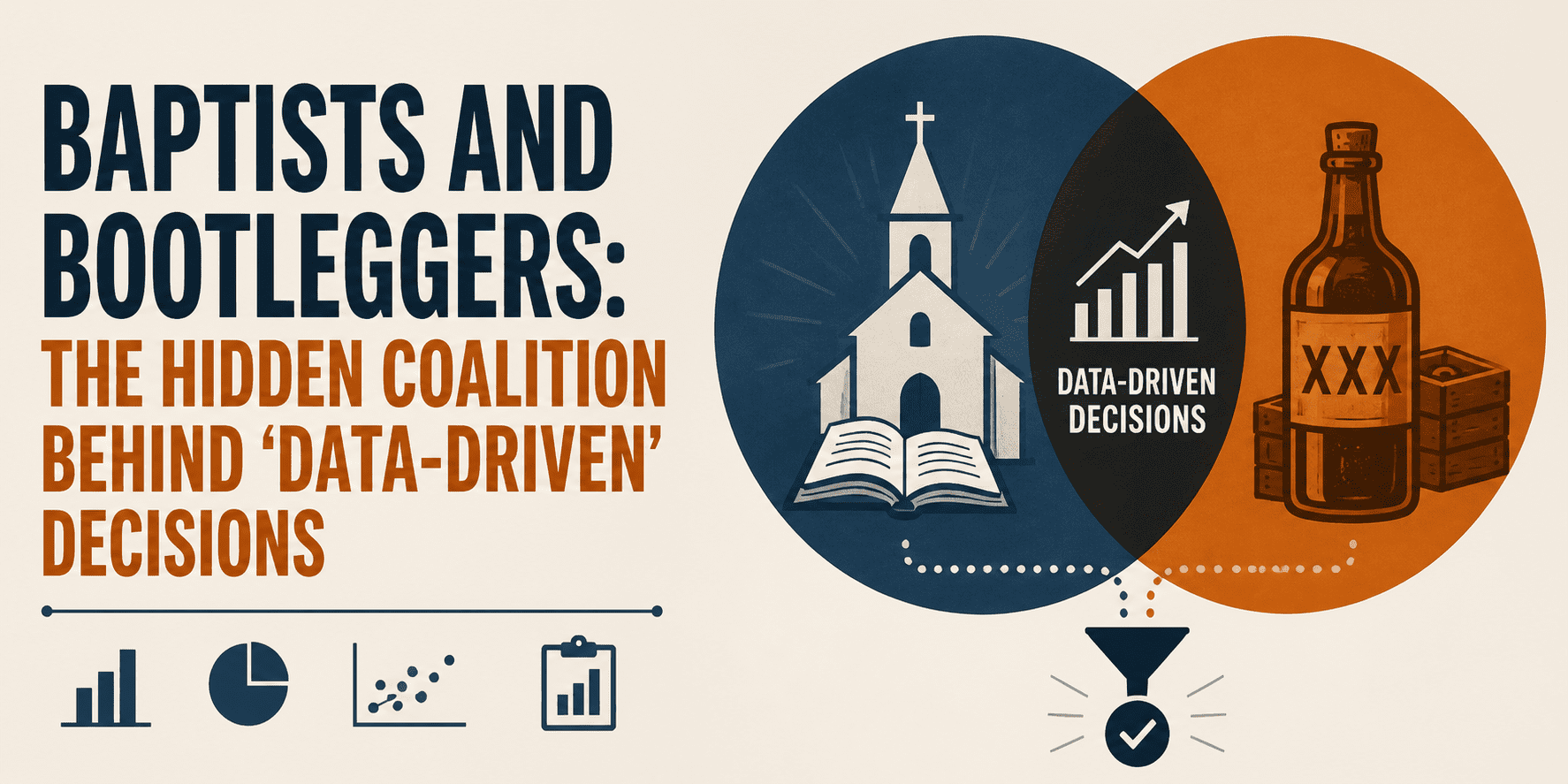
In 1983, economist Bruce Yandle coined the term “Bootleggers and Baptists” to describe an unusual political alliance. His observation centered on Sunday alcohol bans in the American South. Baptists advocated for these laws on moral and religious grounds — they genuinely believed shutting down Sunday liquor sales was the ethical thing to do. Bootleggers, on the other hand, quietly celebrated the same laws because they wiped out their legal competitors for an entire day.
Both camps wanted the identical result, but for completely different motives. The Baptists supplied the moral high ground — the public rationale that politicians could proudly cite. The bootleggers operated in the background, reaping the benefits without drawing attention. Yandle’s key insight was that these odd-bedfellow alliances tend to be far more effective at shaping policy than either group could be on its own.
It’s a compelling model. And it applies to the world of data and analytics with almost eerie accuracy.
In any organization that works with data, you’ll find people who sincerely want evidence to steer their choices. These are your Baptists. They advocate for cleaner data pipelines, sharper dashboards, and more rigorous A/B testing. They insist on statistical significance not to serve a hidden agenda, but because they genuinely trust that better data produces better results.
These individuals are easy to recognize. They’re the ones who revise their thinking when the data challenges their assumptions. They’re perfectly comfortable admitting “I was wrong” or “we need more evidence before we act.” To them, data is like a flashlight in a dark room — a tool that helps everyone see more clearly, even when what it uncovers is unwelcome.
Data Baptists are true believers in the principle, regardless of how the data turns out. And that sincerity is precisely what makes them valuable to the bootleggers.
Now consider the other camp. These are people who start with a predetermined conclusion and then work backward to construct a data narrative that supports it. They’re well-versed in the language of evidence. They can quote statistics, reference dashboards, and deliver polished presentations full of charts. But their analytical process was never truly open-ended. The conclusion was locked in before the analysis even began.
Data bootleggers engage in tactics like cherry-picking time frames that favor their preferred narrative. They’ll highlight metrics that make their project look good while conveniently overlooking the ones that don’t. They’ll lean heavily on correlation when it helps them and dismiss it when it doesn’t. And they almost never volunteer data that undermines their argument.
Imagine someone advocating for AI-generated ad copy. They’ll showcase click-through rates from a two-week trial and declare victory. What they’ll leave out is that bounce rates spiked, time on page plummeted, and the campaign’s cost per acquisition actually increased. The AI ads generated clicks, no question — but so do clickbait thumbnails. The complete picture tells a very different story, and that’s precisely why they keep it hidden.
What makes them so effective is that they sound indistinguishable from the Baptists. Same terminology. Same focus on “what the data reveals.” In a meeting, it’s nearly impossible to tell the two groups apart.
# Why the Coalition Works So Well
This is where Yandle’s framework really hits home. The Baptists lend credibility. When someone with a sincere commitment to evidence-based thinking backs a decision, it makes it much easier for everyone else to fall in line. The bootleggers surf that wave, borrowing the Baptist’s legitimacy to push through an outcome they wanted from the start.
And here’s the real sting: the Baptists frequently have no idea they’re part of this arrangement. They believe the decision was reached on its merits because, from their perspective, the data genuinely supported it. They examined the numbers honestly and drew their own conclusion. The bootlegger simply made sure only the “right” numbers made it onto the table.
# Learning to Tell Them Apart
So what practical steps can you take? Begin by observing how people react when the data contradicts what they hoped to see. Baptists will lean in. They’ll probe further, question their assumptions, and potentially change course. Bootleggers will dodge. They’ll reframe the discussion, switch to a different metric, or abruptly declare that the data “doesn’t tell the whole story.”
Similarly, notice the difference between who actually analyzes the data and who decides which data gets analyzed in the first place. There’s a critical distinction between someone who examines all the available evidence and someone who hand-picks a convenient slice of it.
You should also ask whether the analysis was genuinely open-ended or whether the conclusion was already floating around before anyone even touched the data. You won’t always be able to draw a clear line between the two.
The entire purpose of the coalition is to blur that line. But simply being aware of the dynamic gives you a meaningful edge — because the vast majority of people in most organizations have never stopped to consider that their “data-driven” culture might be powered by two very different engines running at the same time.
# Final Thoughts
Yandle’s framework was originally designed for regulatory economics, but the pattern it captures is universal. Anytime decisions carry moral or intellectual weight, you’ll find people who genuinely believe in the principle and people who simply exploit the cover it offers. Data-driven culture is no different.
Your best safeguard is straightforward: stay curious about who stands to gain from a decision, not just what the numbers appear to say. Because the numbers can be accurate, the analysis can be rigorous, and the whole thing can still be a bootlegger’s playground. Strong data practice means asking “why this particular data?” just as often as you ask “what does this data tell us?”
Nahla Davies is a software developer and tech writer. Before committing to technical writing full time, she managed — among other notable roles — to serve as a lead programmer at an Inc. 5,000 experiential branding firm whose clients include Samsung, Time Warner, Netflix, and Sony.
