




A global operation from legislation enforcement authorities in partnership with personal firms has disrupted FrostArmada, an APT28 marketing campaign hijacking native site visitors from MikroTik and TP-Hyperlink routers to steal Microsoft account credentials.
The Russian risk group APT28, additionally tracked as Fancy Bear, Sofacy, Forest Blizzard, Strontium, Storm-2754, and Sednit, has been linked to Russia’s Common Employees Most important Intelligence Directorate (GRU) eighty fifth Most important Particular Service Heart (GTsSS) army unit 26165.
Within the FrostArmada assaults, the hackers compromised primarily small workplace/residence workplace (SOHO) routers and altered the area title system (DNS) settings to level to digital personal servers (VPS) below their management, which acted as DNS resolvers.

This allowed APT28 to intercept authentication site visitors to focused domains and steal Microsoft logins and OAuth tokens.
At its peak in December 2025, FrostArmada contaminated 18,000 units throughout 120 international locations, primarily focusing on authorities companies, legislation enforcement, IT and internet hosting suppliers, and organizations working their very own servers.
Microsoft, whose companies had been focused by this marketing campaign, labored along with Black Lotus Labs (BLL), Lumen’s risk analysis and operations division, to map the malicious exercise and determine victims.
With assist from the FBI, the U.S. Division of Justice, and the Polish authorities, the offending infrastructure has been taken neutralized.
FrostArmada exercise
The attackers focused internet-exposed routers, primarily MikroTik and TP-Hyperlink, in addition to some firewall merchandise from Nethesis and older Fortinet fashions.
As soon as compromised, the units communicated with the attackers’ infrastructure and obtained DNS configuration adjustments that redirected site visitors to malicious VPS nodes.
The brand new DNS settings had been routinely pushed to inside units through the Dynamic Host Configuration Protocol (DHCP).
When purchasers queried authentication-related domains the risk actor focused, the DNS server returned the attacker’s IP as an alternative of the actual one, redirecting victims to an adversary-in-the-middle (AitM) proxy.
The one seen signal of fraud for the sufferer would have been a warning for an invalid TLS certificates, which might have simply been dismissed. Nevertheless, ignoring the alert gave the risk actor entry to the sufferer’s unencrypted web communication.
“The actor essentially ran a proxy service as the AitM that the end user was directed to via DNS,” Lumen’s Black Lotus Labs researchers clarify.
“The only sign of this attack would be a pop-up warning about connecting to an untrusted source because of the ‘break and inspect’ configuration.”
“If warnings were present and ignored or clicked through, the actor proxied requests to the legitimate services, collecting the data at the midpoint and collecting data associated with the targeted account by passing the valid OAuth token.”
In some instances, although, the hackers spoofed DNS responses for sure domains, thus forcing affected endpoints to hook up with the assault infrastructures, Microsoft says in a report at this time.
Lumen reviews that FrostArmada operated in two distinct clusters, one known as the ‘Enlargement group’ devoted to gadget compromise and botnet progress, and the second dealing with the AiTM and credential assortment operations.
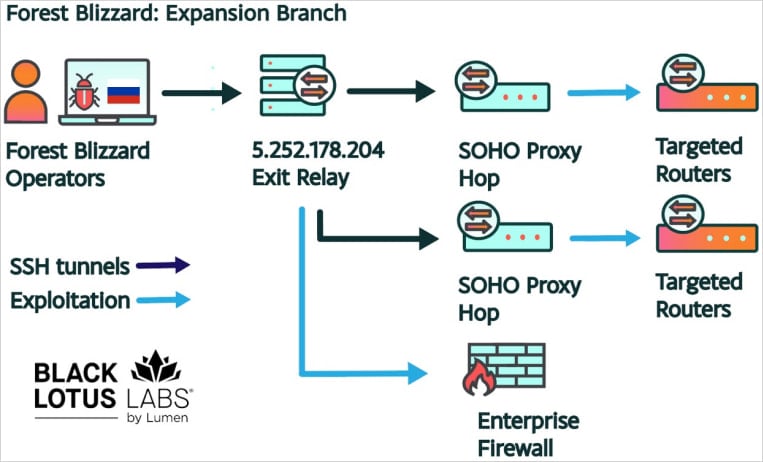
Supply: Black Lotus Labs
FBI cleansing hacked routers
The U.S. Division of Justice (DoJ) says in a press launch at this time that the FBI carried out “a court-authorized technical operation” to safe compromised routers by eradicating APT28’s resolvers although DNS resets, forcing the units to hook up with professional DNS resolvers supplied by their web supplier.
The instructions delivered to affected routers additionally allowed the FBI to gather proof in regards to the risk actor’s exercise.
To make sure that the instructions impression solely the hacker’s operation and didn’t have an effect on the router’s regular performance or collect consumer info, “the government extensively tested the operation on firmware and hardware for affected TP-Link routers.”
It is very important be aware that customers can take away any adjustments made to their units by resetting them to manufacturing unit default settings.
The DoJ additionally supplies a set of suggestions for customers of SOHO units to arrange defenses:
- Substitute routers which might be not obtain assist
- Set up the newest firmware model accessible
- Verify the DNS resolvers listed in router settings
- Evaluation and implement firewall guidelines to stop the undesirable publicity of distant administration companies
In accordance with the DoJ, the state-backed APT28 risk actor has been indiscriminately compromising TP-Hyperlink routers since 2024, exploiting recognized vulnerabilities to steal credentials.
Later, the actor “implemented an automated filtering process to determine which DNS requests were of interest and warranted interception.”
Black Lotus Labs researchers report that FrostArmada exercise elevated sharply following an August 2025 report from the Nationwide Cyber Safety Centre (NCSC) within the UK describing a Forest Blizzard toolset that focused Microsoft account credentials and tokens.
Microsoft confirmed that APT28 carried out AitM assaults in opposition to domains related to the Microsoft 365 service, as subdomains for Microsoft Outlook on the net have additionally been focused.
Moreover, the corporate noticed this exercise on servers belonging to 3 authorities organizations in Africa that weren’t hosted on Microsoft infrastructure. In these assaults, “Forest Blizzard intercepted DNS requests and conducted follow-on collection.”
Black Lotus Labs additionally noticed the risk actor focusing on entities with on-premise electronic mail servers and “a small number of government organizations” in North Africa, Central America, and Southeast Asia.
The researchers be aware that “there was also a connection to a national identity platform in one European country.”
In a report at this time, the UK company says that the AitM exercise impacted each browser periods and desktop functions, and the DNS hijacking is believed to have been opportunistic in nature to construct a big pool of potential targets after which filtering these of curiosity.
Black Lotus Labs has printed a small set of indicators of compromise for the VPS servers used in the course of the FrostArmada marketing campaign:
| IP deal with | First Seen | Final Seen |
|---|---|---|
| 64.120.31[.]96 | Could 19, 2025 | March 31, 2026 |
| 79.141.160[.]78 | July 19, 2025 | March 31, 2026 |
| 23.106.120[.]119 | July 19, 2025 | March 31, 2026 |
| 79.141.173[.]211 | July 19, 2025 | March 31, 2026 |
| 185.117.89[.]32 | September 9, 2025 | September 9, 2025 |
| 185.237.166[.]55 | December 30, 2025 | December 30, 2025 |
The researchers be aware that defenders ought to implement certificates pinning for company units (laptops, cellphones) managed through an MDM resolution, which might generate an error when the attacker tries to intercept and analyze site visitors on their VPS infrastructure.
One other advice is to reduce the assault floor by way of patching, limiting publicity on the general public internet, and eradicating all end-of-life gear.
Microsoft and the NCSC additionally present a listing of IoCs and safety steering to assist defenders determine and forestall DNS hijacking assaults.
Replace [April 7, 18:16 EST]: Article up to date with info from the Division of Justice that grew to become accessible after publishing time.

Automated pentesting proves the trail exists. BAS proves whether or not your controls cease it. Most groups run one with out the opposite.
This whitepaper maps six validation surfaces, reveals the place protection ends, and supplies practitioners with three diagnostic questions for any software analysis.
