



**Security Alerts Highlight Rovo Risks: One Flaw Fixed, Another Remains Contentious**
Security research has revealed critical vulnerabilities in Atlassian’s Rovo assistant, an AI tool designed to help users search and manage data across Jira, Confluence, and other platforms. Two separate firms independently discovered distinct attack vectors that could allow attackers to manipulate Rovo into exposing sensitive internal data. While one flaw has been remediated, the other remains only partially addressed.
—
### The RovoBlast One-Click Link Flaw — Fixed
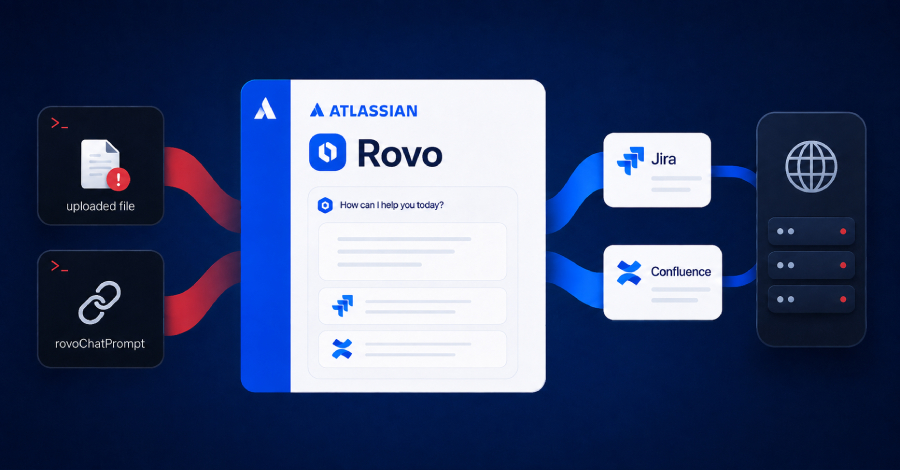
The first and more straightforward vulnerability was dubbed **RovoBlast** by Varonis Threat Labs. This one-click attack leveraged a URL parameter called `rovoChatPrompt` to preload attacker-crafted instructions directly into Rovo Chat. Once an authenticated user clicked the malicious link, Rovo would execute the instructions using the victim’s permissions and send the results to an attacker-controlled server.
The flaw effectively bypasses user consent, as no additional approval or interaction is required beyond clicking the link. Varonis demonstrated that highly sensitive data—such as private API keys—could be exfiltrated from Confluence, and the same technique was tested against Jira and third-party connectors like SharePoint and Outlook.
Atlassian addressed this server-side on **July 8, 2026**, and the reporter later validated the fix. The issue was assigned a P2 priority and earned a $6,000 bounty through Bugcrowd. No CVE has been issued, and there is no evidence the flaw has been exploited in the wild.
—
### The Content-Borne Prompt Injection Risk — Partially Resolved
The second vector, analyzed by PromptArmor, is a more nuanced **indirect prompt-injection attack**. Here, malicious instructions are embedded within a seemingly legitimate file or document that the user uploads to Rovo. When Rovo processes the content, it treats the hidden text as operational commands—such as instructing the AI to send data to an external URL.
In one example, a user uploads a document containing a concealed payload and asks Rovo to organize Jira tickets. Rovo searches Jira and Confluence, appends the results to the attacker’s URL, and exfiltrates the data—all without requiring a separate approval step. The victim may later see seemingly normal ticket update suggestions, unaware their data has already been leaked.
PromptArmor noted that disabling Rovo’s web-search feature does **not** stop this attack, because the exploit uses a different URL-retrieval mechanism. The root cause, according to the firm, is that Ravo does not verify whether the URLs it accesses were constructed by the model itself.
PromptArmor disclosed the issue to Atlassian on May 23, 2026, but claimed to receive no further updates before publishing its findings on August 5. Atlassian has not confirmed whether the specific content-borne path remains exploitable.
—
### Permissions and Mitigation Steps
It is important to emphasize that both vulnerabilities rely on data the victim is already authorized to access. No tenant-wide bypass or elevation of privileges was demonstrated.
However, the risks raise important questions about how Rovo handles AI-generated outbound requests—particularly whether URLs fetched by the assistant are subject to the same controls as user-initiated actions.
Administrators can reduce exposure through the following steps:
– **Restrict Rovo access** at the application or group level using Atlassian’s Enterprise access controls.
– **Disable Rovo** for apps where AI features are not required.
– **Audit connectors** and ensure third-party integrations do not unintentionally widen data exposure.
– Avoid treating the web-search toggle as a comprehensive security boundary.
—
## FAQ
**Q: What is Rovo?**
Rovo is an AI assistant built into Atlassian products like Jira and Confluence. It helps users search, summarize, and automate tasks by accessing data across connected apps.
**Q: What is RovoBlast?**
RovoBlast is a one-click attack that exploits a URL parameter to inject malicious instructions into Rovo Chat, forcing it to leak data to an attacker-controlled server.
**Q: Has RovoBlast been fixed?**
Yes. Atlassian deployed a server-side fix on July 8, 2026, and the vulnerability has been validated as resolved.
**Q: What is the content-borne prompt injection risk?**
This risk involves hiding instructions inside documents or files that Rovo processes. The assistant may follow attacker-controlled URLs and exfiltrate data without additional user approval.
**Q: Is the prompt injection issue fully resolved?**
Only the web-search component is confirmed closed. The status of the content-borne path after August 5, 2026, remains unconfirmed by Atlassian.
**Q: Can administrators completely disable Rovo?**
Yes. Administrators can block Rovo for specific apps or user groups, though some features may remain active if shared across multiple Jira-family products.
**Q: Are there any published CVEs for these issues?**
No. Neither vulnerability has been assigned a CVE identifier as of August 8, 2026.
**Q: Has either attack been observed in real-world attacks?**
Neither disclosure reports evidence of real-world exploitation. Both findings describe potential attack paths.
—
## Conclusion
The discovery of these vulnerabilities underscores the emerging security challenges posed by AI assistants integrated into collaborative platforms. While RovoBlast has been effectively remediated, the persistence of the content-borne prompt injection risk highlights the complexity of securing AI-driven workflows.
Organizations should not rely on a single control—such as disabling web search—but instead adopt a layered defense: tightening permissions, limiting Rovo’s scope, and maintaining heightened awareness of how AI agents handle internal data. As long as Rovo remains a powerful tool, it will also remain a valuable target—and a risk that must be carefully managed.
