



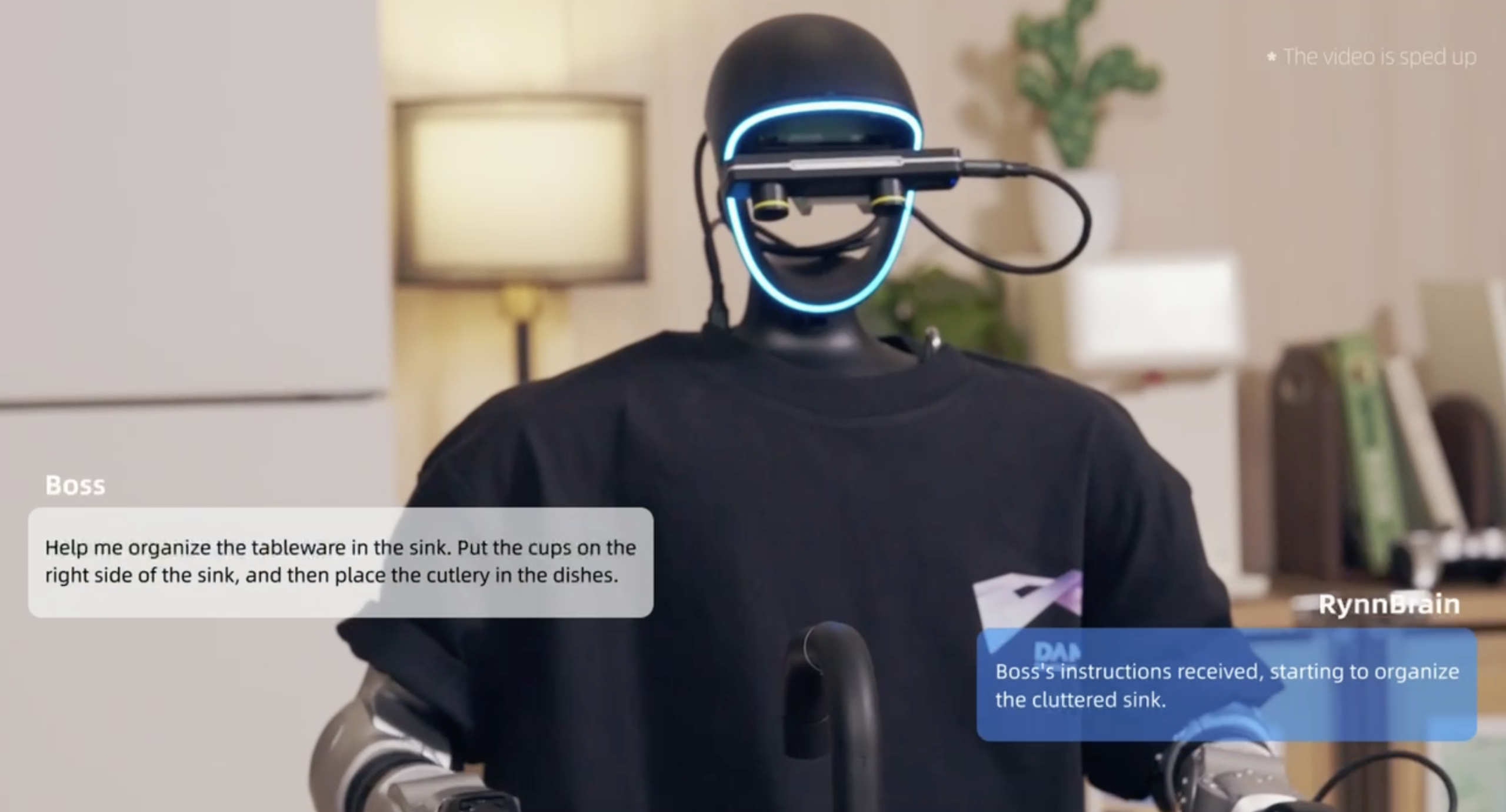
Alibaba has entered the race to construct AI that powers robots, not simply chatbots. The Chinese language tech big this week unveiled RynnBrain, an open-source mannequin designed to assist robots understand their surroundings and execute bodily duties.
The transfer indicators China’s accelerating push into bodily AI as ageing populations and labour shortages drive demand for machines that may work alongside—or change—people. The mannequin positions Alibaba alongside Nvidia, Google DeepMind, and Tesla within the race to construct what Nvidia CEO Jensen Huang calls “a multitrillion-dollar growth opportunity.”
In contrast to its rivals, nevertheless, Alibaba is pursuing an open-source technique—making RynnBrain freely out there to builders to speed up adoption, just like its strategy with the Qwen household of language fashions, which rank amongst China’s most superior AI methods.
Video demonstrations launched by Alibaba’s DAMO Academy present RynnBrain-powered robots figuring out fruit and putting it in baskets—duties that appear easy however require advanced AI governing object recognition and exact motion.
The expertise falls beneath the class of vision-language-action (VLA) fashions, which combine pc imaginative and prescient, pure language processing, and motor management to allow robots to interpret their environment and execute applicable actions.
In contrast to conventional robots that observe preprogrammed directions, bodily AI methods like RynnBrain allow machines to study from expertise and adapt behaviour in actual time. This represents a elementary shift from automation to autonomous decision-making in bodily environments—a shift with implications extending far past manufacturing facility flooring.
From prototype to manufacturing
The timing indicators a broader inflexion level. In response to Deloitte’s 2026 Tech Traits report, bodily AI has begun “shifting from a research timeline to an industrial one,” with simulation platforms and artificial information technology compressing iteration cycles earlier than real-world deployment.
The transition is being pushed much less by technological breakthroughs than by financial necessity. Superior economies face a stark actuality: demand for manufacturing, logistics, and upkeep continues rising whereas labour provide more and more fails to maintain tempo.
The OECD initiatives that working-age populations throughout developed nations will stagnate or decline over the approaching many years as ageing accelerates.
Components of East Asia are encountering this actuality sooner than different areas. Demographic ageing, declining fertility, and tightening labour markets are already influencing automation decisions in logistics, manufacturing, and infrastructure—significantly in China, Japan, and South Korea.
These environments aren’t distinctive; they’re merely forward of a trajectory different superior economies are prone to observe.
On the subject of humanoid robots particularly—machines designed to stroll and performance like people—China is “forging ahead of the U.S.,” with corporations planning to ramp up manufacturing this 12 months, based on Deloitte.
UBS estimates there might be two million humanoids within the office by 2035, climbing to 300 million by 2050, representing a complete addressable market between $1.4 trillion and $1.7 trillion by mid-century.
The governance hole
But as bodily AI capabilities speed up, a crucial constraint is rising—one which has nothing to do with mannequin efficiency.
“In physical environments, failures cannot simply be patched after the fact,” based on a World Financial Discussion board evaluation printed this week. “Once AI begins to move goods, coordinate labour or operate equipment, the binding constraint shifts from what systems can do to how responsibility, authority and intervention are governed.”
Bodily industries are ruled by penalties, not computation. A flawed advice in a chatbot will be corrected in software program. A robotic that drops a component throughout handover or loses steadiness on a manufacturing facility ground designed for people causes operations to pause, creating cascading results on manufacturing schedules, security protocols, and legal responsibility chains.
The WEF framework identifies three governance layers required for secure deployment: govt governance setting threat urge for food and non-negotiables; system governance embedding these constraints into engineered actuality by cease guidelines and alter controls; and frontline governance giving employees clear authority to override AI choices.
“As physical AI accelerates, technical capabilities will increasingly converge, but governance will not,” the evaluation warns. “Those that treat governance as an afterthought may see early gains, but will discover that scale amplifies fragility.”
This creates an asymmetry within the US-China competitors. China’s sooner deployment cycles and willingness to pilot methods in managed industrial environments may speed up studying curves.
Nevertheless, governance frameworks that work in structured manufacturing facility settings could not translate to public areas the place autonomous methods should navigate unpredictable human behaviour.
Early deployment indicators
Present deployments stay concentrated in warehousing and logistics, the place labour market pressures are most acute. Amazon just lately deployed its millionth robotic, a part of a various fleet working alongside people. Its DeepFleet AI mannequin coordinates this huge robotic military throughout all the fulfilment community, which Amazon stories will enhance journey effectivity by 10%.
BMW is testing humanoid robots at its South Carolina manufacturing facility for duties requiring dexterity that conventional industrial robots lack: precision manipulation, advanced gripping, and two-handed coordination.
The automaker can be utilizing autonomous car expertise to allow newly constructed vehicles to drive themselves from the meeting line by testing to the ending space, all with out human help.
However functions are increasing past conventional industrial settings. In healthcare, corporations are creating AI-driven robotic surgical procedure methods and clever assistants for affected person care.
Cities like Cincinnati are deploying AI-powered drones to autonomously examine bridge constructions and street surfaces. Detroit has launched a free autonomous shuttle service for seniors and other people with disabilities.
The regional aggressive dynamic intensified this week when South Korea introduced a $692 million nationwide initiative to provide AI semiconductors, underscoring how bodily AI deployment requires not simply software program capabilities however home chip manufacturing capability.
NVIDIA has launched a number of fashions beneath its “Cosmos” model for coaching and working AI in robotics. Google DeepMind affords Gemini Robotics-ER 1.5. Tesla is creating its personal AI to energy the Optimus humanoid robotic. Every firm is betting that the convergence of AI capabilities with bodily manipulation will unlock new classes of automation.
As simulation environments enhance and ecosystem-based studying shortens deployment cycles, the strategic query is shifting from “Can we adopt physical AI?” to “Can we govern it at scale?”
For China, the reply could decide whether or not its early mover benefit in robotics deployment interprets into sustained industrial management—or turns into a cautionary story about scaling methods sooner than the governance infrastructure required to maintain them.
(Picture by Alibaba)
See additionally: EY and NVIDIA to assist corporations check and deploy bodily AI
Wish to study extra about AI and massive information from trade leaders? Verify outAI & Massive Information Expo happening in Amsterdam, California, and London. The excellent occasion is a part of TechEx and is co-located with different main expertise occasions, clickhere for extra info.
AI Information is powered by TechForge Media. Discover different upcoming enterprise expertise occasions and webinars right here.
