



# A New Multi-Agent System Enables AI to Produce Coherent, Long-Form Videos
Artificial intelligence has made remarkable strides in generating short video clips with stunning visual fidelity. However, when asked to produce a narrative that spans multiple scenes over several minutes, these systems tend to fall apart. Characters change outfits between shots, settings shift without explanation, and errors in early scenes compound into irreparable damage downstream. Researchers have long recognized two core problems: semantic drift, where details gradually diverge across shots, and cascading failures, where a single flawed element corrupts everything that follows. Tracing the root cause of a broken video has remained an elusive challenge.
A breakthrough from a leading AI research lab tackles these failures head-on by introducing a layered system of intelligent frameworks designed to govern the entire lifecycle of long-form video production. Rather than relying on a single model to do everything, the system coordinates multiple specialized agents that plan, generate, monitor, and self-correct. The result is a pipeline capable of producing minutes-long, multi-shot videos with stable characters, consistent environments, and narrative coherence that previous approaches simply could not achieve.
—
## The Core Problem: Why Multi-Shot AI Video Breaks Down
Modern diffusion models excel at producing individual high-quality frames and short video segments in seconds. The difficulty lies in the gaps between those segments. Most existing pipelines treat each shot as an independent task, feeding them handcrafted prompts with no awareness of what came before. This isolation creates two destructive patterns.
First, semantic drift occurs when visual details — a character’s clothing, the color of a room, the position of an object — gradually change from shot to shot. There is no mechanism to anchor the story’s visual world and hold it steady. Second, cascading failures happen when an error in an early shot, such as a misplaced prop or an inconsistent background, gets baked into the system’s understanding and then propagates through every subsequent scene, magnifying the problem with each step.
The research team frames this as a fundamental credit assignment problem: when a final video fails, it is extraordinarily difficult to trace that failure back to the specific prompt or decision that caused it, making targeted correction nearly impossible.
—
## The Architecture: Four Frameworks Working in Concert
The solution takes the form of an orchestration layer built on top of powerful multimodal foundation models. This design makes it model-agnostic, meaning the same coordination layer could theoretically drive different video generators depending on what is available. Outputs produced through the system also inherit built-in provenance watermarking from the underlying generation models.
### Framework 1: Strategic Planning Through Bandit Search
The first framework handles creative planning by framing it as a multi-armed bandit problem. An orchestrating agent explores combinations of creative strategies, narrative modes, and aesthetic styles to find the configuration that yields the best story. A planning agent then constructs a detailed storyboard, breaking the narrative into discrete visual beats. Specialized sub-agents for keyframe design, video synthesis, and audio production each contribute their part. Finally, a multimodal judge reviews the assembled cut, scores it, and feeds a structured reward signal back to the planner so it can refine future decisions. This framework has been accepted to a prominent conference on computational linguistics.
### Framework 2: Persistent Visual Memory for World Consistency
The second framework introduces a persistent visual memory system that tracks characters, locations, and objects as the story unfolds. When a scene revisits a previous location or character, the system retrieves stored visual anchors to ensure continuity. In rigorous testing scenarios — including a simulated museum heist sequence — earlier systems failed to retain key details such as a character’s headwear or the specific jewel being stolen. This new memory system maintained consistency for both elements throughout the entire sequence. This work has been accepted to a major natural language processing conference.
### Framework 3: Autoregressive Segment-by-Segment Generation
The third framework is a training-free architecture designed explicitly for long-form generation. It processes video in segments, and each segment goes through a cycle of retrieving relevant context from a multimodal memory, synthesizing new footage, refining it against stored anchors, and updating the memory. The agent dynamically switches between extrapolation mode, which invents new story beats, and interpolation mode, which returns to previously established entities. Google demonstrated a continuous ten-minute film generated entirely through this approach, with characters and locations remaining stable throughout.
### Framework 4: Closed-Loop Prompt Refinement
The fourth framework acts as a quality control mechanism. It automatically generates visual questions about each prompt, then uses vision-language model critiques to act like semantic gradients that rewrite and improve the original text instructions. Critically, this process requires no access to the internal workings of the video generation model — it works entirely through external evaluation. A global selection step then picks the best output across all iterations rather than defaulting to the final one, ensuring that the highest-quality result is always chosen. This framework showed strong gains on established text-to-video benchmarks.
—
## Benchmarks and Measured Performance
The research team introduced three new evaluation suites tailored to the specific challenges of long-form video generation. One benchmark contains hundreds of advertising scenarios involving fictional products and diverse brands. Another stresses the system’s ability to handle scene reappearances and prop state changes. A third focuses on cases where important visual assets disappear for many segments before returning, testing the memory system’s retention.
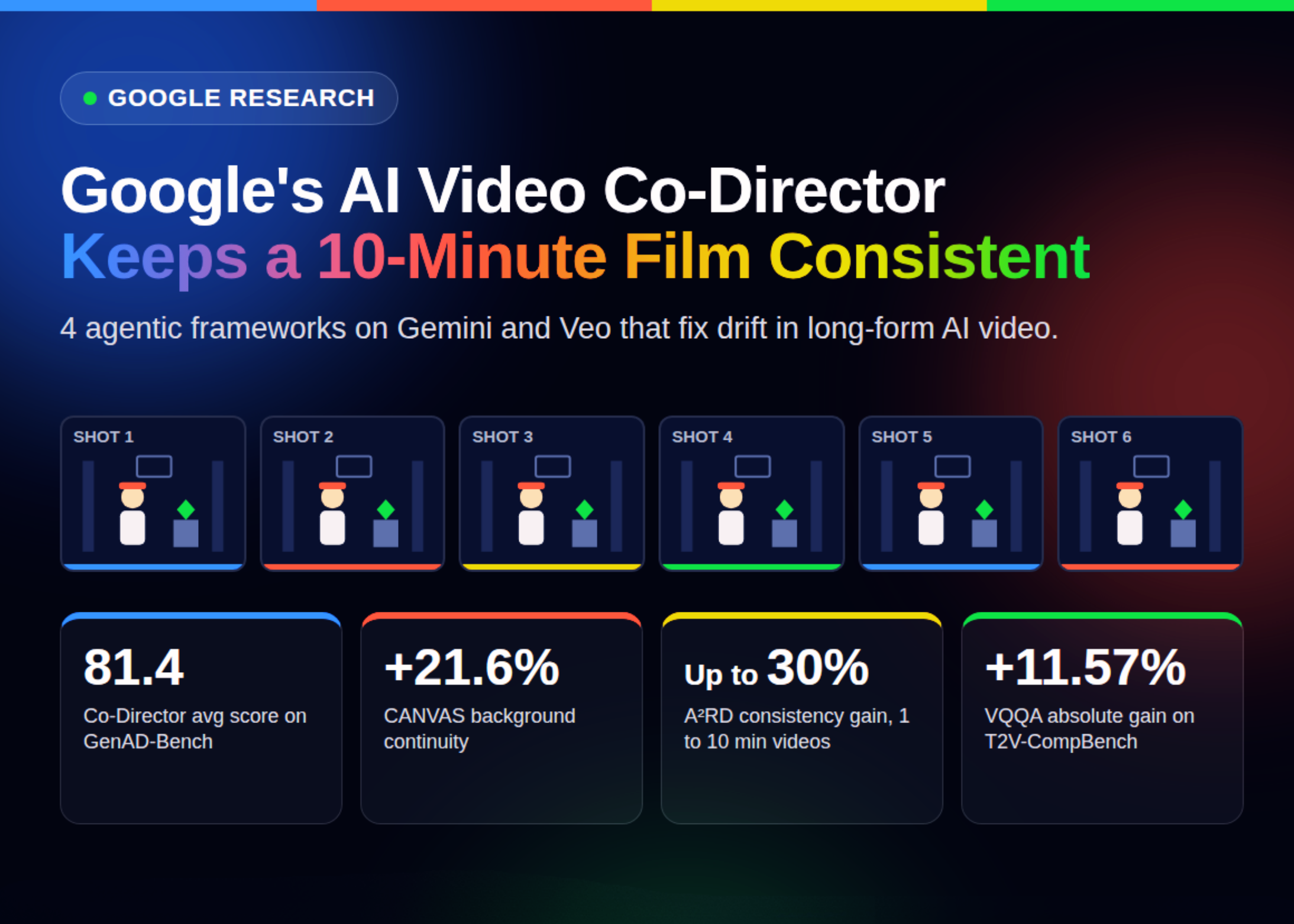
Across these benchmarks, the frameworks delivered impressive results. The planning framework achieved a score of 81.4 on a creative advertising benchmark and earned a 3.96 out of 5 in human evaluations, surpassing a random search baseline of 75.7 and outperforming several prominent existing systems including state-of-the-art models from competing labs. The persistent memory framework delivered gains exceeding 20% in background continuity and nearly 10% in character consistency. The segment-by-segment generation framework improved consistency by up to 30% and narrative coherence by 20% on videos ranging from one to ten minutes. The prompt refinement framework achieved absolute improvements of over 11% on one major text-to-video benchmark and over 8% on another.
—
## How the System Stacks Up Against Alternatives
| Capability | This System | Leading Competitor A | Leading Competitor B | Leading Competitor C |
|—|—|—|—|—|
| **Output Length** | Up to 10 minutes continuous | Roughly 1 minute | Not specified | Image sequences only |
| **Audio Support** | Voiceover and musical score | None reported | Subtitles and audio | None |
| **Consistency Method** | Persistent visual memory + multimodal video memory | Keyframe memory bank | Hierarchical planning | Subject tracking network |
| **Self-Correction** | Bandit feedback loop + iterative prompt rewriting | Aesthetic filtering | None reported | None reported |
| **Training Required** | None (orchestrates existing models) | Fine-tuning on base model | Per-character fine-tuning | None |
| **Accessibility** | Partial code public | Public | Public | Public |
The system stands out for producing the longest coherent output while requiring no fine-tuning, making it more accessible and flexible than alternatives that demand extensive retraining.
—
## Frequently Asked Questions
**What exactly is this system?**
It is a multi-agent orchestration layer that coordinates the planning, generation, and quality control of long-form, multi-shot video content. It sits on top of existing multimodal models and guides them through a structured pipeline.
**How long can videos produced by this system be?**
The segment-by-segment generation framework was evaluated on videos ranging from one to ten minutes, and the researchers released a continuous ten-minute demonstration film with full narrative coherence.
**Can developers and creators try this today?**
To a degree, yes. The planning framework and segment-by-segment generation framework have public code repositories available. The persistent visual memory component is forthcoming, and the complete integrated pipeline is not yet available as a consumer product.
**What makes this approach different from simply prompting a video model multiple times?**
The key difference is the closed-loop coordination. Instead of treating each shot in isolation, the system maintains a living memory of the story world and uses automated judges and refinement cycles to continuously steer generation toward consistency and quality.
**Is watermarking included?**
Yes. Outputs inherit provenance watermarking directly from the underlying generation models, providing a layer of traceability.
—
## Conclusion
Long-form AI video generation has been held back by a persistent inability to maintain visual and narrative consistency across multiple shots and extended durations. By decomposing the problem into specialized frameworks — planning, memory, generation, and refinement — and orchestrating them through intelligent agent coordination, this new system addresses the root causes of semantic drift and cascading failure. The combination of a bandit-driven creative planner, a persistent visual memory engine, an autoregressive segment generation architecture, and a closed-loop prompt refinement loop represents a significant architectural advance. While the full pipeline is not yet a polished consumer product, the open release of key components and the strong benchmark performance signal that coherent, minutes-long AI-generated video is moving from research curiosity toward practical reality.
Thank you for reading
