



Although Congress established the Pandemic Response Accountability Committee to monitor over $5 trillion in emergency COVID-19 funds, the PRAC is now moving into a fresh chapter of its oversight mission.
The PRAC, a group of agency inspectors general formed in March 2020 under the Coronavirus Aid, Relief and Economic Security (CARES) Act, was initially set to wind down in September 2025. However, the pandemic watchdog continues its work and is now supervising another large wave of government spending.
The One Big, Beautiful Bill Act, enacted last year, extends the PRAC’s operations through 2034 and grants the watchdog authority to monitor expenditures from the budget reconciliation legislation.
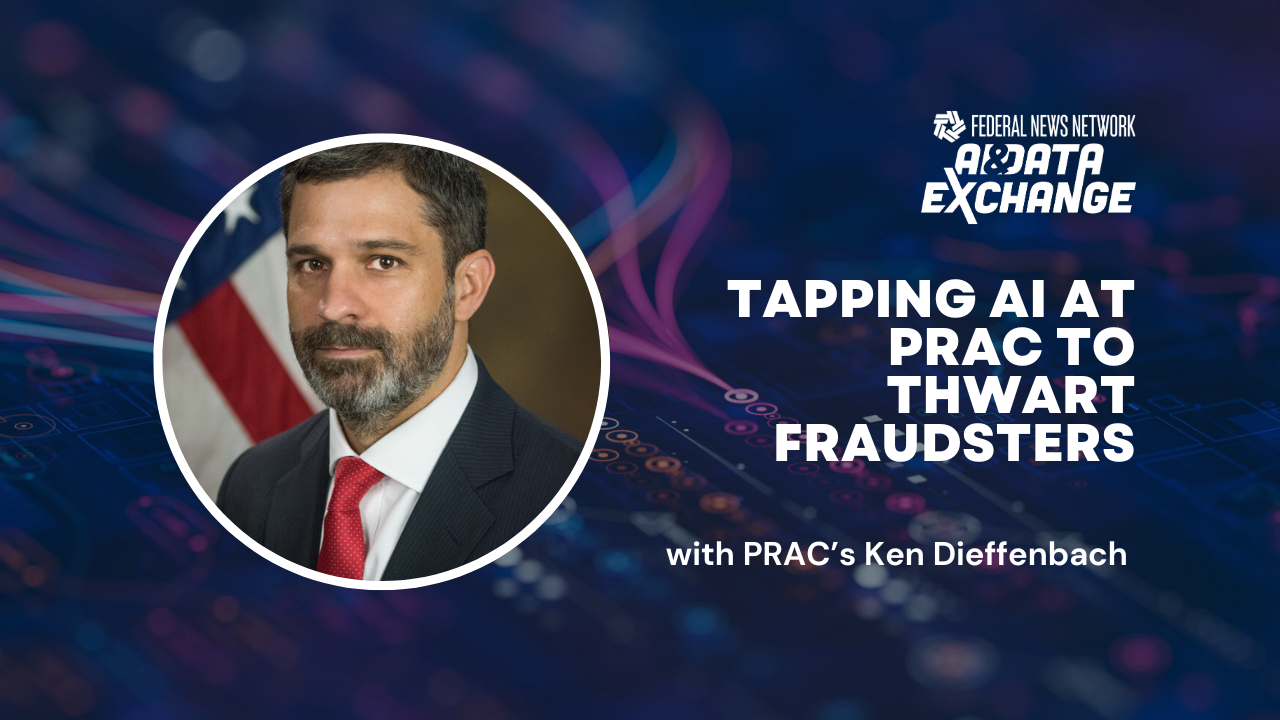
Ken Dieffenbach, the PRAC’s executive director, said the organization remains heavily engaged in pandemic-related probes while shifting its focus to a new set of responsibilities. The PRAC continues to collaborate with law enforcement and is backing more than 1,000 cases involving roughly $2.5 billion in suspected fraud losses.
According to Dieffenbach, many of the fraud-related lessons uncovered during the peak of the COVID-19 pandemic are directly relevant to the PRAC’s current efforts. He shared these insights during Federal News Network’s AI & Data Exchange 2026.
“We discovered that during the pandemic, a significant portion of the losses could have been avoided. We’re working to ensure the right people understand these lessons so we won’t find ourselves in the same situation when, inevitably, another disaster strikes and large sums of money need to be distributed rapidly,” he explained.
AI reshapes oversight operations
The PRAC is harnessing artificial intelligence tools to sift through enormous volumes of federal spending records and to highlight potentially fraudulent transactions for its team to examine. Dieffenbach noted that these cutting-edge tools have dramatically amplified the effectiveness of investigators and auditors.
“Our work revolves around gathering, analyzing, and sharing information. AI is extremely valuable in this area because it accomplishes tasks that humans simply couldn’t perform as efficiently, as accurately, or as swiftly,” he said.
Moving from “pay and chase” to prevention
A top priority for the PRAC today is transitioning from a reactive approach — commonly known as “pay and chase” — to a proactive strategy that blocks fraudulent payments before they go out.
“The PRAC’s primary objective now is to use these tools and data to equip grant officers, contracting officials, and possibly OIG staff with new insights so we can pause, halt, or conduct due diligence before funds are disbursed. Once the money leaves, it’s extremely expensive to recover. We’ll never see it again,” Dieffenbach said. “The prosecution process is very drawn out, so we want to do everything possible to stop these issues at the outset.”
Dieffenbach informed members of the House Oversight and Government Reform Committee in January that the PRAC has built an AI-powered “fraud prevention engine,” trained on more than 5 million applications from pandemic relief programs. This system can process 20,000 federal funding applications per second and detect data irregularities before payments are issued. He noted that development on this engine started last summer.
“We’ve concentrated on how this model can be tailored to new federal programs to rapidly provide decision-makers with critical information before funds are released,” he said.
While agencies emphasized payment speed over payment accuracy in 2020, Dieffenbach said that with today’s technology, they no longer need to sacrifice one for the other.
“We do need to find the right balance, but framing it as ‘either distribute funds quickly or halt to check for fraud’ is a false dilemma. You can achieve both,” he said.
Cross-agency data verification strategies
To combat fraudulent payments, the Trump administration has issued executive orders expanding agency access to datasets such as the Treasury Department’s Do No Pay files and the Social Security Administration’s Death Master File. Nevertheless, agencies still frequently encounter legal obstacles when trying to share data with one another for fraud prevention. Dieffenbach explained that the PRAC has found a workaround through straightforward yes/no verification checks.
“We asked Social Security, ‘Can you simply confirm whether that Social Security number was ever issued? If so, does the name on file match ours? And does the date of birth align with our records?’ We weren’t requesting any actual data — just a yes or no answer,” he said.
Using this method, the PRAC identified 1.4 million potentially invalid Social Security numbers that were used to claim $79 billion in pandemic funding.
“That served as a kind of pilot project, demonstrating that even a modest amount of pre-award screening — simply verifying basic information — could have potentially prevented substantial fraud and eliminated the need for the pay-and-chase approach,” Dieffenbach said.
Fraudsters keeping pace with AI
As the government turns to AI to combat fraud, criminals are leveraging the same technology — raising the bar for oversight organizations.
“They’re deploying artificial intelligence against us to generate highly convincing fake documents,” Dieffenbach said. “There was a time in the oversight field when auditors and investigators could glance at a receipt, a contract, or a bank statement and recognize it as authentic. Today, it’s far more difficult to determine whether those documents are genuine or legitimate.”
Fraudsters are also employing bots and other technologies to exploit vulnerabilities in agency programs.
“We have to seriously consider the fact that while we can use these tools to gain better visibility, criminals are using them every day in new and evolving ways, and we need to stay ahead of them,” Dieffenbach said.
Explore more articles and videos now on the AI & Data Exchange event page.
Copyright
© 2026 Federal News Network. All rights reserved. This website is not intended for users located within the European Economic Area.
