



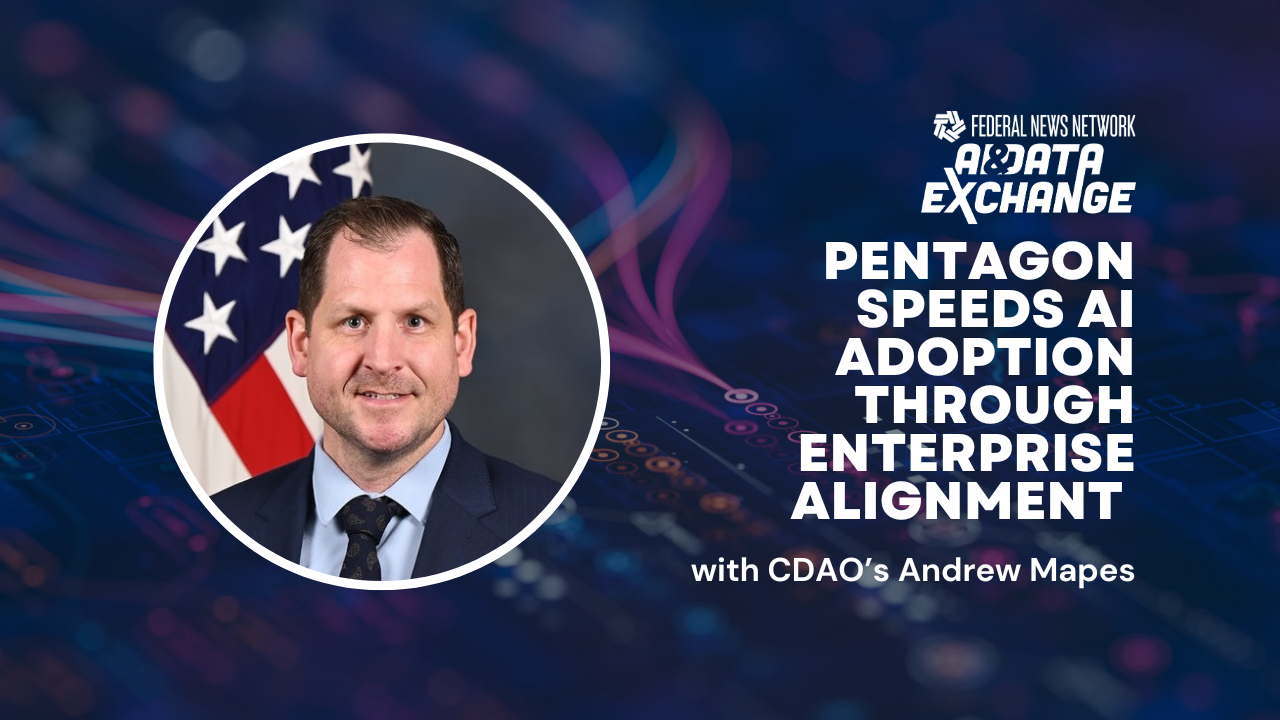
Since the Pentagon merged its Chief Digital and Artificial Intelligence Office (CDAO) into the Office of the Under Secretary for Research and Engineering last year, the unit has been going through a period of change. Before this shift, CDAO reported straight to the deputy secretary of Defense, and some experts feared the reorganization might push AI initiatives to the sidelines or diminish their visibility within the department.
However, Andrew Mapes, the acting principal deputy chief digital and AI officer, says the opposite is happening: the restructuring is actually helping CDAO move faster to deliver AI capabilities across the entire department at scale.
“With the ongoing consolidation of the innovation ecosystem under the chief technology officer, I believe we’ve had a tremendous opportunity to keep accelerating our progress. Being aligned under the Chief Technology Office has allowed us to concentrate much more sharply on delivering real capabilities and collaborating with stakeholders to pinpoint the department’s enterprise-level needs,” Mapes explained during Federal News Network’s AI & Data Exchange 2026.
“Simple changes like no longer needing to run a separate enterprise business office just for our own team, and instead staying laser-focused on getting capabilities into the hands of warfighters — that’s, in my view, one of the most significant improvements we’ve seen since joining the CTO. I understand there were worries about AI being pushed lower in the hierarchy. But if anything, it’s raised AI’s profile and given us the freedom to act much more swiftly in carrying out the AI strategy.”
Aiming to cut down on redundant technology efforts
Last year, Under Secretary for Research and Engineering Emil Michael brought together several innovation-focused organizations — including the Defense Innovation Unit — contending that the Pentagon’s innovation landscape had grown disjointed, with duplicated roles and ambiguous lines of authority. Michael also trimmed the Pentagon’s roster of “critical technology areas” from 14 down to six: AI, contested logistics, quantum, hypersonics, biomanufacturing, and directed energy.
Mapes noted that putting applied AI front and center — combined with CDAO’s placement under Michael’s office — sends “strong signals to the department” that the technology is now an unmistakable priority in ways “we may not have experienced under our previous structure.”
This shift has sharpened the CDAO team’s focus on implementing Defense Secretary Pete Hegseth’s AI strategy as well as the national AI action plan, Mapes added.
‘Pace-setting projects’
The AI strategy, unveiled in January, assigned CDAO the lead on seven “pace-setting projects.” The office has already launched one of these initiatives: GenAI.mil, a platform built to provide generative AI tools to department personnel.
While the initial release featured Google’s Gemini model — suitable for sensitive but unclassified data — the department intends to roll out additional models accessible at all classification levels. Mapes said these new models are expected to go live in the coming months.
Other projects include Swarm Forge, which centers on human-machine collaboration; Agent Network, designed to integrate AI agents into command-and-control systems such as the Maven Smart System; and Ender’s Foundry, aimed at speeding up AI-powered simulation and testing.
CDAO recently released a solicitation calling on technology companies to submit proposals for the Swarm Forge project.
“We’ll keep seeing opportunities — whether in autonomy, AI capabilities, or various other areas — that will be ideal for performers who may not have traditionally worked together within the Pentagon. I think it’s a truly exciting time to be collaborating not just with CDAO, but across the entire department. We’re going to need a wide range of players to help us tackle some complex and cutting-edge challenges,” Mapes said.
On the intelligence front, programs like Open Arsenal will accelerate the conversion of intelligence into operational capabilities, and Project Grant will “transform deterrence from static postures and guesswork into dynamic pressure with clear, interpretable outcomes,” he said.
On the business operations side, the Enterprise Agents project will concentrate on developing and deploying AI agents for enterprise workflows.
Ensuring high-quality datasets
“None of the AI capabilities we’re rolling out today will succeed unless we get our own data house in order. That’s something we’ll continue to emphasize — the foundational principles of data management and making sure the War Data Platform can support the AI capabilities the department keeps bringing online. Looking ahead, and in partnership with other stakeholders across the department, we also need to ensure the AI infrastructure is in place to handle the growth and expansion that’s projected for the future,” Mapes said.
CDAO’s Advana — the department’s largest data platform for advanced analytics, originally built to serve the comptroller’s office — has expanded dramatically over the years. It essentially became a “victim of its own success,” leading the department to restructure Advana — now called the War Data Platform — into three separate program components.
“Advana historically served many purposes, supported numerous users, and hosted a wide array of tools and applications that may not have truly addressed enterprise-wide needs. That’s not to say they lacked value or utility for individual users, but we want to make sure we’re focused and disciplined about delivering solutions that are genuinely scaled and benefit the entire enterprise,” Mapes said. “For us to fully realize the impact we believe CDAO should have, it really comes down to modernizing the data layer.”
Find more articles and videos now on the AI & Data Exchange event page.
Copyright
© 2026 Federal News Network. All rights reserved. This website is not intended for users located within the European Economic Area.
