



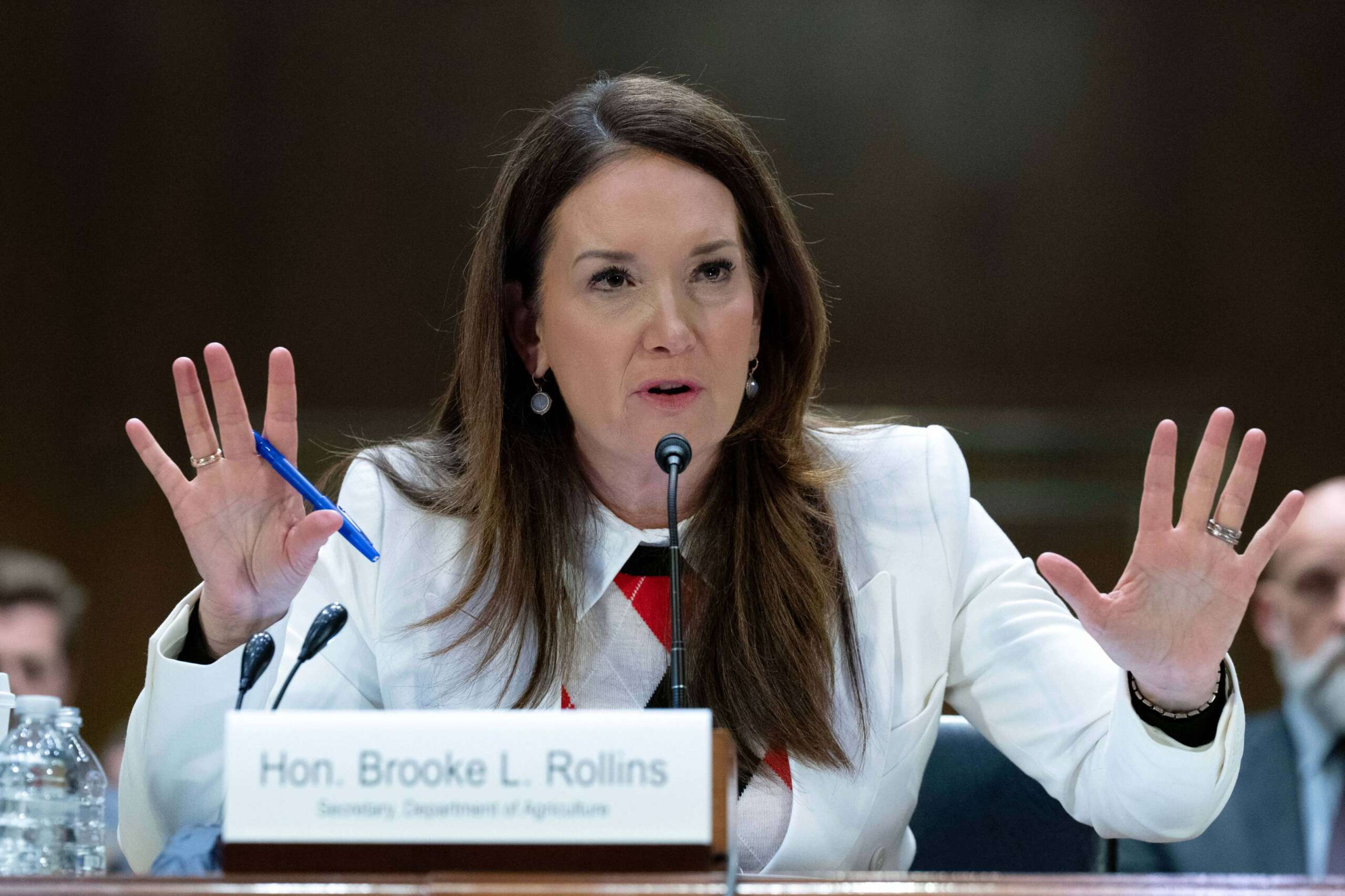
Staff members at the Department of Agriculture have filed a lawsuit against Agriculture Secretary Brooke Rollins regarding a series of emails she distributed to employees. They contend that the messages, which they describe as “increasingly proselytizing,” overstepped legal boundaries and infringed upon First Amendment protections.
The legal action, submitted to the U.S. District Court for the Northern District of California, was prompted by an Easter email Rollins sent to USDA personnel in April. The plaintiffs characterized the message as “unconstitutionally coercive,” arguing it attempted “to impose her brand of Christianity on the agency’s 100,000 employees.”
“We work for the federal government, not a church. I just want to go to work and make my country better — I shouldn’t have to endure sermons and other religious messages forced upon me by the head of a federal agency,” said Ethan Roberts, a physical science technician at USDA and one of the plaintiffs. “When the secretary sends an email, I have to read it. And when those emails are telling me what to believe, they make me feel unwelcome in an agency I’ve dedicated 10 years to.”
The lawsuit aims to prevent Rollins from sending any further religious communications, labeling them a “clear violation” of the First Amendment and the Administrative Procedure Act.
“The denominational favoritism conveyed in Secretary Rollins’ communications indoctrinates USDA employees and has caused them to feel coerced, unwelcome, excluded and like outsiders to the agency,” plaintiffs wrote. “Crucially, Secretary Rollins has sent no messages even acknowledging — let alone celebrating or sermonizing — other religions’ holidays.”
When asked by Federal News Network for a response to the lawsuit, a USDA spokesperson stated, “while we do not comment on pending litigation, we will keep the plaintiffs in our prayers during this process.”
Plaintiffs noted that Rollins’ religious messaging has grown more intense over time, whereas her earlier communications seemed non-denominational. For example, on July 4, 2025, the secretary sent an email marking Independence Day that included the line, “May God continue to protect the United States of America and may His favor shine over all her land.” Similarly, in a Thanksgiving message, Rollins referenced “gratitude towards a loving God” when discussing the first Thanksgiving.
However, Rollins’ subsequent emails displayed an “escalating pattern,” according to the plaintiffs. In a Christmas email, for instance, Rollins wrote, “God gave us the greatest gift possible, the gift of his Son and our Savior Jesus Christ, who came to free us from our sins and open the door to eternal life.”
In her April 5 Easter message, which has been made public, Rollins declared, “Today we celebrate the greatest story ever told, the foundation of our faith and the abiding hope of all mankind.”
Plaintiffs argued that the secretary’s use of words like “our” and “we” implies the existence of an “in-group” religion at USDA, and that those who do not share Rollins’ beliefs might face “negative consequences.”
The Easter email created pressure on USDA staff, leading them to feel “intimidated from expressing their own beliefs at work and compelled to shape their behavior accordingly and hide their own beliefs,” the lawsuit stated.
Some employees expressed concern that they could be targeted or face retaliation if they do not align with the secretary’s personal religious views. Jennifer Wolfe, another plaintiff, reported feeling pressured “to pretend that she is Christian if she wants to advance in her career at USDA.”
Another plaintiff, Lanette Dietrich, requested to be removed from the USDA email distribution list because of the religious content but was informed her request was “not possible,” and that escalating the matter to a higher USDA office would “create trouble” for her.
Rollins’ messages also conflict with USDA’s own policies on religious expression in the workplace, the lawsuit noted. In November 2025, the department released a memo affirming employees’ rights to express their religion at work. The guidance specifies that USDA officials “cannot use official authority to pressure subordinates” and that employees engaging in religious discussions “must stop if a colleague asks you to stop.”
The lawsuit is brought by USDA employees and the National Federation of Federal Employees, a union representing more than 19,000 USDA workers, with legal representation from Americans United for Separation of Church and State, Democracy Forward, and Bryan Schwartz Law.
Rachel Laser, president and CEO of Americans United, described Rollins’ messaging as “a particularly egregious example” of a broader pattern among Trump administration officials.
“It’s only the tip of the iceberg,” Laser said. “Across the federal government, this administration has misused taxpayer resources to preach, hold government-sponsored prayer services during work time and broadcast Christian Nationalism on official social media channels.”
The Trump administration has implemented additional measures to promote religious expression in federal workplaces. In February 2025, President Donald Trump signed an executive order creating a task force charged with reviewing agency activities to identify and eliminate any “anti-Christian policies, practices or conduct.”
Agencies such as the Department of Veterans Affairs have formed internal teams to investigate claims of “anti-Christian bias” in the workplace. The Office of Personnel Management has also encouraged agencies to provide telework accommodations for federal employees for religious reasons.
In July 2025, OPM issued guidance reaffirming that federal employees must be permitted to express their religion at work, provided it does not disrupt business operations. The guidance further clarified that federal employees may attempt to persuade colleagues of “the correctness of their own religious views,” as long as it does not constitute harassment.
Some federal employment lawyers have pointed out that because agency leaders in supervisory positions wield greater authority and influence, religious expression from management may exert pressure on employees and expose agencies to legal challenges.
“The government is not permitted to force religion on people in this country,” said Skye Perryman, president and CEO of Democracy Forward. “It is antithetical to core national principles and a direct assault on our democracy.”
USDA is also carrying out a multi-phase plan to move employees from its component agencies outside the Washington, D.C., area, closer to “the farmers, ranchers and rural communities who benefit from it.” However, federal unions representing the affected USDA employees caution that the relocations will cause major disruptions.
If you would like to contact this reporter about recent changes in the federal government, please email drew.friedman@federalnewsnetwork.com or reach out on Signal at drewfriedman.11
Copyright
© 2026 Federal News Network. All rights reserved. This website is not intended for users located within the European Economic Area.
