



Within the growth of autonomous brokers, the technical bottleneck is shifting from mannequin reasoning to the execution atmosphere. Whereas Massive Language Fashions (LLMs) can generate code and multi-step plans, offering a practical and remoted atmosphere for that code to run stays a major infrastructure problem.
Agent-Infra’s Sandbox, an open-source venture, addresses this by offering an ‘All-in-One’ (AIO) execution layer. Not like normal containerization, which frequently requires guide configuration for tool-chaining, the AIO Sandbox integrates a browser, a shell, and a file system right into a single atmosphere designed for AI brokers.
The All-in-One Structure
The first architectural hurdle in agent growth is software fragmentation. Sometimes, an agent would possibly want a browser to fetch information, a Python interpreter to investigate it, and a filesystem to retailer the outcomes. Managing these as separate companies introduces latency and synchronization complexity.
Agent-Infra consolidates these necessities right into a single containerized atmosphere. The sandbox consists of:
- Pc Interplay: A Chromium browser controllable through the Chrome DevTools Protocol (CDP), with documented help for Playwright.
- Code Execution: Pre-configured runtimes for Python and Node.js.
- Customary Tooling: A bash terminal and a file system accessible throughout modules.
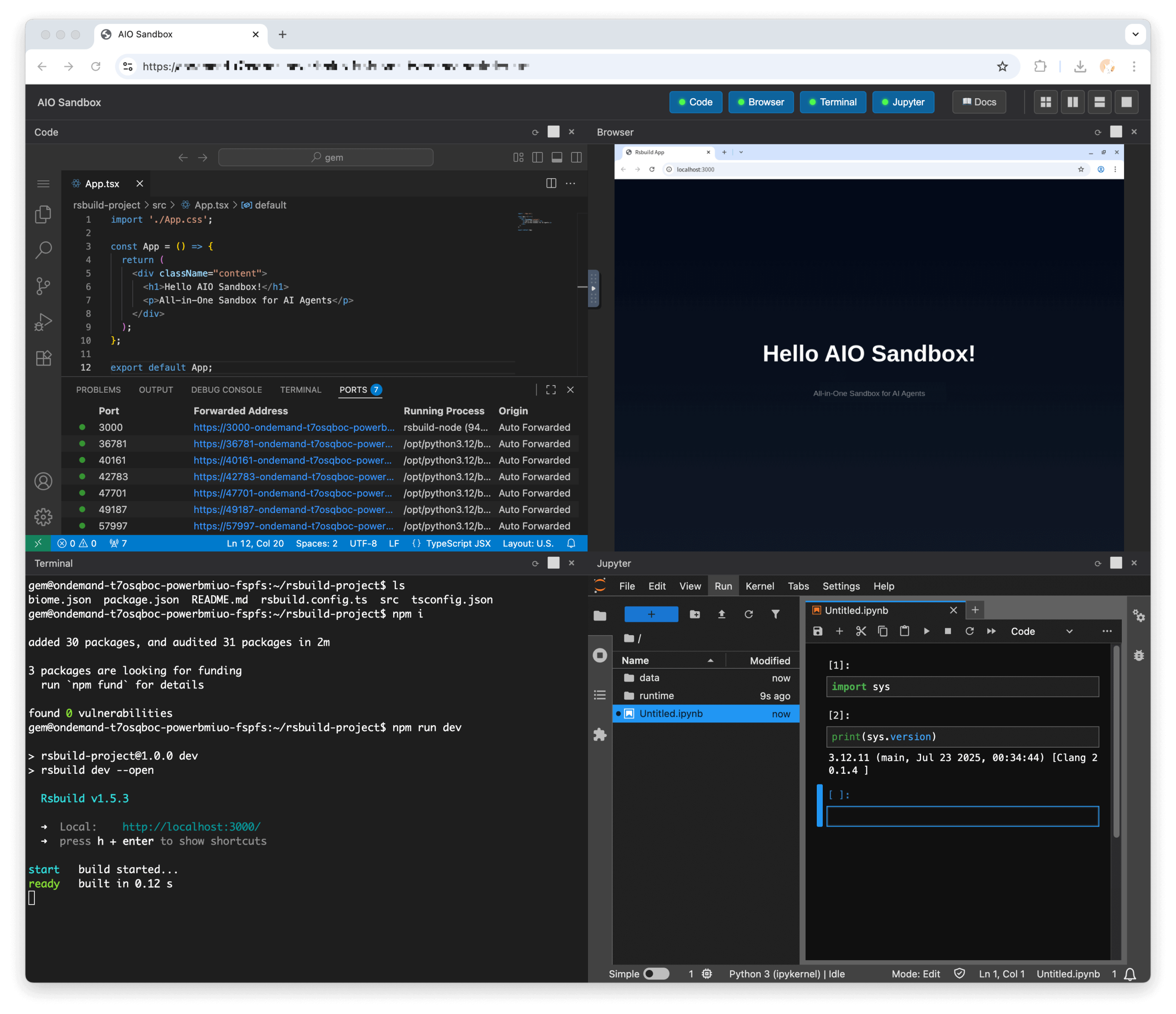
- Improvement Interfaces: Built-in VSCode Server and Jupyter Pocket book situations for monitoring and debugging.
The Unified File System
A core technical characteristic of the Sandbox is its Unified File System. In a typical agentic workflow, an agent would possibly obtain a file utilizing a browser-based software. In a fragmented setup, that file have to be programmatically moved to a separate atmosphere for processing.
The AIO Sandbox makes use of a shared storage layer. This implies a file downloaded through the Chromium browser is straight away seen to the Python interpreter and the Bash shell. This shared state permits for transitions between duties—comparable to an agent downloading a CSV from an online portal and instantly operating a knowledge cleansing script in Python—with out exterior information dealing with.
Mannequin Context Protocol (MCP) Integration
The Sandbox consists of native help for the Mannequin Context Protocol (MCP), an open normal that facilitates communication between AI fashions and instruments. By offering pre-configured MCP servers, Agent-Infra permits builders to reveal sandbox capabilities to LLMs through a standardized protocol.
The accessible MCP servers embody:
- Browser: For net navigation and information extraction.
- File: For operations on the unified filesystem.
- Shell: For executing system instructions.
- Markitdown: For changing doc codecs into Markdown to optimize them for LLM consumption.
Isolation and Deployment
The Sandbox is designed for ‘enterprise-grade Docker deployment,’ specializing in isolation and scalability. Whereas it offers a persistent atmosphere for advanced duties—comparable to sustaining a terminal session over a number of turns—it’s constructed to be light-weight sufficient for high-density deployment.
Deployment and Management:
- Infrastructure: The venture consists of Kubernetes (K8s) deployment examples, permitting groups to leverage K8s-native options like useful resource limits (CPU and reminiscence) to handle the sandbox’s footprint.
- Container Isolation: By operating agent actions inside a devoted container, the sandbox offers a layer of separation between the agent’s generated code and the host system.
- Entry: The atmosphere is managed via an API and SDK, permitting builders to programmatically set off instructions, execute code, and handle the atmosphere state.
Technical Comparability: Conventional Docker vs. AIO Sandbox
| Function | Conventional Docker Method | AIO Sandbox Method (Agent-Infra) |
| Structure | Sometimes multi-container (one for browser, one for code, one for shell). | Unified Container: Browser, Shell, Python, and IDEs (VSCode/Jupyter) in a single runtime. |
| Information Dealing with | Requires quantity mounts or guide API “plumbing” to maneuver recordsdata between containers. | Unified File System: Information are natively shared. Browser downloads are immediately seen to the shell/Python. |
| Agent Integration | Requires customized “glue code” to map LLM actions to container instructions. | Native MCP Assist: Pre-configured Mannequin Context Protocol servers for normal agent discovery. |
| Consumer Interface | CLI-based; Net-UIs like VSCode or VNC require important guide setup. | Constructed-in Visuals: Built-in VNC (for Chromium), VSCode Server, and Jupyter prepared out-of-the-box. |
| Useful resource Management | Managed through normal Docker/K8s cgroups and useful resource limits. | Depends on underlying orchestrator (K8s/Docker) for useful resource throttling and limits. |
| Connectivity | Customary Docker bridge/host networking; guide proxy setup wanted. | CDP-based Browser Management: Specialised browser interplay through Chrome DevTools Protocol. |
| Persistence | Containers are usually long-lived or reset manually; state administration is customized. | Stateful Session Assist: Helps persistent terminals and workspace state through the activity lifecycle. |
Scaling the Agent Stack
Whereas the core Sandbox is open-source (Apache-2.0), the platform is positioned as a scalable answer for groups constructing advanced agentic workflows. By lowering the ‘Agent Ops’ overhead—the work required to keep up execution environments and deal with dependency conflicts—the sandbox permits builders to give attention to the agent’s logic slightly than the underlying runtime.
As AI brokers transition from easy chatbots to operators able to interacting with the online and native recordsdata, the execution atmosphere turns into a vital element of the stack. Agent-Infra group is positioning the AIO Sandbox as a standardized, light-weight runtime for this transition.
Try the Repo right here. Additionally, be happy to observe us on Twitter and don’t overlook to affix our 120k+ ML SubReddit and Subscribe to our E-newsletter. Wait! are you on telegram? now you possibly can be part of us on telegram as properly.

Michal Sutter is a knowledge science skilled with a Grasp of Science in Information Science from the College of Padova. With a stable basis in statistical evaluation, machine studying, and information engineering, Michal excels at remodeling advanced datasets into actionable insights.
