



# The Future of AI Hardware Manufacturing: How Modular Automation Is Changing the Game
## The Challenge Behind the Boom
Artificial intelligence is reshaping nearly every industry, but the hardware that powers it — servers, networking equipment, storage systems — has struggled to keep up with demand. Most manufacturing lines for this equipment rely on rigid, manual processes that are slow, expensive, and extremely difficult to scale. As AI adoption accelerates, these limitations have become a major bottleneck.
## A New Approach to Building AI Infrastructure
A growing number of companies are tackling this problem by rethinking how hardware is designed and assembled from the ground up. Rather than building fixed, dedicated production lines for a single product, they are creating flexible manufacturing platforms that can adapt to different products, configurations, and volumes with minimal rework.
These next-generation systems rely on a modular architecture where individual automation cells work together as part of a larger, coordinated production floor. Each cell can operate independently but is designed to communicate seamlessly with every other cell, allowing manufacturers to start small and expand capacity as demand grows.
## Software-Driven Manufacturing
What makes these modern assembly systems truly different is the role software plays in controlling them. Instead of relying on closed, proprietary hardware setups, today’s platforms use open, programmable environments that give engineers the ability to write, test, and update production logic using familiar development tools.
This means that when a new product version arrives or a design change is needed, updates can often be made through software — without physically rewiring machines or replacing hardware. The result is faster production cycles, lower costs, and the ability to respond to market shifts in days rather than months.
## Precision at Speed
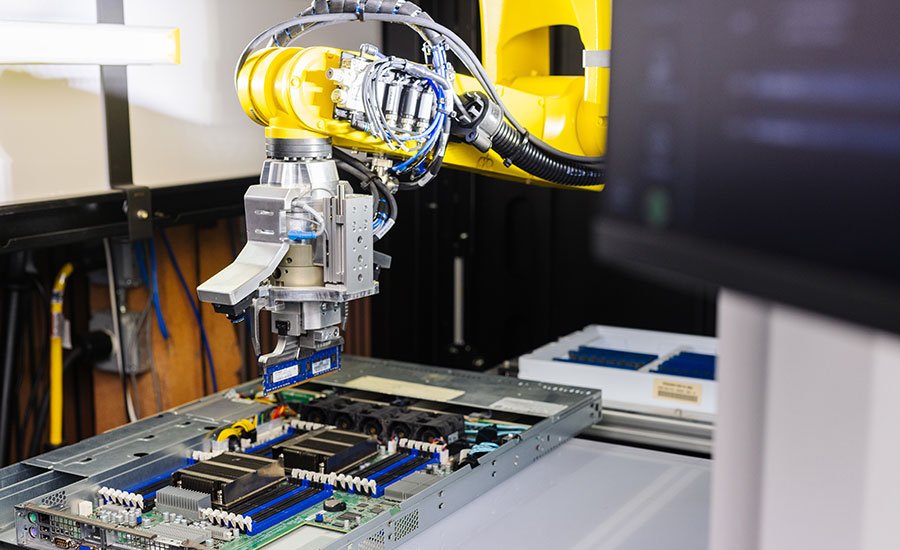
Building data center hardware requires extreme precision. Components like circuit boards, memory modules, and cooling units must be placed and connected with tolerances measured in fractions of a millimeter. Modern automated assembly systems use advanced robotics guided by computer vision and real-time motion control to achieve this level of accuracy — consistently and at high speed.
Machine learning-based inspection tools further enhance quality by detecting defects that human eyes might miss. These systems can learn from thousands of assembly examples, continuously improving their ability to identify issues and flag them for correction before they move downstream.
## Built for Traceability and Quality
In industries where hardware reliability is critical, traceability matters enormously. Every step of the assembly process — from component placement to final inspection — can be tracked digitally, creating a complete record of how each unit was built. This level of transparency helps manufacturers maintain consistent quality, troubleshoot problems quickly, and meet the strict compliance requirements of the technology sector.
## Supporting Domestic Manufacturing Growth
As countries around the world seek to bring advanced manufacturing closer to home, flexible automation platforms are playing an important role. By reducing the complexity and cost of retooling production lines, these systems make it more feasible to build high-tech hardware domestically, creating jobs and shortening supply chains.
—
## Frequently Asked Questions (FAQ)
**Q: What is modular automation in manufacturing?**
A: Modular automation refers to production systems built from independent, interchangeable cells that can be added, removed, or reconfigured as needed. Each cell handles a specific task, but they all communicate with each other to form a complete assembly line. This approach allows manufacturers to scale production up or down and adapt to new products with minimal downtime.
**Q: Why is software so important in modern assembly systems?**
A: Software-defined manufacturing allows engineers to control, monitor, and reconfigure production processes digitally. Instead of making physical changes to hardware every time a product design changes, updates can be pushed through software. This dramatically reduces setup time, lowers costs, and increases the agility of the entire manufacturing operation.
**Q: What kinds of products benefit most from this approach?**
A: Products with high complexity, tight tolerances, and rapidly evolving designs — such as AI servers, networking equipment, and data storage systems — benefit the most. These products demand precision and flexibility that traditional, rigid manufacturing lines simply cannot provide.
**Q: How does real-time communication improve assembly quality?**
A: Real-time communication between controllers, robots, and sensors ensures that every motion, measurement, and decision happens at the exact right moment. This eliminates delays, reduces errors, and enables synchronized operation across multiple automation cells, resulting in higher quality and faster throughput.
**Q: Can modular systems handle small production runs?**
A: Yes, one of the key advantages of modular automation is its flexibility. Because each cell is independent and the system is software-controlled, it is well-suited for both high-volume production and low-volume, high-mix manufacturing where product configurations change frequently.
**Q: How does this approach support quality control?**
A: By integrating machine vision, sensor data collection, and digital traceability at every station, manufacturers can monitor quality in real time. Defects are caught early, and every unit’s production history is recorded, making it easy to identify and resolve issues quickly.
—
## Conclusion
The demand for AI and data center hardware is only going to increase in the years ahead. Meeting that demand requires manufacturing systems that are fast, precise, scalable, and adaptable. Modular, software-driven automation represents a significant step forward in making that possible. By moving away from rigid, manual production lines and embracing flexible, intelligent assembly platforms, manufacturers can keep pace with a rapidly evolving industry while maintaining the quality and traceability that modern technology demands.
The shift toward open, programmable control environments is empowering a new generation of engineers and developers to build smarter factories — ones that can grow, change, and improve alongside the products they create.
Thank you for reading
