



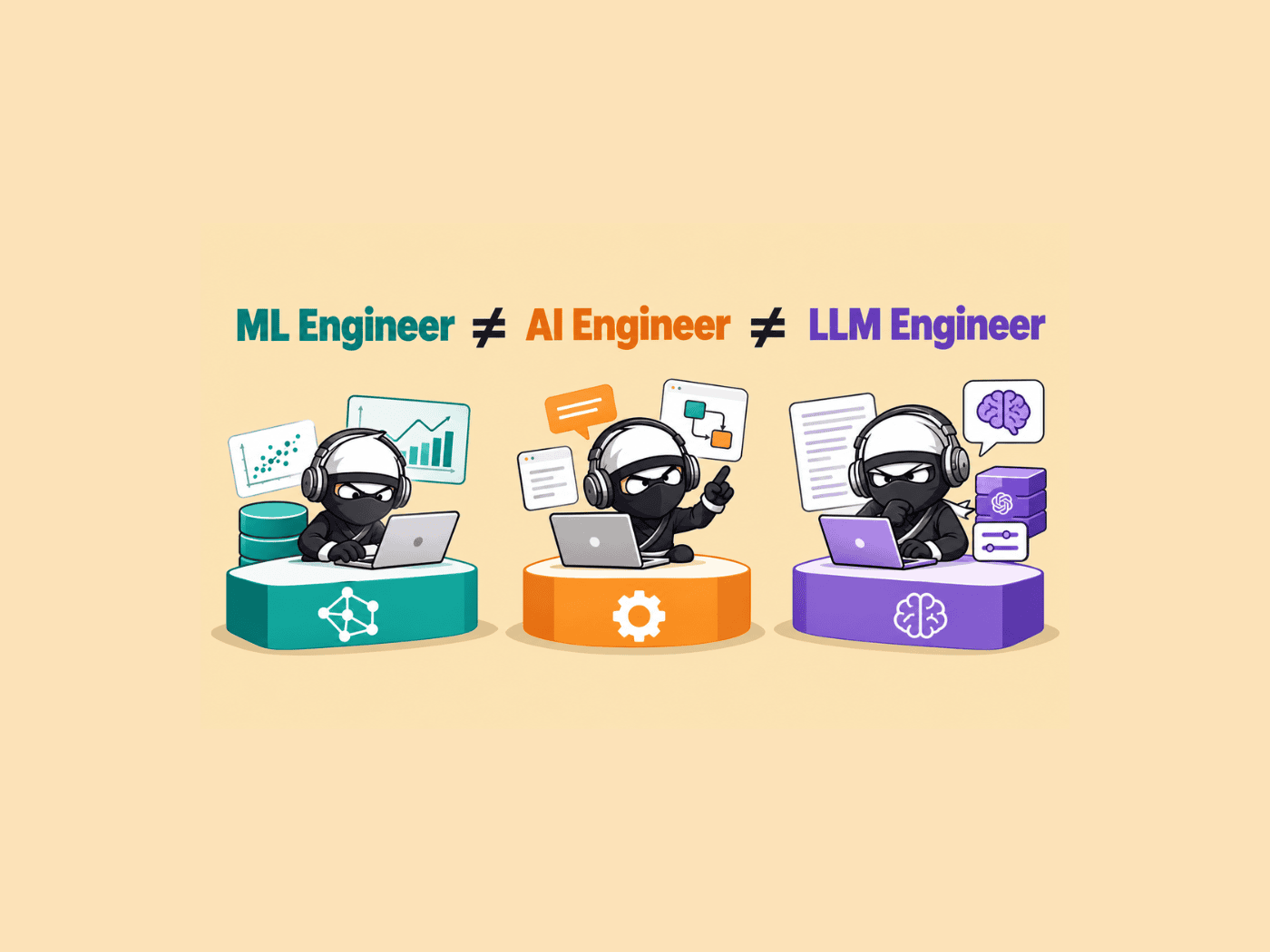
# Understanding the Landscape: ML Engineer, AI Engineer, and LLM Engineer in Today’s Job Market
## The Title Tangle: Why Job Postings Have Become Nearly Unreadable
Imagine opening a single job board and searching for positions in artificial intelligence. You’ll likely encounter titles like Machine Learning Engineer, AI Engineer, Applied AI Engineer, LLM Engineer, and perhaps even Generative AI Engineer — all listed within the same page of results. At first glance, the responsibilities seem interchangeable: Python proficiency, experience with an API for a language model, some reference to retrieval-augmented generation, and a brief note about keeping systems reliable in a live environment.
But when you dig deeper into the actual requirements listed in the description, the differences become striking. One role expects hands-on experience with LangChain or LangGraph. Another specifically asks for fine-tuning expertise using techniques like LoRA or QLoRA. A third emphasizes the ability to call a pre-trained model’s API and write rigorous evaluation scripts. The title is the same; the actual day-to-day work is worlds apart.
This disconnect matters because professionals often build their career strategies around the title printed at the top of a job posting rather than the substance buried beneath it. A person excited about “AI Engineer” roles because of the headline growth might unknowingly step into a position dominated by data pipeline maintenance and prompt rewriting. Conversely, someone assuming that a Machine Learning Engineer role revolves entirely around building neural networks from scratch may find themselves spending most of their time cleaning datasets and designing feature pipelines instead.
Understanding what each role genuinely delivers — the systems they build, the ownership they carry, and the problems they solve — is the best way to make an informed career choice in this rapidly shifting field.
—
## What Each Role Actually Delivers
### The Machine Learning Engineer: From Raw Data to Reliable Production Systems
At its foundation, the Machine Learning Engineer is responsible for taking a validated analytical approach and transforming it into a system that operates dependably in a live environment, handling new data continuously without degrading in quality.
The daily workflow typically follows a consistent pattern: gathering raw data from various sources, cleaning and structuring it, selecting an appropriate algorithm, training the model, validating its performance against established metrics such as mean squared error or accuracy scores, deploying it to a production environment, and then continuously monitoring its output as fresh data flows in over time.
The technology stack is heavily rooted in traditional machine learning infrastructure. Engineers in this space work with Python as the primary language, paired with frameworks like PyTorch or TensorFlow for deep learning tasks, and scikit-learn for more classical approaches. Platforms like Amazon SageMaker and Databricks are common for managing the full lifecycle of model training and deployment, including feature stores that serve consistent inputs to models at scale.
A defining characteristic of this role is where the bulk of effort goes. The lion’s share of time is spent on data — its quality, its structure, and its relevance — rather than on selecting or tweaking algorithms. A poorly defined feature window, duplicated labels, or insufficiently cleaned input data will cause a model to fail long before the choice of algorithm becomes the limiting factor. This makes the role a hybrid of applied data science and software engineering, with a strong emphasis on building systems that are durable and scalable.
### The AI Engineer: Bridging Pre-Trained Models and Real-World Products
The AI Engineer occupies a different position in the development pipeline. Rather than building or training a model from scratch, this role starts after a large, pre-trained model has already been developed and made available — typically through a cloud-based API from providers like OpenAI, Anthropic, or Google.
The primary responsibility is integration and productization: connecting that existing model to a tangible application that delivers real value to users. This might look like a customer support tool that interprets and resolves tickets, an internal search system that pulls relevant documents from a company’s knowledge base, or an automated agent capable of executing a sequence of steps to complete a complex workflow.
A typical day for an AI Engineer involves several distinct activities. A significant portion goes toward prompt engineering and design, crafting instructions and contexts that elicit the best possible responses from the model. Another substantial block covers retrieval and orchestration — connecting the model to external data sources so it can ground its outputs in factual, up-to-date information. This is often powered by vector databases such as Pinecone, Qdrant, or Weaviate, and orchestrated using frameworks like LangChain, LlamaIndex, or LangGraph.
The role also includes backend engineering tasks such as building APIs, managing databases, and ensuring that the system integrates cleanly with existing software. A smaller but important portion is dedicated to evaluation and monitoring — watching for hallucinations, tracking the quality of outputs over time, and setting up alerting systems that flag when a model’s performance drifts.
It’s worth understanding one of the most common misconceptions about this role: many newcomers expect to spend their days training custom models. In practice, very little model training occurs. The work largely happens after a model has already been trained and validated, focusing instead on making that model serve real users reliably in a production setting rather than performing impressively in a one-off demo.
### The LLM Engineer: A Focused Specialization in Language Model Fine-Tuning
The LLM Engineer is a specialized variant of the AI Engineer, with a narrower scope centered specifically on large language models rather than on AI broadly. While computer vision systems, recommendation engines, and other forms of artificial intelligence fall under the umbrella of “AI,” the LLM Engineer’s domain is exclusively text-based language models.
The defining additional responsibility beyond what an AI Engineer typically handles is fine-tuning: the process of adjusting the internal weights of a pre-trained model using domain-specific data. Techniques like Low-Rank Adaptation (LoRA) and Quantized Low-Rank Adaptation (QLoRA) are central to this work, allowing engineers to customize a general-purpose model’s behavior for a specialized task — such as legal document analysis, medical literature summarization, or code generation for a specific programming language — without the cost and complexity of training from scratch.
However, experienced LLM Engineers often emphasize a counterintuitive principle: the best work involves avoiding fine-tuning whenever possible. Stronger retrieval strategies, longer and better-structured prompts, or simply switching to a different base model frequently resolve the same performance issues at a fraction of the cost and with significantly less ongoing maintenance overhead. The disciplined approach is to exhaust these simpler alternatives first, measure their impact rigorously, and only turn to fine-tuning when all other options have been genuinely ruled out.
This role overlaps heavily with the AI Engineer in day-to-day activities — prompt design, retrieval architecture, evaluation pipelines, backend integration — but adds a deeper layer of technical work around model adaptation and specialization.
—
## The Root of the Confusion: Industry Naming Inconsistencies
The chaos in job titles has a straightforward origin. Machine learning engineering emerged as a distinct discipline when deploying trained models became a full-time responsibility rather than an afterthought attached to data analysis. Then, in a remarkably short span starting around 2022, generative AI introduced an entirely new category of work that the industry has been struggling to name consistently ever since.
Because no standardized naming convention exists, a single job can appear under multiple titles across different companies and platforms: AI Engineer, GenAI Engineer, Applied AI Engineer, Prompt Engineer, RAG Engineer, and others. The variation is not just cosmetic — it can carry real financial implications. Two postings describing nearly identical duties and expectations sometimes feature meaningfully different salary ranges depending solely on which title the hiring team selected, not on the actual scope of the work involved.
Company scale further compounds the problem. At a small startup or early-stage company, a single individual might be responsible for all aspects of the pipeline — training the model, building retrieval systems, and shipping features to end users — under whichever title the company happens to use. At a large enterprise, these responsibilities frequently splinter across multiple specialized teams, potentially including applied AI product engineers, ML engineers focused specifically on model quality and performance, AI research engineers, AI infrastructure engineers, and forward-deployed implementation engineers who build and maintain AI systems inside customer environments. The number of distinct roles grows as the organization scales.
The most practical piece of advice in navigating this landscape is straightforward: read the actual list of responsibilities and requirements before applying to any position. Asking yourself what you would be expected to build during the first ninety days, and what you would own and maintain after that period, reveals far more about the true nature of the role than the job title alone ever could.
—
## Building a Foundation That Works Across All Three Roles
Regardless of which of these titles ends up on an offer letter, the core competencies that interviewers evaluate are remarkably consistent across all three positions. The interview process for machine learning engineers, AI engineers, and LLM engineers alike leans heavily on three foundational areas: proficiency in SQL, the ability to manipulate and shape data effectively, and — perhaps most importantly — the capacity to reason clearly about a problem before committing to any code.
Companies like Meta, Uber, Google, and others evaluate candidates on coding questions rooted in practical scenarios such as building recommendation systems, forecasting time-series data, and processing textual information. These are paired with theoretical questions that probe understanding of model evaluation, the mechanics of data leakage, and the ability to communicate tradeoffs between different technical approaches clearly and persuasively.
The central insight that applies universally is this: the most impactful work in all three roles comes from defining the problem correctly, identifying the right signals to use, and avoiding common data pitfalls — not from memorizing specific algorithms or framework-specific syntax. A strong intuition for data and a clear problem-solving methodology will carry a candidate further than deep expertise in any single tool or library.
—
## Frequently Asked Questions
**What is the biggest misconception about AI Engineers?**
The most widespread misconception is that AI Engineers spend their days training custom machine learning models from scratch. In reality, AI Engineers primarily work with pre-trained models that are accessed through APIs. The bulk of their time goes toward prompt design, retrieval architecture, integration with existing systems, and monitoring output quality — not model training.
**Can an LLM Engineer do the work of an AI Engineer and vice versa?**
In practice, yes, with some adjustment. An LLM Engineer already possesses most of the skills needed for AI Engineering — prompt design, retrieval systems, orchestration frameworks, and evaluation pipelines. The reverse is slightly less seamless, as an AI Engineer without experience in fine-tuning, weight adjustment, and domain-specific model adaptation may need additional training to take on full LLM Engineering responsibilities.
**How much does company size affect what these titles mean?**
Company size has a significant effect. In small organizations, a single engineer may hold responsibilities spanning all three roles under a single title. In larger companies, the responsibilities are distributed across multiple specialized positions, sometimes creating five or more distinct job categories that each map partially to one of these three titles.
**Is SQL really that important for these roles?**
Yes. SQL appears consistently as one of the highest-weighted skills in interview processes for all three roles. Data shaping, querying, and manipulation form the backbone of nearly every machine learning and AI project, and the ability to work with databases efficiently is a universal requirement regardless of the specific title.
**Should I focus on fine-tuning if I want to become an LLM Engineer?**
Familiarity with fine-tuning is valuable, but experienced practitioners emphasize that it should be a last resort rather than a first move. Strong retrieval strategies, prompt engineering, and careful base model selection often solve the same problems more cheaply and with less maintenance burden. An LLM Engineer’s value lies in knowing when fine-tuning is truly warranted versus when a simpler approach will suffice.
**Will these titles eventually stabilize?**
Industry naming conventions typically stabilize over time, but it may take several more years before consistent standards emerge across companies and regions. In the meantime, the most reliable approach is to evaluate each opportunity based on its specific requirements and expected deliverables rather than relying on the title alone.
—
## Conclusion
The artificial intelligence job market is currently defined more by its inconsistencies than by its standardization. A Machine Learning Engineer’s primary deliverable is a trained, deployed model that operates reliably on new data over time. An AI Engineer builds the application layer around a pre-trained model, connecting it to real users through retrieval, orchestration, and prompt engineering. An LLM Engineer narrows that focus further, adding the specialized skill of fine-tuning language model weights for domain-specific performance.
The interview process and the foundational skills required remain largely the same across all three titles: strong SQL ability, clear analytical thinking, and the discipline to define problems correctly before writing any code. Companies rename roles frequently and often faster than they update their evaluation criteria, so encountering an unfamiliar title on a job posting should not be cause for alarm.
The single most reliable step you can take before committing to any role is to read the full list of expected deliverables — the things you would build, own, and sustain over the coming months. That list is the truest job description available, regardless of the two or three words printed at the top of the posting. Treat it as your guide, and you’ll be well-positioned to make a choice that aligns with both your skills and your aspirations.
Thank you for reading.
