



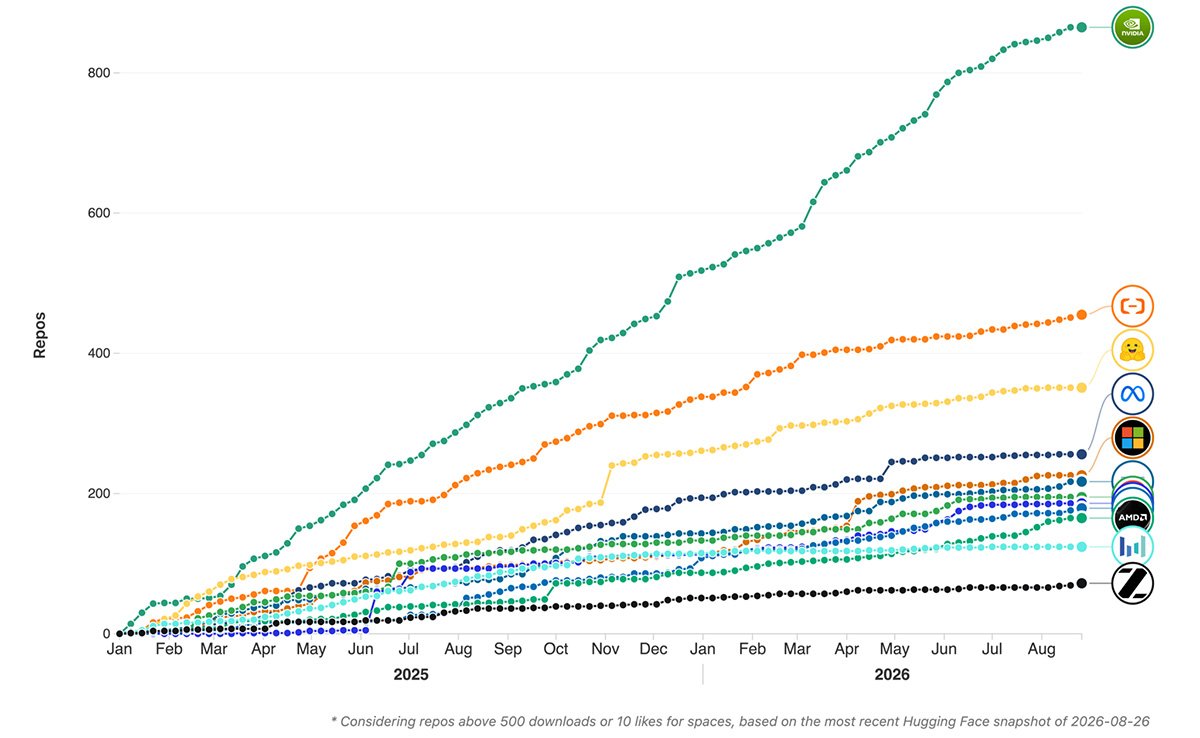
# The AI Platform Play: Why Owning the Model Marketplace May Matter More Than Owning the Chip
### The semiconductor arms race has drawn headlines, but a quieter acquisition reshapes who controls the future of intelligent systems.
—
## The Great Chip Diversification Wave
The past year has seen an unprecedented rush to diversify away from a single silicon vendor. OpenAI partnered with Broadcom to develop Jalapeño, reportedly the fastest tape-out in advanced semiconductor history, targeting shipment by the end of the calendar year. Anthropic assembled a full in-house hardware division, offering compensation packages exceeding $485,000 and pursuing a multi-gigawatt TPU arrangement with Google and Broadcom. Amazon’s Trainium and Meta’s MTIA silicon programs continue expanding, while AMD acquired the AI startup World Labs in an $8.2 billion deal. Qualcomm has entered a collaboration with Liquid AI around embedded autonomous agents, and Skild AI introduced its S1 foundation model as a general-purpose option for real-world tasks. Google DeepMind went further, embedding Gemini Robotics 2 directly into Apptronik’s Apollo 2 humanoid platform.
On the surface, each of these moves looks like a bid for compute independence. The message is consistent: the industry wants alternatives to a single dominant hardware supplier.
But the story may be incomplete.
—
## The Layer Nobody Is Building Beneath
For every major lab pouring capital into custom silicon, roughly 200,000 other organizations lack the capital, expertise, or motivation to design their own processors. Those companies — spanning logistics, manufacturing, healthcare, agriculture, retail, and dozens of other verticals — still need a place to discover, adapt, and deploy AI models. That discovery and deployment layer has long been the most democratized entry point in the entire AI ecosystem.
When one company quietly purchases the platform that dominates that layer, it reframes the entire competitive landscape. The acquisition signals a strategic bet that the real long-term value sits not at the transistor level, but at the interface where every developer, enterprise, and government agency ultimately connects to AI capabilities.
The buyer? A company whose name appears on virtually every GPU datacenter buildout of the past decade. The target? The world’s largest open-source AI model repository and community.
—
## “Sovereign” and What It Actually Means for Physical Systems
The word “sovereign” has become a recurring theme in technology strategy discussions this year. Governments worldwide are pouring public funds into AI infrastructure programs with the explicit goal of reducing dependence on foreign-controlled compute ecosystems. They want national AI capabilities that cannot be severed by a vendor dispute, a geopolitical shift, or a change in licensing terms.
For software and cloud applications, sovereignty remains somewhat abstract — data residency, compliance frameworks, and contractual guarantees handle most of the concern. Physical AI is fundamentally different.
A robot operating on a factory floor cannot tolerate the latency of a remote API call when making a split-second safety decision. It needs inference running locally, sensor streams kept within the operational perimeter, and a deployment stack that remains stable regardless of what happens in distant cloud regions. In robotics, sovereignty is not a procurement preference — it is an engineering necessity.
Yet the same concentration of power that exists in the cloud AI layer threatens to repeat itself at the edge. The company that controls the training frameworks, simulation environments, edge runtime tooling, and model distribution channels is not merely selling hardware. It is defining the architectural defaults for how physical intelligence gets built, deployed, and maintained across every factory, warehouse, hospital, and field site.
—
## Building Above the War, Not Inside It
Some companies are choosing a different path — one that sidesteps the silicon fight entirely by focusing on the application layer. The idea is straightforward: build tools and platforms that are agnostic to whatever hardware happens to run them, and let the expensive hardware competition unfold without taking sides.
One such company launched a sovereign AI platform recently, positioning itself as an agentic operating system designed to let business users deploy and manage AI workflows without needing deep hardware knowledge, a data center footprint, or a dedicated engineering team in residence. The pitch is less about who manufactures the chip and more about whether inference is fast, affordable, and dependable enough for daily operations.
The economic logic is compelling. The companies pouring billions into custom silicon are essentially funding a war that the application-layer providers can observe — and profit from — without ever firing a shot. As long as inference demand continues growing regardless of which silicon architecture wins, the platforms that sit between the models and the end users capture value at every level of the stack.
—
## What This Means for the Next Decade of AI Development
The convergence of model repositories, developer ecosystems, and deployment infrastructure has historically been fragmented. Multiple platforms, competing standards, and hardware-specific optimization requirements made the developer journey complex and vendor-dependent. An acquisition that consolidates the model discovery and community layer creates a new kind of gatekeeper — one that sits upstream of every chip vendor and downstream of every end-user application.
For physical AI specifically, this consolidation raises important questions about interoperability, portability, and long-term vendor lock-in. A robot’s intelligence should, ideally, be portable across compute environments — from a NVIDIA GPU in a factory rack to a Qualcomm-accelerated edge module to a custom ASIC running local inference. The less the software stack assumes about the hardware beneath it, the more resilient the deployment becomes.
The broader trend suggests that the AI industry’s power centers are shifting — not from one chipmaker to another, but from hardware-centric ecosystems toward platforms that orchestrate intelligence across whatever substrate happens to be available.
—
## Frequently Asked Questions
**Q: Why is the acquisition of a model repository considered strategically significant compared to chip development?**
A: Custom silicon addresses a narrow slice of the AI value chain — compute execution for specific workloads. A model repository touches every stage of the development lifecycle: discovery, fine-tuning, benchmarking, deployment, and community collaboration. By controlling the repository, a company positions itself as the universal on-ramp for AI development regardless of which hardware runs the models. Chip designs serve specific buyers; repositories serve virtually everyone.
**Q: What does “sovereign AI” mean in the context of robotics?**
A: In robotics, sovereignty refers to the ability of a machine to operate independently of external cloud dependencies for its core inference and decision-making functions. Because robots often work in environments where network latency, connectivity interruptions, or data-exfiltration restrictions make cloud reliance impractical, sovereignty at the edge becomes a hard requirement for safety, responsiveness, and data privacy.
**Q: Are custom chips from OpenAI, Anthropic, and others a threat to the dominant hardware supplier?**
A: Custom silicon represents a real engineering achievement and a meaningful cost optimization for the organizations building it. However, these chips are currently designed for narrow, internal-use workloads. They have not yet demonstrated the breadth of software ecosystem support, developer community size, or deployment volume that established platforms offer. The threat is real in the long term but has not yet materialized at scale for the broader market.
**Q: How does the application-layer strategy differ from the hardware strategy?**
A: Hardware strategy involves massive capital expenditure, years-long development cycles, and deep specialization in silicon design and manufacturing. Application-layer strategy focuses on software, tooling, and platform services that run atop any available hardware. The application layer can adapt to hardware shifts relatively quickly, whereas chip designs are locked in for years. The application layer also serves a vastly larger addressable market.
**Q: What should companies deploying physical AI look for in a platform partner?**
A: Key considerations include hardware-agnostic inference capabilities, robust edge deployment tooling, local data processing to ensure sovereignty and privacy, real-time performance guarantees, and a model ecosystem that supports transfer learning and fine-tuning for domain-specific tasks. Vendors should be evaluated on their ability to keep the software stack portable as hardware choices evolve.
**Q: Is this consolidation of the model marketplace a concern for open-source AI?**
A: Concentration of the primary open-source AI repository under a single commercial entity raises legitimate questions about governance, neutrality, and long-term access. Supporters argue that the acquirer has historically supported open-source communities and that the platform’s scale benefits developers. Critics caution that commercial incentives may gradually shift the platform’s priorities away from community-driven development. The outcome will depend on how the acquired organization is integrated and governed going forward.
—
## Conclusion
The race to build custom AI chips has captured the technology industry’s attention and capital, but the deeper strategic maneuver may already be complete. The company most positioned to influence how AI models are found, selected, adapted, and deployed across every sector — including robotics and physical automation — made a calculated investment in the connective tissue of the entire ecosystem.
Whether that investment proves transformative or merely defensive will depend on how the model marketplace evolves, how open-source communities respond, and whether application-layer platforms can maintain true hardware neutrality as the industry matures. One thing is clear: the future of intelligent systems will be shaped as much by who controls the platforms developers use as by who manufactures the silicon they run on.
The organizations that build products and deploy AI at scale would be wise to watch not just the chip headline, but the quieter consolidation happening in the layers where intelligence is actually discovered, shared, and put to work.
Thank you for reading
