



**A New Paradigm in Industrial Automation: Purpose-Built Robotics Takes Center Stage**
A Santa Clara-based robotics startup founded in 2024 is rapidly reshaping the industrial automation landscape. Having secured $100 million in funding and developed four distinct iterations of its mobile manipulator, the company has transitioned from early pilot programs to active production contracts in record time. Its current fleet of robots is already operational for 16 hours a day, five days a week, achieving up to 99% uptime.
The urgency behind this push is rooted in a deepening labor crisis. The United States currently faces over half a million unfilled manufacturing positions, a number that market analysts expect to swell into the millions over the coming years. While the demand for industrial output continues to rise, the available workforce continues to shrink.
Addressing this challenge requires a fundamentally different approach. The founders observed that much of the current humanoid robotics sector focuses on the human form factor—legs and all—and attempts to retrofit that design to solve a specific problem. Instead, this startup chose to start from the bottom up, focusing entirely on the specific tasks required on the factory floor, including the dust, dirt, and grease that come with the territory.
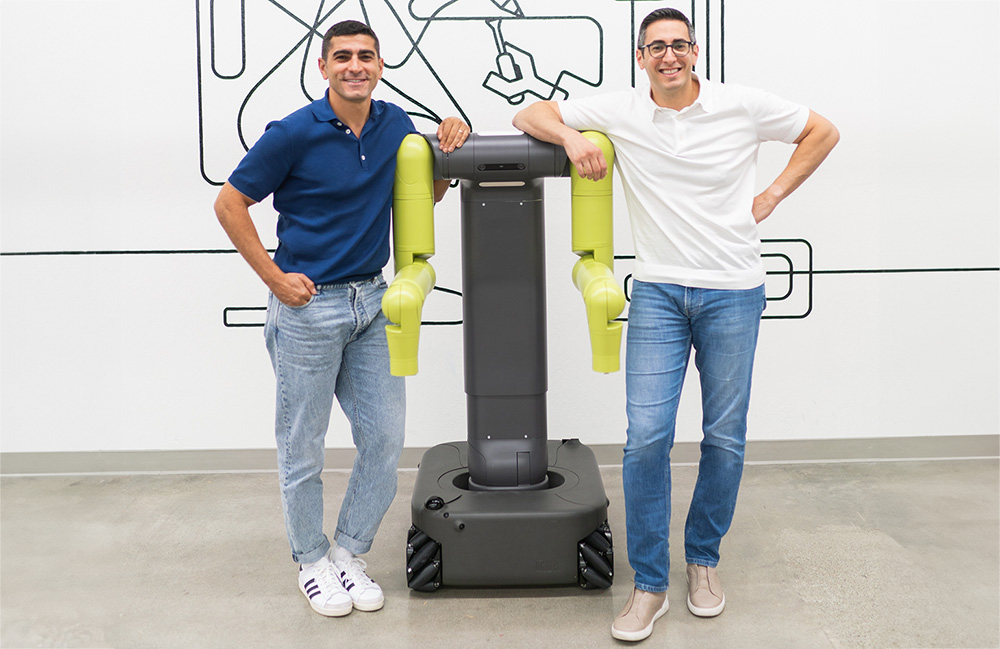
This “jobs to be done” philosophy resulted in a wheeled mobile manipulator designed with a remarkably small footprint, allowing it to navigate through standard doors and tight spaces. Despite its compact base, the robot boasts a large dynamic reach, capable of accessing the back of a four-foot pallet or reaching deep into shelving up to three meters high. It can handle payloads of up to 30 kilograms, making it highly versatile for a range of industrial applications.
The system extends beyond the physical robot. It integrates seamlessly with customers’ existing infrastructure and relies on a proprietary global network that functions as a fabric of shared learning. This means that if a robot encounters a specific error or learns a novel solution at a facility in California, a robot operating in Japan can leverage that knowledge the very next day.
Rather than developing technology in isolation, the company immersed itself with early partners directly on the factory floor and in warehouses. By watching operators perform their work and identifying friction points, the team zeroed in on two initial workflows: mixed-case palletizing and tote handling. This hands-on, iterative approach established a data flywheel. As robots deploy and master specific tasks, they collect invaluable real-world data that trains more generalized models, compounding intelligence over time and building customer trust.
To handle the variety of tasks required in industrial settings, the robots are equipped with a modular end-of-arm interface. The team initially experimented with off-the-shelf grippers but found they did not perform well enough. They eventually landed on a custom-designed, highly capable miniaturized vacuum suction gripper, alongside a parallel gripper with two fingers. Interestingly, the design team realized that the gripper itself does not need complex actuation. Because the arms possess seven degrees of freedom each, the extra articulation allows for simplified tooling, proving that intelligence and arm maneuverability can compensate for a less complex hand.
Looking ahead, the company plans to tackle the assembly and fabrication of durable goods, with the ultimate goal of building cars, ships, planes, and eventually other robots. The founders stress that industrial work demands extreme reliability, which is required from Day 1, whereas true generalization is a journey that unfolds over time.
To scale up, the company is transitioning to a Robots-as-a-Service (RaaS) model. The goal is to run its fleets around the clock, seven days a week, before the end of the year. In the near term, the company expects to have a couple of hundred robots on production contracts, scaling to thousands by 2028 as it gears up for mass production. This scaling process will focus on streamlining mechanical manufacturing, reducing actuator costs through supplier partnerships, and eliminating redundancy in electronic systems.
***
**FAQ: Understanding the Next Wave of Industrial Robotics**
**Q: Why did the company choose a wheeled robot over a humanoid design?**
A: The company determined that starting with a human form factor was inefficient for industrial tasks. By focusing on the specific jobs that needed to be done, they developed a wheeled base that offers a smaller footprint for navigating factory doors and aisles while maintaining a large dynamic reach and high payload capacity.
**Q: What is the “shared learning network” and how does it work?**
A: The shared learning network is a global system where robots exchange operational data and solutions in real time. If one robot learns how to handle a specific error or new object at a facility in one country, that knowledge is instantly available to other robots in the network, allowing them to adapt the next day.
**Q: What tasks are the robots currently performing?**
A: The company’s initial deployments focused on mixed-case palletizing and tote handling. These foundational tasks allowed the company to refine its systems and build a roadmap for progressively more complex automation, such as assembly and fabrication.
**Q: What is the timeline for scaling up production?**
A: The company aims to operate its robot fleets 24/7 by the end of the current year. It plans to have a couple hundred robots on long-term production contracts in the coming year, with a target of thousands of units deployed by 2028 as it moves into mass production.
***
**Conclusion: The Future of Autonomous Labor**
The industrial sector is at a critical juncture, facing an escalating gap between production demands and human labor availability. By abandoning the trend of humanoid mimicry in favor of a task-centric, purpose-built design, this new wave of robotics offers a pragmatic and scalable path forward. Through continuous field deployment, a shared global learning network, and a commitment to mass production, these systems are poised to not only fill the labor gap but fundamentally redefine how durable goods are manufactured and moved across the globe. The journey from pilot to production marks just the beginning of a new era in industrial automation.
Thank you for reading
