



# Boosting Assembly Line Flexibility with Modern Adjustable Workstations and Storage Solutions
Modern manufacturing demands more than just speed—it requires adaptability. Production runs change frequently, products evolve, and assembly cells must be reconfigured on short notice. Every minute spent on changeover is a minute lost in production. That’s why today’s assembly facilities are turning to innovative workstation designs and flexible material handling systems that can be quickly adjusted, reconfigured, and repurposed to meet shifting demands.
## The Need for Adaptable Workspaces
Assembly environments are no longer static. A product manufactured one week may be entirely different the next. This reality puts enormous pressure on floor managers to create workspaces that can adapt just as quickly. Ergonomic considerations add another layer of complexity, as operators need adjustable surfaces, proper lighting, and easy access to tools and components to maintain both comfort and productivity throughout long shifts.
The good news is that a growing number of manufacturers are responding with systems designed from the ground up for flexibility. These solutions range from height-adjustable workbenches to integrated flow racks that bring materials directly to the point of use, reducing wasted motion and streamlining the assembly process.
## Height-Adjustable Workstations for Precision Tasks
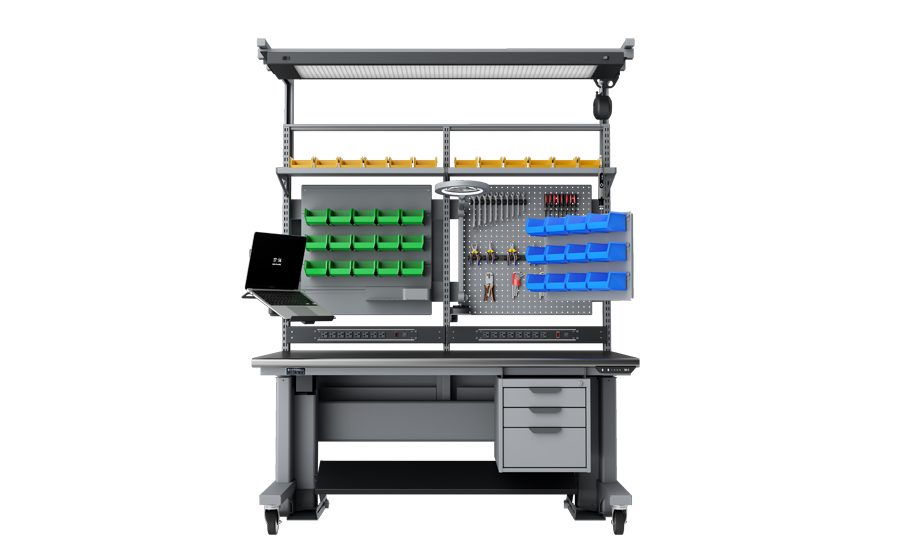
One of the most impactful upgrades an assembly line can make is investing in electric height-adjustable workstations. These systems are designed to accommodate operators of different sizes and to support a wide range of precision assembly tasks. Key features often include adjustable laptop holders for digital work instructions, overhead LED lighting with integrated tool tracks, and circular LED magnifiers that improve visibility during fine detail work while reducing eye strain.
Storage is also a critical consideration. Stacked steel drawers and pegboard panels keep essential tools within arm’s reach, while articulating bin holders can swing parts into position when needed and tuck them away when not in use. Footrests promote operator comfort during extended periods of standing, and multi-outlet power strips ensure that all powered tools and devices have access to electricity exactly where they’re needed.
## Combining Work Surfaces with Gravity-Fed Material Delivery
Another approach gaining traction is the integrated flow rack workstation, which merges a traditional assembly surface with a gravity-fed parts delivery system into a single footprint. This type of setup is particularly well-suited for assembly, packaging, kitting, and other operations where materials and the work process need to coexist in a compact space.
Angled flow-rack lanes present components directly to the operator, while the integrated work surface provides a dedicated area for hands-on tasks. The flow rack itself can accommodate a variety of container types, including totes, boxes, and loose components. Dedicated return lanes can be built in to handle empty containers, keeping the workspace tidy and organized.
Configurability is a major advantage. Depending on the application, the system can incorporate different conveyor options—micro wheels for lighter products, skate wheels for heavier parts, or other conveyor styles for specific container types and load requirements. Adjustable material presentation angles, multiple levels of point-of-use storage, and ergonomic work surfaces can all be tailored to the specific manufacturing process. Best of all, these systems can be repaired, adjusted, reconfigured, or reused as operational needs evolve over time.
## Mobile Flow Racks for Lean Manufacturing
Stair-stepped mobile flow racks offer yet another approach to keeping materials organized and accessible on the assembly floor. These rack systems are engineered to support lean manufacturing principles by ensuring that materials are used in the order they are received, which helps maintain proper inventory control and reduces waste.
The stair-stepped design features multiple levels, each of which can be raised or lowered independently without changing the overall conveyor length. This allows for quick reconfiguration using basic hand tools, making it easy to adapt the rack to different product lines or changing workflow requirements. Locking casters provide stability during operation while still allowing the entire unit to be repositioned effortlessly across the factory floor.
Construction typically involves heavy-gauge pipe—often 28- or 42-millimeter dimensions—capable of supporting loads up to 1,500 pounds. Static-safe versions are available for environments where electrostatic discharge could damage sensitive components. The conveyor system is compatible with plastic returnable totes, corrugated containers, and cardboard boxes, making it versatile enough to handle a wide range of part types and packaging formats.
## Modular and Adjustable Workbenches
For facilities that need maximum flexibility, modular adjustable workbenches offer a compelling solution. These workbenches allow operators to adjust the height of the work surface using a hand crank, electric motor, or a simple pin-in-hole mechanism. The modular design means the bench can be converted into a complete workstation at any time simply by adding uprights, shelves, and accessories.
This approach provides the flexibility to meet changing job requirements without investing in entirely new furniture. Accessories are available for a wide range of applications, including assembly, inspection, testing, and packaging. Specialized features such as tilt-top surfaces and oversized work areas can be combined with standard components like air manifolds and swing arms to create designs that optimize both worker comfort and productivity.
All-steel, fully welded construction ensures durability and requires little to no maintenance. Scratch-resistant powder-coat finishes resist chipping and flaking, and units are typically shipped fully assembled, ready for use within minutes of delivery to the floor.
## Key Takeaways
The common thread across all of these solutions is adaptability. Whether it’s a height-adjustable workstation, an integrated flow rack system, a mobile stair-stepped rack, or a modular workbench, the goal is the same: create an assembly environment that can change as quickly as the products being built. Reducing changeover time, minimizing wasted motion, and improving operator comfort all contribute to higher throughput and better product quality.
Investing in flexible assembly infrastructure is not just a reaction to current market demands—it’s a strategic move that positions a manufacturing facility to respond efficiently to whatever challenges the future may bring. With the right combination of adjustable workstations, intelligent material flow systems, and modular furniture, assembly lines can stay agile, ergonomic, and productive in an ever-changing production landscape.
—
## Frequently Asked Questions (FAQ)
**Q: Why is flexibility so important on modern assembly lines?**
A: Product lifecycles are shortening and production runs are changing more frequently than ever. Assembly cells must be rearranged, part supplies repositioned, and workflows adjusted quickly. Time spent on changeover is time not spent making product, so flexibility directly impacts profitability.
**Q: What are the main benefits of height-adjustable workstations?**
A: Height-adjustable workstations improve ergonomics by accommodating operators of different sizes, reduce fatigue during long shifts, and can be quickly repositioned or modified to support different tasks. They also help maintain consistent productivity across a diverse workforce.
**Q: How does a flow rack workstation improve efficiency?**
A: A flow rack workstation combines material storage and the assembly surface in one footprint, bringing parts directly to the operator through gravity-fed lanes. This reduces wasted movement, keeps components organized, and supports lean manufacturing principles like first-in, first-out inventory management.
**Q: Can these systems be reconfigured as needs change?**
A: Absolutely. Most modern flexible workstation systems are designed to be adjusted, reconfigured, or repurposed as production requirements evolve. Features like adjustable angles, modular components, locking casters, and interchangeable conveyor options make it easy to adapt without purchasing entirely new equipment.
**Q: What should I look for when choosing an assembly workstation?**
A: Consider the types of tasks performed, the weight and size of components being handled, the available floor space, ergonomics requirements, and how frequently the layout needs to change. Look for systems with modular designs, durable construction, and options for lighting, power, and storage that match your specific operational needs.
**Q: Are mobile flow racks suitable for heavy-duty applications?**
A: Yes. Many mobile flow racks are built from heavy-gauge pipe and can support loads of up to 1,500 pounds or more. They are designed for real production environments and can handle a variety of container types, from lightweight totes to heavy corrugated boxes.
—
## Conclusion
The evolution of assembly line design is driven by one overriding need: the ability to change quickly and efficiently. Adjustable workstations, integrated flow systems, mobile racks, and modular benches all serve this goal by giving manufacturers the tools to reconfigure their production environments on demand. By investing in these flexible solutions, assembly operations can reduce changeover times, improve operator comfort, minimize waste, and stay competitive in a marketplace that demands constant adaptation.
Whether you’re outfitting a new facility or retrofitting an existing one, the principles remain the same—design for adaptability, prioritize ergonomics, and choose systems that grow with your needs. The right workstation and material handling infrastructure can make all the difference between a rigid, inefficient operation and a nimble, high-performing assembly line.
Thank you for reading
