



# AI Coding Agents for Enterprise: What Procurement, Legal, and Security Teams Need to Know
## Why Your Organization Can’t Afford to Skip the Contract Review
When an enterprise deploys an AI coding agent across dozens or hundreds of engineers, the decision is rarely made by a single team. Procurement evaluates total cost of ownership, legal reviews intellectual property exposure, and security examines where sensitive data flows. Yet most evaluation guides are written from the perspective of the individual developer, not the organization approving a company-wide rollout.
This guide walks through the four questions every enterprise stakeholder should answer before signing on the dotted line: Who absorbs the cost if AI-generated code triggers an intellectual property claim? Where do the prompts your engineers type actually live? What can administrators log or control? And what does a 500-seat deployment actually cost when you factor in the necessary enterprise tiers?
The underlying contract language for the major AI coding platforms was reviewed in September 2026. This is informational reporting and should not be treated as legal guidance. Final terms should always be reviewed by qualified counsel.
## The Landscape: Fewer Vendors, More Complexity Than You Might Expect
At first glance, the market looks crowded with five distinct brands. In practice, the contract picture is more consolidated. One high-profile acquisition means two previously separate products now share a single pricing structure and a unified set of terms. Enterprise buyers should think of the ecosystem as four distinct contractual frameworks rather than five independent products.
This matters because each framework carries different obligations around indemnification, data handling, and administrative controls. Understanding those differences is essential before committing to a deployment at scale.
—
## The Questions Nobody Asks (Until It’s Too Late)
### 1. Who Pays If Generated Code Triggers an Intellectual Property Claim?
The most overlooked clause in any AI tool contract is the indemnification provision. Most vendors offer some form of protection, but the scope, exclusions, and financial caps vary dramatically.
**Fully Covered — Uncapped**
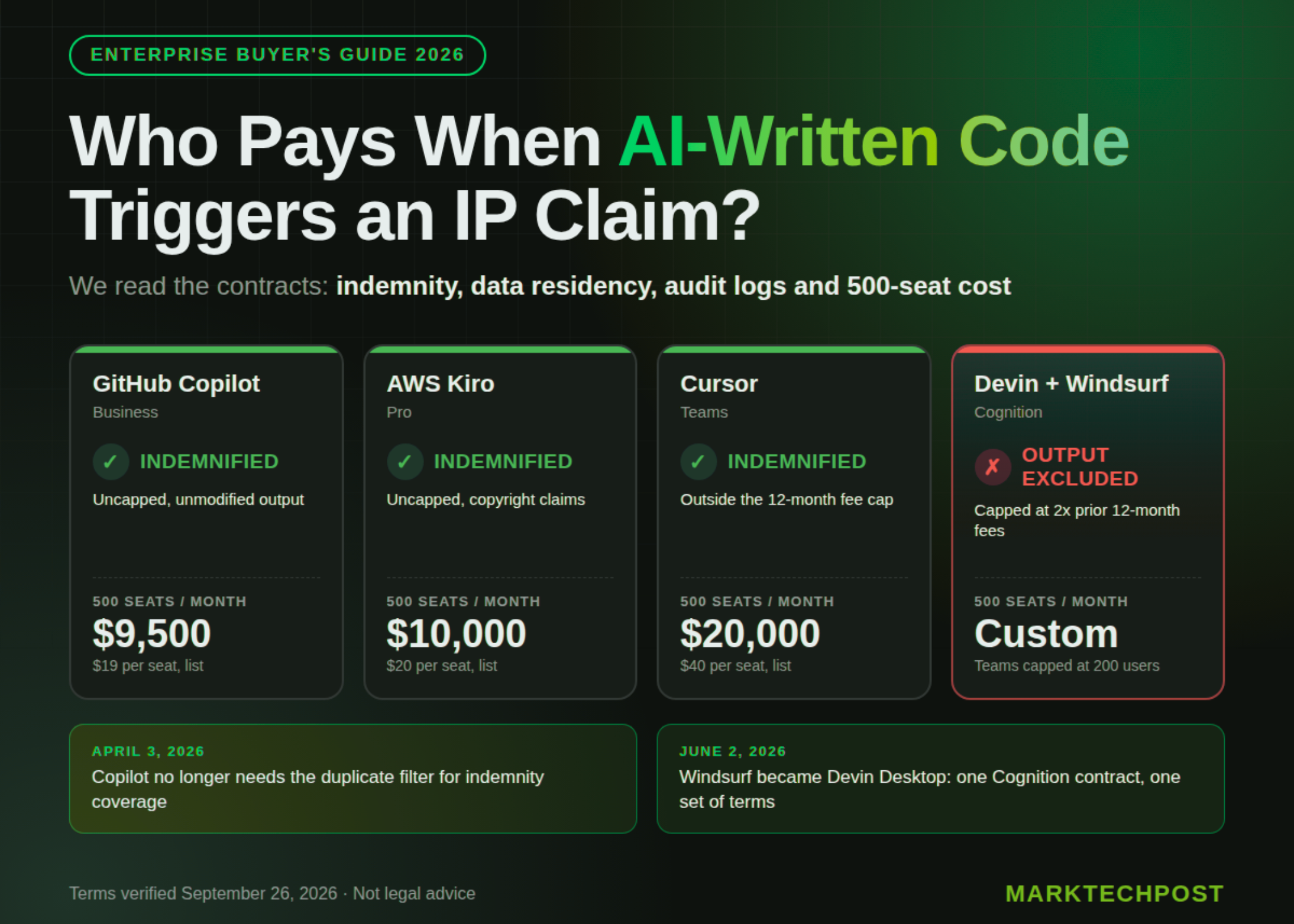
Two major platforms offer uncapped indemnification for intellectual property claims arising from their AI-generated output. One platform, owned by the company behind a widely used software collaboration suite, provides this protection for its business and enterprise tiers on unmodified code outputs. Another, backed by a leading cloud infrastructure provider, offers uncapped coverage specifically for copyright claims on output from its AI coding service. Both protections are available on paid tiers and come with restrictions around disabling content filters.
**Broad on Paper, Narrow in Practice**
A third platform describes its coverage as defending claims that its suggestions infringe third-party intellectual property. The contract naming is inclusive, but the exclusions are meaningful. If the code is modified after generation, if safety filters are disabled, or if the organization used the output in a way it knew likely infringed, the indemnity does not apply. Notably, the indemnity is carved out of the contract’s existing fee cap rather than being a separate commitment — meaning it could reduce the vendor’s maximum liability under other clauses. On consumer-facing agreements, the obligation is reversed, and users must indemnify the platform instead.
**Excluded from Coverage**
One vendor defines its output as part of customer data, then explicitly excludes customer data from its intellectual property indemnity. This means AI-generated code falls outside the protection promise entirely on standard terms. The financial cap on exposure is tied to two times the fees collected over the prior twelve months. For any organization using this vendor’s autonomous coding agent or its recently consolidated development environment, negotiating an exception in the order form is essential.
### 2. Where Do Prompts Live?
Every query a developer types — whether it’s a natural-language instruction or a code completion request — must travel somewhere. The data residency and retention policies vary significantly across providers.
**IDE-Based Tools With Strict Retention Limits**
One major platform states that prompts entered directly within its integrated development environment are not retained for business and enterprise accounts. However, prompts from other surfaces — the vendor’s website, mobile applications, and command-line interfaces — are kept for 28 days. Separate from prompts, user engagement data is retained for up to two years. Organizations operating under this platform’s enterprise cloud with a data residency option can constrain AI processing to either the United States or the European Union, with a processing fee increase of roughly 10 percent and a narrower model catalog.
**Cloud-Native With Customer-Controlled Logging**
The platform built by the cloud infrastructure giant stores enterprise content in the geographic region configured for the user profile, and inference processing stays within US or European boundaries except for models flagged as experimental. Critically, enterprise customer data is not used to improve the service. Administrators can set up prompt logging that routes daily activity reports into an Amazon Simple Storage Service bucket under the customer’s own account — keeping the entire record chain within the organization’s infrastructure.
**Privacy-First Model With No Region Selection**
One startup-backed platform offers a privacy mode that establishes zero data retention agreements with every model provider and does not use customer code for training. File contents are temporarily cached, encrypted with keys generated by the customer, and not permanently stored. However, the platform does not publicly offer a customer-selectable processing region. Every request still passes through the vendor’s backend servers.
**Dedicated Infrastructure With Opt-Out Nuances**
The vendor behind the autonomous agent and the recently consolidated development environment bars training on customer data without written consent. Enterprise deployments run the coding agent inside a single-tenant virtual private cloud connected through a private networking link, with the agent’s reasoning layer still operating in the vendor’s cloud. On self-serve paid plans, training on customer data continues until the customer opts out. On team plans, only a designated administrator can trigger that opt-out.
### 3. What Can Admins Log and Control?
Enterprise deployment requires visibility. The audit and administrative capabilities across vendors vary from comprehensive to conspicuously absent at certain tiers.
One platform provides an enterprise audit log that records vendor-generated coding agent activity under a specific action identifier. Agent actions map to the automated system rather than individual developers, and prompts executed locally within the integrated editor do not appear in these logs. Administrators can control which models are available, manage feature previews, and set spending limits.
The cloud infrastructure vendor supports single sign-on through its identity service, Okta, and Microsoft Entra ID. When administrators enable prompt logging and daily activity reports, the data lands in a storage bucket inside the customer’s own cloud account, meaning prompt records remain fully within organizational control.
Another platform offers single sign-on and team-wide privacy mode at the team tier. However, full audit logging, user provisioning via SCIM, repository permission controls, and a code tracking API are gated behind the enterprise tier.
The autonomous agent vendor provides admin dashboards, centralized controls, and single sign-on exclusively at the enterprise level, with audit log access through a dedicated application programming interface.
### 4. What Does 500 Seats Actually Cost?
List prices below reflect monthly USD costs before usage overages and applicable taxes. The “true” cost figure represents the minimum tier that delivers both intellectual property indemnity and single sign-on capability in a single package.
| Option | Per Seat / Month | 500 Seats / Month | 500 Seats / Year | Included Usage | Buyer Note |
|——–|——————|——————-|——————|—————-|————|
| Platform A Business Tier | $19 | $9,500 | $114,000 | 1,900 pooled credits per seat | SAML SSO and data residency require the enterprise cloud add-on |
| Platform A Business + Enterprise Cloud | $40 | $20,000 | $240,000 | Same pooled credit model | Real cost if enterprise cloud is not already part of existing spend |
| Platform A Enterprise + Enterprise Cloud | $60 | $30,000 | $360,000 | 3,900 pooled credits per seat | Adds codebase indexing and deeper integration with the collaboration platform |
| Cloud Provider AI Coding Pro | $20 | $10,000 | $120,000 | 1,000 credits per user | Additional credits billed at $0.04 each; self-serve tiers cover up to 500 seats |
| Cloud Provider AI Coding Pro+ | $40 | $20,000 | $240,000 | 2,000 credits per user | Same indemnity as the standard Pro tier |
| Startup Platform Teams | $40 | $20,000 | $240,000 | Per plan allowance | Lacks audit logs and SCIM; enterprise tier is custom priced |
| Autonomous Agent Teams | $40 + $80 team fee | Not applicable | Not applicable | Daily and weekly quotas | Teams tier caps at 200 users; 500 seats requires the custom enterprise tier |
**Two meters sit above every seat.** One vendor transitioned to a usage-based credit model where each credit is worth one cent, and individual seats may consume credits at different rates depending on how intensively the coding agent is used. Another bills additional credits at four cents each, and enterprise overages are disabled by default, requiring proactive management. Agent-heavy development teams should model actual usage patterns rather than estimating based on seat count alone.
—
## Feature Comparison at a Glance
| Capability | Platform A Business/Enterprise | Cloud Provider AI Coding Pro | Startup Platform Teams | Autonomous Agent Enterprise |
|————|——————————-|——————————|————————|—————————-|
| IP Indemnity on Generated Code | Yes, unmodified output | Yes, copyright claims | Yes, named suggestions | No, output excluded under standard terms |
| Indemnity Cap | Uncapped | Uncapped (copyright) | Outside 12-month fee cap | Two times trailing 12-month fees |
| Business Data Used for Training | No | No (enterprise users) | No with privacy mode | No (enterprise); opt-out needed on self-serve |
| Prompt Retention | IDE: not retained. Other surfaces: 28 days | Region-based; optional logging to customer’s storage | Zero data retention with privacy mode | Customer tenant with dedicated virtual private cloud |
| Customer-Selectable Region | Two regions available; plus a premium | Multiple regions plus government cloud | Not publicly offered | Dedicated single-tenant virtual private cloud |
| Single Sign-On | SAML via enterprise cloud | Identity provider integration | SAML or OIDC on teams | SAML or OIDC on enterprise |
| Audit Logs | Yes, prompts excluded | Prompt logs and activity reports | Enterprise only | Enterprise API endpoints |
| 500-Seat List Price (Monthly) | $9,500–$30,000 | $10,000 | $20,000 or custom | Custom pricing |
—
## Understanding the Usage-Based Billing Shift
One of the most significant changes in the platform pricing landscape in recent months has been the move toward usage-based AI credits. Rather than a flat per-seat fee that includes unlimited AI-assisted coding, one major vendor now charges credits on a 1-cent-per-credit basis. This means that teams with heavy agent usage can see monthly bills that exceed what the seat price alone would suggest.
Another vendor prices additional credits at a 4-cent mark, with enterprise overage billing turned off by default. This creates an interesting dynamic: administrators must make an intentional choice to enable overage spending, which can serve as a natural budget control but also means that agent-heavy teams may hit usage limits unexpectedly if overages are not enabled upfront.
For procurement teams evaluating total cost of ownership, the seat price should be treated as a baseline rather than a final number. A usage model should be built based on expected agent interactions per developer per day, current codebase complexity, and the types of tasks the agent will be asked to handle.
—
## Frequently Asked Questions
**Q: Does the vendor’s intellectual property indemnity cover code that an autonomous agent writes entirely without human intervention?**
A: For most vendors, the answer depends on whether the output is classified as generated code or customer data under the contract. Some platforms explicitly include agent-generated output under their indemnity promise. One vendor, however, defines all output as customer data and excludes it from coverage. Organizations planning to use autonomous coding agents should verify this specific distinction early in the procurement process.
**Q: Can we run these tools with our own API keys to reduce vendor data exposure?**
A: This varies significantly by platform. One provider routes all requests through its own backend regardless of whether the user supplies a personal API key. Another provider allows enterprise deployments where inference is isolated in a customer-controlled virtual private cloud, though the reasoning layer still operates within the vendor’s cloud infrastructure. The vendor backed by the major cloud provider offers customer-managed encryption keys and keeps enterprise content within the configured geographic region.
**Q: What happens to our audit trail if developers use the agent in the integrated development environment versus through a browser interface?**
A: One platform explicitly excludes locally executed prompts from its enterprise audit log, though API usage streaming is undergoing public preview for certain enterprise configurations. Another vendor routes all prompt logging through an Amazon S3 bucket that lives under the customer’s own cloud account, providing a fully auditable record. The distinctions between IDE-based prompts and cloud-based prompts are a critical part of the evaluation process for security teams.
**Q: Are the terms we see today stable, or should we expect significant changes?**
A: Vendor terms evolve frequently. The contract language reviewed here was verified at a specific date and with a specific set of product pages. Key policy changes have occurred, including the removal of certain mandatory safeguards that previously affected coverage eligibility. Any purchase decision should be based on the terms current at the time of contract execution, not historical snapshots.
**Q: What is the single most important negotiation point for enterprise buyers?**
A: For one vendor in particular, the classification of AI-generated output as customer data that is excluded from all intellectual property indemnity is the critical issue. Without negotiating a specific carve-out in the order form, the standard terms provide no coverage for the organization’s own generated code. This single clause should be the starting point for any legal review of that vendor’s contract.
**Q: Can we scale past the team tier limits with managed seat expansion?**
A: Not directly on the standard team plans. One vendor caps its team offering at 200 users, meaning a 500-seat deployment automatically falls into the custom-priced enterprise tier. Another vendor’s self-serve tiers cover up to 500 seats, after which a sales engagement is required. Procurement teams should plan for custom pricing conversations whenever seat counts exceed the published tier limits.
—
## The Bottom Line for Enterprise Decision-Makers
The AI coding agent market has matured enough that enterprise-grade contract frameworks now exist across most major platforms. However, maturity varies by vendor — and those differences carry real financial and legal risk.
The clearest picture of protection belongs to the platforms offering uncapped indemnification with minimal exclusions. The most complex risk profile sits with the vendor that categorizes all output as customer data, effectively removing AI-generated code from any indemnification promise unless specifically negotiated.
For the procurement lead, the real cost at 500 seats extends well beyond the list price. Factoring in required companion subscriptions for enterprise features like single sign-on and data residency, usage-based overages, and the seat limits imposed by team tiers reveals the true total cost picture.
For the security reviewer, the prompt storage and audit logging capabilities determine whether the tool can be deployed with confidence. Some platforms offer full visibility into agent activity within the customer’s own infrastructure, while others maintain opaque data flows that may not satisfy internal compliance requirements.
Ultimately, the right AI coding agent for an enterprise is the one whose contract terms align with the organization’s risk appetite, whose data handling practices satisfy the security team’s requirements, and whose total cost at the planned seat count fits within the approved budget. None of these can be determined from feature lists alone — the contract details are where the real evaluation begins.
Thank you for reading
