



# Altar-1: A New Open-Weight Security Model Built for Air-Gapped and On-Premises Networks
## Introduction
A security-focused AI company has introduced Altar-1, a groundbreaking open-weight language model engineered specifically for cybersecurity applications within environments where data cannot leave the premises. The model serves as the brain behind an autonomous pentesting appliance designed to operate in restricted network environments, including bank data centers bound by strict residency regulations and industrial control systems with no external internet connectivity.
Unlike traditional security AI tools that rely on third-party cloud-hosted models, Altar-1 runs entirely on hardware the customer owns. This fundamental architectural choice eliminates a major vulnerability vector in AI-assisted security work: the transmission of sensitive source code, internal documentation, and unpatched vulnerability reports through external APIs.
## Why Security AI Needs a Different Deployment Model
Most cutting-edge AI models today are closed systems hosted on provider-managed servers. For cybersecurity teams operating under stringent compliance frameworks, this creates an uncomfortable risk profile. When a pentester feeds network diagrams, application source code, or discovered vulnerabilities into a cloud-hosted model, those artifacts leave the organization’s perimeter — potentially violating data governance policies, regulatory mandates, or air-gap isolation requirements.
Open-weight models were developed partly to solve this residency problem. However, they introduced their own deployment headaches. Many of the largest open-weight architectures use a mixture-of-experts design where dozens of sub-networks compete to process each incoming token. Storing all of these expert networks consumes enormous amounts of GPU memory, and the memory consumed by maintaining conversation context further compounds the issue.
For a security agent that may run for hours across a complex codebase or network topology, the working memory requirements are substantial. This created a gap between having an open model and actually being able to deploy it on a single machine without external GPU clusters.
## The Architecture Behind Altar-1
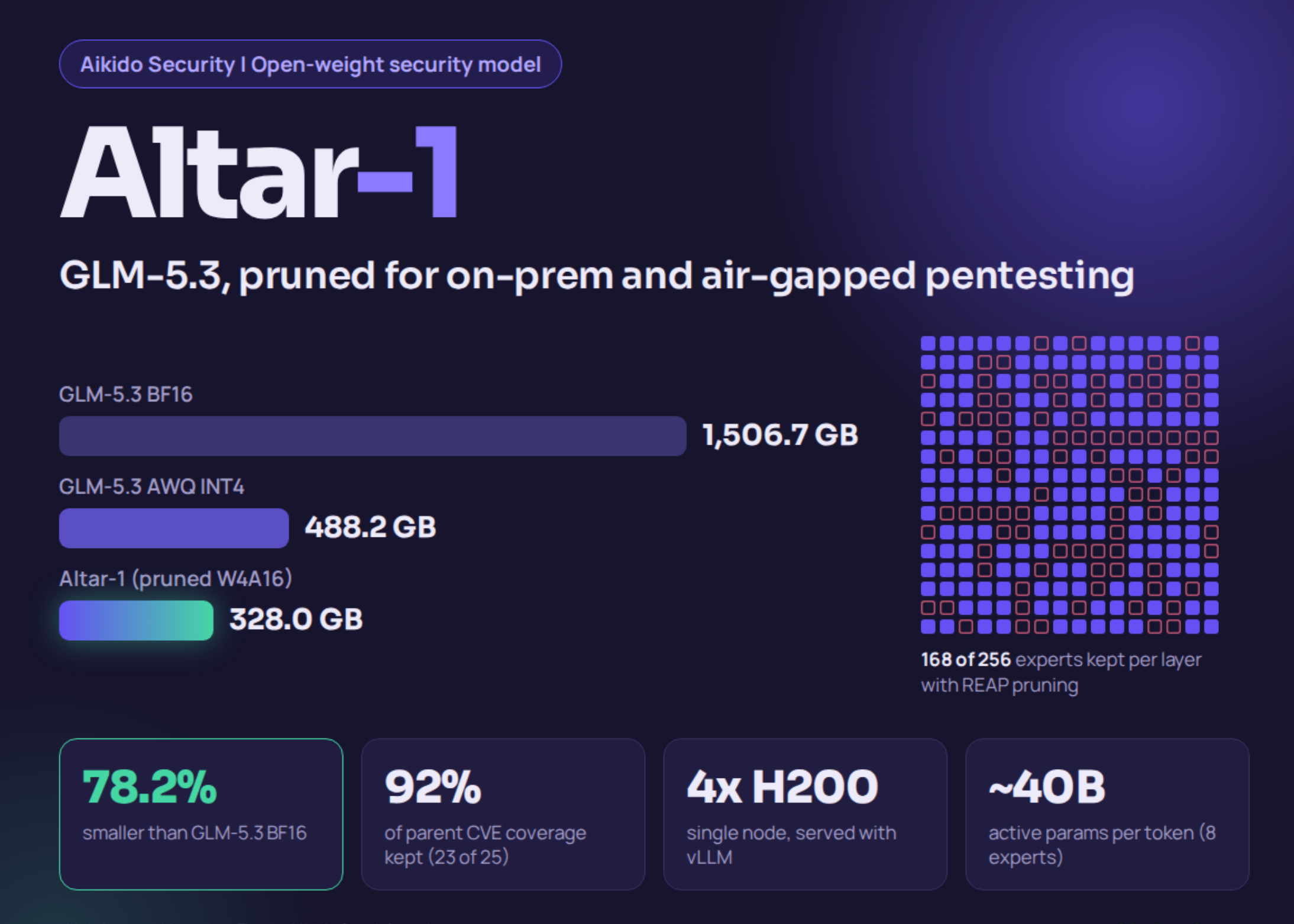
The foundation model underlying Altar-1 contains 753 billion parameters organized across 256 expert sub-networks per layer. For each token processed, the routing mechanism selects 8 of those 256 experts, resulting in approximately 40 billion active parameters at any given moment. This massive architecture was compressed into a deployable form through two sequential optimization stages.
### Stage One: Quantization
The first step involved converting the model’s weight precision from 16-bit floating point to a more compact representation. The team started from a 4-bit quantized version of the parent model, storing routed expert weights at reduced precision while preserving full precision for attention mechanisms, shared expert components, dense layers, and the output head. This single transformation slashed the storage footprint from over 1.5 terabytes to under 500 gigabytes.
### Stage Two: Expert Pruning
The second stage targeted the mixture-of-experts structure directly. Rather than retraining the model or fine-tuning it in any way, the team applied a router-weighted pruning algorithm that evaluated each expert based on two criteria: the magnitude of its routing weight and the strength of its output signal. This scoring system ensured that the experts most critical to performance — particularly those handling specialized tasks like code analysis, rare language processing, and structured output generation — were preserved.
After pruning, the model retained 168 of the original 256 experts per layer, removing 88 experts (roughly one-third of the expert pool). The routing mechanism itself remained completely unchanged, continuing to select 8 experts per token from the reduced pool. The entire process required no additional training data or fine-tuning cycles.
## Deployment Feasibility
The model is publicly available and can be served using the vLLM inference framework on a single computing node equipped with four NVIDIA H200 GPUs. The total storage requirement for the model weights is 328 gigabytes, leaving substantial headroom for context memory. The reference deployment uses a maximum context window of over 130,000 tokens, which is essential for analyzing large codebases or maintaining extended conversational security assessments.
An interactive deployment calculator is available that allows operators to compare the model’s stored size against different GPU configurations, including 4x and 8x H200 setups as well as H100-based nodes. The calculator visualizes how much memory remains for context caching after the model weights are loaded, helping teams understand whether their specific hardware can support the workload.
## Performance Benchmarks
The team evaluated the compressed model against three reference points: the original full-precision parent model, the 4-bit quantized model before pruning, and the final Altar-1 configuration. Evaluation was conducted across 30 software repositories containing 32 known vulnerabilities, with each case run three times to measure consistency.
The compressed model achieved an average recall rate of approximately 60% across the three runs. It successfully identified at least one instance of 23 out of 32 vulnerabilities during testing, matching the coverage rate of the quantized-but-unpruned baseline. Compared to the full-precision parent, Altar-1 retained 92% of the vulnerabilities originally discovered while operating at a roughly 5-point lower recall rate.
The fidelity gap between the compressed model and its full-precision ancestor was measured at approximately 0.5 nats of Kullback-Leibler divergence across a standardized evaluation panel, indicating minimal semantic drift from the compression pipeline.
## Calibration and Training Data
The calibration datasets used to guide the pruning decisions included traces from the company’s own pentesting harness, alongside coding benchmarks, tool-calling scenarios, reasoning tasks, and multilingual text drawn from standard reference corpora. The company explicitly states that no customer data was involved in this calibration process.
The scoring methodology was designed to protect specialists — experts that handle rare languages, code analysis, and structured output formats were evaluated based on their peak contribution within a single domain’s workload, ensuring that niche capabilities were retained even if those experts were not the most frequently activated.
## Frequently Asked Questions
**What is Altar-1?**
Altar-1 is a compressed, open-weight language model built for cybersecurity applications. It is specifically designed to run on customer-owned hardware for penetration testing, vulnerability analysis, and security assessments in restricted network environments.
**Why can’t existing open models serve this purpose?**
Many existing open-weight models require enormous GPU memory, especially when running mixture-of-experts architectures. For long-running security agents that maintain extensive conversation context, the memory demands often exceed what a single node can provide, forcing teams to use external infrastructure that breaks air-gap and data residency requirements.
**How was the model compressed?**
Altar-1 was created through a two-step process: first, the model weights were quantized from 16-bit to 4-bit precision for expert parameters, and second, a router-weighted pruning algorithm removed 88 of 256 expert networks per layer. No retraining was performed at any stage.
**What hardware is required to run Altar-1?**
The reference deployment uses a single node with four NVIDIA H200 GPUs (141 GB of memory each) and the vLLM inference framework. The model card specifies that Hopper-architecture GPUs are required.
**How accurate is the compressed model compared to the original?**
The compressed model maintains approximately 92% of the vulnerability coverage achieved by the full-precision parent model, with a KL divergence of roughly 0.5 nats, indicating minimal loss in semantic fidelity.
**Is customer data used anywhere in the model?**
No. The calibration data was drawn from internal pentesting traces, coding benchmarks, tool-calling scenarios, reasoning tasks, and multilingual reference corpora. The company has confirmed that no customer data was included.
**What types of security tasks can Altar-1 perform?**
The model powers an autonomous pentesting appliance designed for on-premises and air-gapped networks. It supports code analysis, vulnerability rediscovery, tool calling, and structured output generation for security workflows.
**Where can I find the model?**
The weights are publicly available on a major open-source model repository and can be served with standard open-source inference frameworks.
## Conclusion
Altar-1 represents a meaningful step toward making powerful AI-driven security tools accessible in the most demanding operational environments. By combining quantization with expert pruning, the team achieved a roughly 78% reduction in storage size without requiring any model retraining, preserving the core capabilities needed for real-world penetration testing and vulnerability analysis. The open-weight licensing model, paired with the ability to run on a single high-end GPU node, removes the dependency on external cloud infrastructure that has long been a barrier for security teams in regulated industries. As AI-assisted security workflows become standard practice, models like this one — designed from the ground up for sovereignty and isolation — may become the backbone of on-premises AI security operations.
Thank you for reading
