



# Boston Dynamics Unveils Dedicated Humanoid Training Facility in Georgia
## A Permanent Base for Scaling Atlas Automation
Boston Dynamics has opened a permanent robotics training and testing center designed to prepare its Atlas humanoid robots for real-world industrial deployment. The new facility, located adjacent to Hyundai Motor Group’s Metaplant America site near Savannah, Georgia, represents a significant step forward from earlier experimental trials and is built to serve as a long-term hub for developing, refining, and scaling humanoid capabilities.
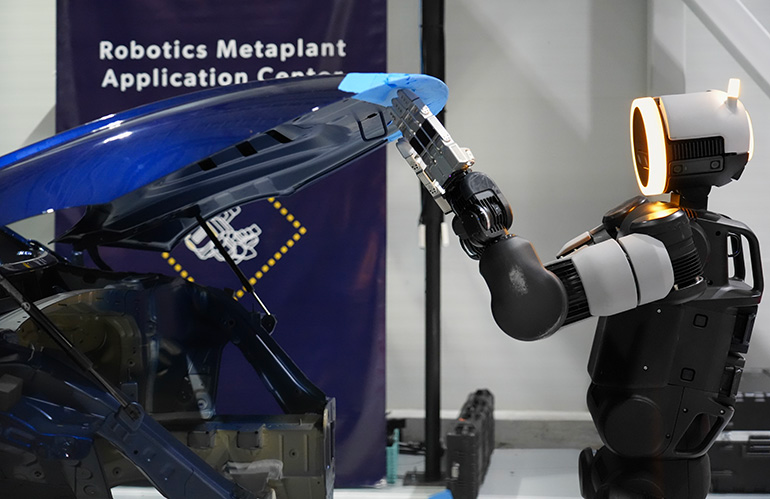
Zack Jackowski, chief product and technology officer at Boston Dynamics, described the facility as a “Robot Behavior Factory” where actual automotive parts, fixtures, and workcells are combined with Atlas robots and skilled operators to generate large volumes of high-quality training data. The center operates in close coordination with the surrounding manufacturing plant, enabling a feedback loop between real production conditions and robot behavior development.
## From Proof-of-Concept to Permanent Operations
Earlier humanoid trials at automotive facilities were limited in scope, offering short-term deployments that generated valuable lessons but lacked the permanence and scale needed for enterprise-grade automation. Jackowski explained that those initial efforts focused on understanding operational realities — such as the right balance of off-site preparation, on-site testing, and simulated training — before committing to a larger footprint.
The Georgia center consolidates those learnings into a standing operation. It serves as the foundation for building every capability required to deploy Atlas across global manufacturing sites, including data collection pipelines, application testing protocols, and support workflows for humanoid integration.
## Training Atlas on Real Manufacturing Tasks
At the facility, Atlas is learning to perform logistics and sequencing tasks commonly found in automotive assembly. These include preparing parts, organizing them in the correct order, and placing them at designated stations for workers or automated systems.
The complexity of these tasks stems from several factors:
– **Surface interaction:** Automotive components feature intricate geometries and varied textures that demand sophisticated dexterous manipulation.
– **Grasping constraints:** Many parts have cosmetic or fragile areas that cannot be gripped, requiring the robot to identify safe contact points.
– **Bimanual coordination:** Large, heavy, or awkwardly shaped parts often require both arms working in tandem to lift, rotate, and position them.
– **Packaging challenges:** Extracting components from shipping materials and inserting them into high-density storage cubbies adds another layer of difficulty.
Boston Dynamics is drawing on multiple data sources to train Atlas, including teleoperation demonstrations, reinforcement learning in simulated environments, and Universal Manipulation Interface (UMI) devices that allow human operators to guide the robot through motions.
## Surprising Findings and Design Validation
One notable discovery so far is that the production design assumptions built into Atlas have largely held up well in real factory conditions. Jackowski noted that the team is learning more about the applications themselves — how to adjust fixtures and packaging to better suit humanoid interaction, how to collect reliable data in active production environments, and how to establish support processes that keep humanoid operations running smoothly.
## Ambitious Timeline and Expansion Plans
Hyundai Motor Group has committed to deploying Atlas across its global manufacturing network, with plans to introduce 25,000 units at Hyundai and Kia plants worldwide over the coming years. Boston Dynamics expects to reach component-level assembly tasks by 2030, with Atlas eventually taking on repetitive motions and physically strenuous work such as heavy lifting.
The Savannah center is already operational in its first phase, but further expansion is imminent. A new building opening next year will increase the facility’s capacity roughly tenfold, allowing Boston Dynamics to accelerate preparation for automotive deployments and begin exploring use cases in other industries.
Staff from Boston Dynamics’ headquarters in Waltham, Massachusetts, have relocated to Georgia, and the company is actively hiring across multiple departments to support the growing operation.
## Broader Industry Context
The launch of RMAC comes amid a wave of humanoid robot manufacturing investments worldwide. Hyundai has announced plans for a U.S. factory capable of producing up to 30,000 robots per year by 2028. Other companies are also scaling up:
– **1X Technologies** has begun producing its NEO robot in Hayward, California, with a San Carlos facility targeting over 100,000 units annually by late 2027.
– **Agility Robotics** is operating RoboFab in Fremont, California, designed for 10,000 Digit robots per year.
– **Engine AI** is building toward 10,000 annual units at its Shenzhen facility.
– **Tesla** has converted part of its Fremont plant for Optimus production, targeting over 50,000 units annually, with a new Texas Gigafactory aiming for 10 million robots per year.
– **UBTech** plans to manufacture 10,000 robots annually at its Liuzhou, China, facility.
Boston Dynamics also noted that its existing Spot quadruped and Stretch trailer-unloading robots continue to find customers across manufacturing, aerospace, semiconductors, logistics, food and beverage, and life sciences sectors. Data collected from Spot deployments is helping the company build a deeper understanding of industrial environments, while customers who started with Spot are developing institutional expertise that positions them well for future humanoid integration.
## SoftBank Acquisition Will Not Affect Atlas Development
Jackowski confirmed that the recent acquisition of the Robotics and AI Institute (RAI) from Hyundai by SoftBank will have no impact on Atlas development. He emphasized that Boston Dynamics and RAI have operated as separate organizations with distinct goals since their inception, and that the RMAC facility is expected to significantly boost the company’s data collection and policy evaluation velocity.
—
## Frequently Asked Questions
**What is the Robotics Metaplant Application Center (RMAC)?**
RMAC is a permanent training and testing facility operated by Boston Dynamics at Hyundai Motor Group Metaplant America near Savannah, Georgia. It is designed to prepare Atlas humanoid robots for real-world industrial deployment by generating high-quality behavioral data using actual manufacturing components and workcells.
**How is RMAC different from previous humanoid robot trials?**
Previous trials were short-term, hands-on deployments focused on gathering design insights. RMAC is a permanent facility that operates continuously in coordination with a live manufacturing plant, serving as a dedicated hub for data collection, application testing, and capability building at scale.
**What tasks is Atlas learning to perform?**
Atlas is currently being trained on logistics and sequencing tasks common in automotive manufacturing, including preparing parts, organizing them for assembly, grasping complex components, and handling items from shipping packaging into storage and transport systems.
**When will Atlas be used in actual car production?**
Hyundai plans to deploy Atlas across its global network beginning with 25,000 units at Hyundai Motor and Kia plants over the next few years. Component-level assembly is targeted for development by 2030.
**How many units can the new RMAC facility handle?**
A new building opening next year will expand the facility by approximately ten times its current size, significantly increasing training capacity and enabling exploration of additional industry use cases.
**Is the SoftBank acquisition of Hyundai’s RAI affecting Atlas?**
No. Boston Dynamics has stated that BD and RAI have always been separate organizations with different objectives, and the acquisition has no impact on Atlas development or the RMAC facility.
**What other companies are building humanoid robot manufacturing capacity?**
Multiple companies are scaling production, including 1X Technologies, Agility Robotics, Engine AI, Tesla, and UBTech, with annual production targets ranging from 10,000 to 10 million units across various global facilities.
—
## Conclusion
The opening of Boston Dynamics’ Robotics Metaplant Application Center marks a pivotal shift in how humanoid robots are developed and deployed at industrial scale. By establishing a permanent, real-world training environment inside a functioning automotive plant, the company is moving beyond theoretical experiments and toward a concrete roadmap for mass deployment. The partnership with Hyundai provides both a testing ground and a clear path to global manufacturing integration, while the facility’s expansion plans signal a commitment to long-term growth. As the broader industry races toward mass production of humanoid robots, RMAC represents a tangible milestone in turning general-purpose automation from a promise into an operational reality.
Thank you for reading
