



# Qwen3.8-LiveTranslate: A New Era in Real-Time Speech Interpretation
## A Paradigm Shift in Simultaneous Translation
Real-time interpretation has long been one of the most demanding tasks in artificial intelligence. Balancing speed, accuracy, and fluency requires models to process incoming speech while simultaneously producing translated output — all without falling behind the speaker. Qwen3.8-LiveTranslate represents a significant leap forward in this space, offering a production-ready solution that can operate as a hosted API through Alibaba Cloud’s Model Studio and QwenCloud platforms.
## How It Works
The system listens to live speech input, optionally paired with video frames, and returns both translated text and synthesized speech while the original speaker is still talking. This creates a seamless experience that mirrors the workflow of a professional human interpreter sitting in a conference room.
### The Interleave Architecture
At the heart of this release is a redesigned pipeline called the Interleave architecture. Traditional simultaneous interpretation systems follow a cascade approach — first converting speech to text, then translating that text, and finally generating audio. Each stage hands off to the next, creating bottlenecks and cumulative delay.
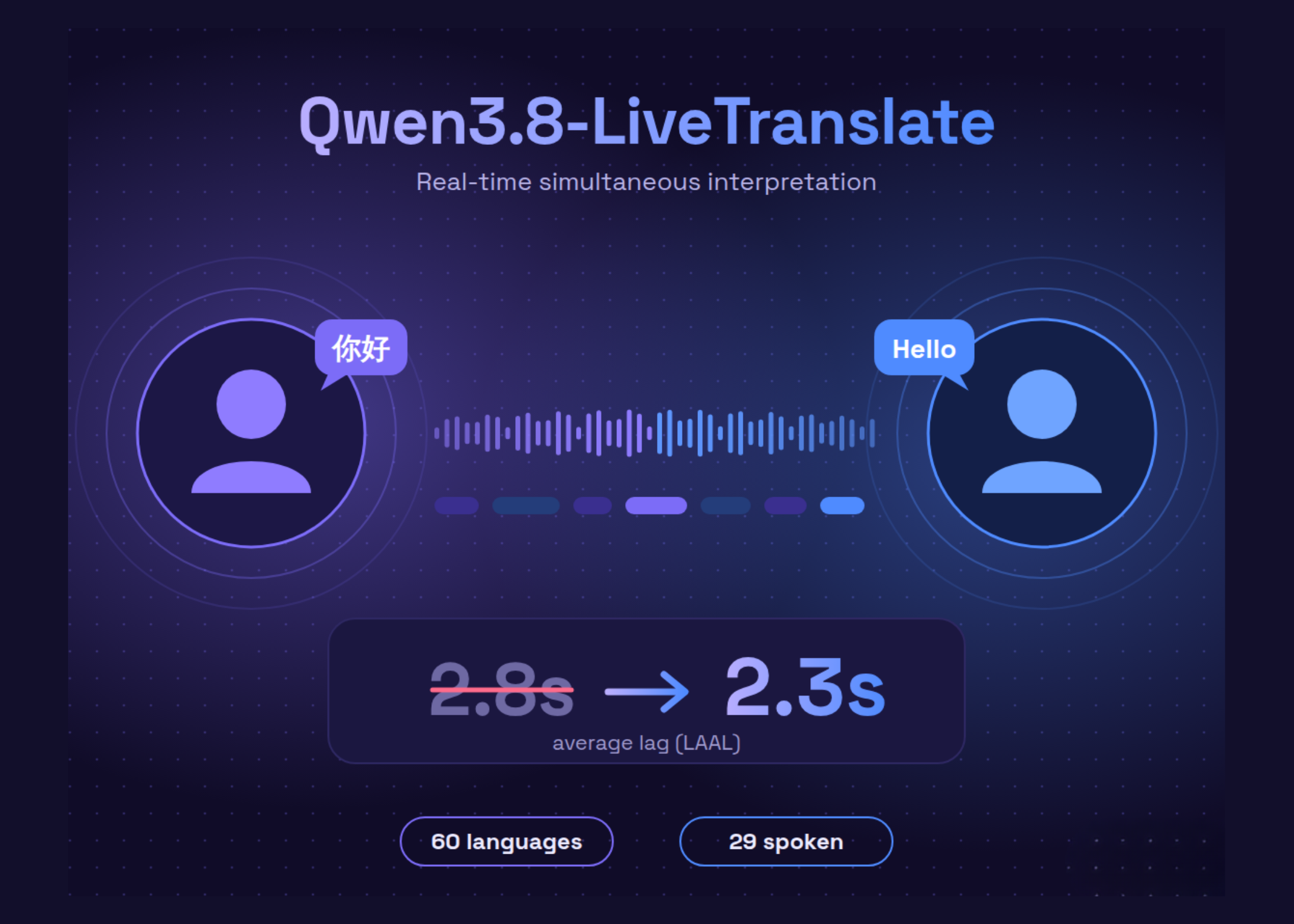
The Interleave architecture instead keeps audio, source text, and translation unified within a single time-ordered stream. By processing all three signals in parallel and coordinating them tightly, the model reduces the average time gap between the original speaker’s words and the translated output. This gap, measured by a metric called Length-Adaptive Average Lagging (LAAL), has improved from 2.8 seconds down to 2.3 seconds — an 18 percent reduction.
The LAAL metric is particularly important because it rewards systems for producing lean, accurate translations rather than simply generating more text. It accounts for the length of the source material and penalizes unnecessary verbosity, encouraging concise and faithful output.
### Technical Foundation
The model is built on the Qwen-Omni stack, which draws from large-scale multimodal training data and cross-language alignment techniques. It benefits from visual enhancement capabilities, meaning video input can supplement audio for richer context. The underlying Flash variant also supports offline audio and video translation, making it versatile for both live and pre-recorded content.
## Three Key Capabilities
### Real-Time Speaker Diarization
In multi-party conversations, identifying who is speaking and maintaining their vocal identity is essential. Qwen3.8-LiveTranslate distinguishes between different speakers in real time, assigning each turn to the correct individual. The system also preserves each speaker’s voice characteristics through stable voice cloning. For sessions with frequent speaker changes, an “always” mode re-clones the voice before each response, ensuring continuity across turns.
### Synchronized Bilingual Display
Source text and its translation appear on screen simultaneously, helping users follow along in both languages. Through the API, the transcription of the original speech streams as its own set of events, running in parallel with the translation stream. This feature is especially valuable for live broadcasts, education, and accessibility use cases.
### Long-Context Disambiguation
Names and terminology can be ambiguous without context. “Jordan,” for example, could refer to a person or a country. The model leverages the conversation history accumulated throughout a session to resolve such ambiguities correctly. A person introduced early in a meeting will be consistently referred to by name later, even when the reference could be confused with a geographic or other entity.
## Deployment and Access
The model is available immediately as a hosted API. Developers can access it via WebSocket on Alibaba Cloud Model Studio and QwenCloud using the endpoint identifier `qwen3.8-livetranslate-flash-realtime`. This makes integration straightforward for applications that need real-time translation capabilities without managing infrastructure.
## Language Coverage
Qwen3.8-LiveTranslate supports 60 input languages, with 29 of those also available for speech output alongside text. The remaining 31 languages return text-only translations. This broad coverage spans major global languages as well as less commonly supported ones, making it suitable for diverse international applications.
## Cost Estimation
Pricing is token-based. Audio input is billed at 7 tokens per second, while audio output costs 12.5 tokens per second. For a typical one-hour session with spoken translation output, costs vary by region — for example, approximately $0.50 to $1.20 per hour depending on the selected deployment region. These are list prices from the model studio and may be subject to promotional pricing. The estimates assume that translated audio runs for the same duration as the source and do not include text transcript tokens or image tokens.
## Frequently Asked Questions
**What is the difference between Qwen3.8-LiveTranslate and its offline counterpart?**
The live version is optimized for streaming, low-latency scenarios where the model processes and returns translation while the speaker is still talking. The offline variant handles pre-recorded audio and video files without the need for real-time constraints.
**How is speaker diarization handled in noisy environments?**
The model uses a combination of acoustic cues and conversational patterns to attribute speech to the correct speaker. While performance may vary in extremely noisy conditions, the system is designed to maintain reasonable accuracy even in challenging audio environments.
**Can the model translate between any pair of the 60 supported languages?**
The system accepts input in all 60 languages. Speech output is available for 29 languages. Text output is available for all 60, meaning translation between any pair is supported at the text level, but spoken output depends on the target language being among the 29 supported for audio generation.
**What does the Interleave architecture actually interleave?**
It interleaves audio chunks, source text transcriptions, and translation segments into one unified stream. Rather than processing each stage sequentially and waiting for completion, the model coordinates all three streams so that translation can begin as soon as sufficient context is available from the audio and text streams.
**Is video input required?**
No. Video frames are optional and used as supplementary input to improve interpretation quality. The model works with audio input alone.
**How does long-context disambiguation affect latency?**
Because the model uses the accumulated conversation history to resolve ambiguities, longer sessions provide more context and potentially better translation accuracy for named entities and domain-specific terms. The architecture is designed to manage this context efficiently without introducing significant additional delay.
## Conclusion
Qwen3.8-LiveTranslate sets a new benchmark for what real-time simultaneous interpretation can achieve with current AI technology. By rethinking the translation pipeline through its Interleave architecture, the model delivers faster, more faithful, and more natural output than previous approaches. Its combination of speaker diarization, bilingual synchronization, and context-aware disambiguation addresses many of the pain points that have historically limited automated interpretation systems. With straightforward API deployment and broad language support, it opens the door to real-time multilingual communication in a wide range of practical applications, from international business meetings to live broadcast accessibility.
Thank you for reading
