



# Belamaf-Based Therapy in Relapsed/Refractory Multiple Myeloma: A Multicentre Clinical Study with Integrated γδ T Cell Receptor Profiling
## Introduction
Multiple myeloma (MM) remains an incurable hematological malignancy for the majority of patients, particularly those who experience relapse after receiving multiple prior lines of therapy. The clinical challenge is compounded when patients become refractory to key drug classes, including immunomodulatory agents such as lenalidomide and proteasome inhibitors. In response to this unmet need, a multicentre clinical investigation was launched to evaluate a bispecific antibody-based treatment approach combining belamaf with standard-of-care agents pomalidomide and dexamethasone in patients with relapsed/refractory disease.
Beyond the clinical trial itself, this investigation was paired with a comprehensive translational research programme aimed at characterising the tumour immune microenvironment, with a particular focus on gamma-delta (γδ) T cells and their T cell receptors (TCRs). By integrating clinical outcomes data with advanced single-cell sequencing and machine learning approaches, researchers sought to identify biomarkers and therapeutic targets that could inform future treatment strategies for MM patients.
## The Algonquin Study: Design and Patient Population
The study was designed as an ongoing, multicentre, open-label, single-arm investigation conducted across nine Canadian sites. It followed a two-part structure: the first part focused on dose exploration, while the second part evaluated the safety, tolerability, and clinical activity of the optimal dose and schedule identified in the initial phase. The trial enrolled patients with relapsed/refractory MM who had experienced disease progression after at least one prior line of antimyeloma treatment and had documented resistance to lenalidomide along with prior exposure to proteasome inhibitors, administered either in separate regimens or in combination.
To be eligible, patients needed to be at least 18 years of age with an Eastern Cooperative Oncology Group performance status of 0–2. They were required to have either undergone autologous stem cell transplantation or been deemed transplant-ineligible. Adequate bone marrow, renal, and cardiac function were mandatory. Patients with prior exposure to pomalidomide or BCMA-targeted therapies were excluded, as were those with concurrent corneal epithelial disease, serious or unstable preexisting medical conditions, or psychiatric disorders that could interfere with safety assessments or study compliance.
Sex was not a factor in the study design or patient selection process; it was determined based on self-reporting. The study adhered to the Declaration of Helsinki, International Council for Harmonisation Good Clinical Practice Guidelines, and local regulatory standards, with all participants providing written informed consent.
## Treatment Regimen and Dosing Strategies
Belamaf was administered via a 30-minute intravenous infusion on a four-weekly schedule at a dose of 1.92 mg per kilogram of body weight. Several alternative dosing strategies were evaluated across different patient cohorts, including administrations every four, eight, or twelve weeks at 2.5 mg per kilogram, as well as split-dose regimens in which the total dose was divided equally and administered on days one and eight of each cycle. Another cohort received a loading dose of 2.5 mg per kilogram in the first cycle, followed by a reduced dose of 1.92 mg per kilogram from the second cycle onward.
Pomalidomide was given at a fixed dose of 4 mg on day 21 of a 28-day cycle, while dexamethasone was administered weekly at 40 mg, with a reduced dose of 20 mg for patients older than 75 years. Patients remained on treatment until disease progression, unacceptable toxicity, or withdrawal of consent.
Ophthalmology examinations were performed before each belamaf infusion, and preservative-free lubricant eye drops were provided throughout the treatment period. Dose modifications for each drug were made independently according to predefined criteria based on the nature and toxicity grade of any adverse events.
## Sample Collection and Translational Research Cohorts
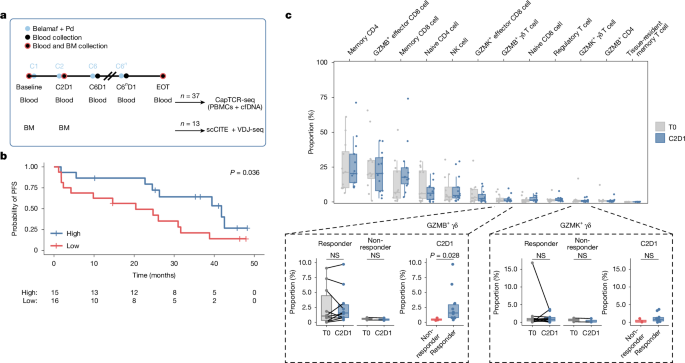
As part of the translational research programme, bone marrow and peripheral blood samples were collected from enrolled patients at defined time points during the study. Samples were selected and sequenced on an ongoing basis based on availability, with bone marrow samples included for patients who had both baseline and cycle 2 day 1 samples available. The quality of samples was carefully assessed, and those with poor viability or quality were excluded from specific analyses.
A separate set of patient samples was obtained for training machine learning models used to predict T cell reactivity. These samples included bone marrow aspirates from MM patients receiving standard-of-care treatment at the study site, as well as commercially sourced specimens from patients at various stages of disease and treatment history. In addition, melanoma and lung cancer tissue samples were obtained from surgical resections to serve as comparison groups in the broader immunological investigation.
## γδ T Cell Receptor Discovery and Screening
A central component of the translational research was the characterisation of γδ T cell receptors and their capacity to recognise and kill myeloma cells. γδ T cells represent a unique subset of T lymphocytes that express a distinct T cell receptor composed of gamma and delta chains, rather than the alpha and beta chains found on conventional T cells. These cells are known for their ability to recognise stress-related molecules on tumour cells without the need for classical major histocompatibility complex presentation.
To systematically identify γδ TCRs with reactivity against MM cells, researchers constructed a panel of TCR expression vectors. Each construct was designed to normalise surface expression by replacing native signal peptide sequences with a synthetic fibroin light chain signal peptide. The TCR genes were codon-optimised for human cell expression and assembled into lentiviral and transposon-based delivery systems that allowed stable insertion into T cell lines.
A custom Jurkat cell line was engineered to express green fluorescent protein (GFP) upon TCR activation, providing a convenient readout for reactivity screening. These reporter cells were co-cultured with myeloma cell lines, and activation was measured by quantifying the increase in GFP-positive cells. TCRs that produced at least a 15% increase in activation strength were classified as tumour-reactive, while those showing no significant increase were considered non-reactive. Borderline responses were excluded to minimise false positives.
## Receptor Specificity and Ligand Identification
To understand what molecules the reactive γδ TCRs recognised on myeloma cells, researchers performed systematic ligand identification experiments. Myeloma cell lines were genetically modified using CRISPR gene editing to knock out specific genes encoding candidate ligands, including beta-2-microglobulin (B2M), BTN3A, and various HLA class I molecules. By testing TCR reactivity against these modified cell lines, researchers could narrow down the specific molecules responsible for target recognition.
The investigation revealed that some γδ TCRs recognised CD1d molecules on the surface of myeloma cells. CD1d is a non-classical antigen-presenting molecule that presents lipid antigens to certain T cell populations. Other TCRs demonstrated specificity for particular HLA-C alleles, with reactivity dependent on the specific HLA-C variant expressed by the target cell. This finding has implications for understanding how γδ T cells might discriminate between healthy and malignant cells in the bone marrow microenvironment.
## Machine Learning Model for Reactivity Prediction
To streamline the identification of tumour-reactive γδ T cells without requiring labour-intensive functional screening for every receptor, researchers developed a machine learning tool called PreGame. This model was trained using a discovery cohort of 22 patients, incorporating multimodal data including gene expression profiles, surface protein measurements, and cell cycle-related features.
The training dataset was balanced using a synthetic oversampling technique to ensure that rare tumour-reactive T cells were adequately represented. After extensive optimisation, a random forest model achieved the best predictive performance, measured by the area under the receiver operating characteristic curve. The model was subsequently validated in two independent patient cohorts and demonstrated the ability to accurately classify γδ T cells as tumour-reactive or non-reactive based on their molecular features alone.
Application of PreGame to the larger clinical trial sample substantially expanded the number of tumour-reactive γδ T cells available for downstream analyses, revealing important transcriptional differences between reactive and non-reactive populations. This included the identification of expanded clonotypes with distinct gene expression signatures compared to low-frequency clones, suggesting that antigen-driven expansion plays a role in shaping the γδ T cell repertoire in myeloma patients.
## Single-Cell Sequencing and Immune Profiling
The study employed cutting-edge single-cell sequencing technologies to characterise the immune landscape in bone marrow samples from myeloma patients. Using a combination of single-cell RNA sequencing, cellular indexing of transcriptomes and epitopes by sequencing (CITE-seq), and T cell receptor sequencing, researchers were able to simultaneously measure gene expression, surface protein levels, and TCR sequences in individual cells.
A custom bioinformatics pipeline was developed to process gamma-delta TCR sequencing data, which is not natively supported by standard analysis platforms. This pipeline integrated data from two complementary primer sets to maximise the recovery of paired gamma and delta chain sequences, enabling accurate identification of unique TCR clonotypes and their assignment to individual cells.
Cell-type annotations were refined through the identification of differentially expressed markers for each immune population. Malignant plasma cells were distinguished by expression of CD138 and BCMA, normal B cells by their polyclonal B cell receptors and expression of CD19 and CD79A, and various T cell subsets by their TCR type and canonical surface markers. Natural killer cells were differentiated from γδ T cells by the absence of TCR sequences despite expression of some shared markers.
## Clinical Outcomes Analysis
Progression-free survival (PFS) in the clinical trial cohort was analysed using standard Kaplan-Meier methodology. Patients were stratified by median values of various biomarkers and clinical parameters to identify potential predictors of treatment response. Statistical comparisons between groups were performed using log-rank tests for the subset of patients with available bone marrow sequencing samples, and alternative survival comparison methods for the full cohort when many patients remained on active treatment at the time of analysis.
The integration of clinical data with the γδ T cell receptor findings opened new avenues for understanding how the adaptive immune response contributes to treatment outcomes in relapsed/refractory myeloma. By correlating TCR repertoire features with clinical endpoints, the study sought to identify immune parameters that might predict benefit from belamaf-based therapy.
## FAQ
**What is belamaf?**
Belamaf is a bispecific antibody designed to engage immune effector cells with myeloma cells, facilitating targeted destruction of cancer cells. It is administered as a intravenous infusion and is used in combination with other antimyeloma agents such as pomalidomide and dexamethasone.
**Who was eligible for the Algonquin study?**
Adult patients aged 18 years or older with relapsed or refractory multiple myeloma who had progressed after at least one prior line of treatment, were resistant to lenalidomide, and had been exposed to proteasome inhibitors were eligible. Patients needed adequate organ function and performance status, and those with prior exposure to pomalidomide or BCMA-targeted therapies were excluded.
**What are gamma-delta T cells and why are they important in this study?**
Gamma-delta T cells are a distinct subset of T lymphocytes that express receptors composed of gamma and delta chains rather than the conventional alpha and beta chains. They are of particular interest because they can recognise stress signals and lipid antigens on tumour cells independently of classical HLA presentation, making them attractive candidates for immunotherapy.
**How does PreGame work?**
PreGame is a machine learning model that uses gene expression data, surface protein measurements, and cell cycle features from individual T cells to predict whether a given gamma-delta T cell receptor will be reactive against myeloma cells. This allows researchers to prioritise receptors for further testing without performing costly and time-consuming functional assays for every receptor.
**What is CapTCR-seq?**
CapTCR-seq (hybrid-capture TCR sequencing) is a method for enriching and sequencing T cell receptor genes from genomic DNA. It uses custom probes to capture TCR loci and allows for high-throughput analysis of TCR diversity and clonality in patient samples.
**How were patient samples collected and processed?**
Bone marrow aspirates were collected from the pelvic bone and peripheral blood samples were obtained at defined time points during treatment. Samples were processed within hours of collection, with mononuclear cells isolated using density gradient centrifugation, cryopreserved in dimethyl sulfoxide, and stored for subsequent single-cell sequencing or functional assays.
**What were the key safety considerations in the study?**
Ophthalmology monitoring was a key safety measure, with examinations performed before each belamaf infusion. Dose modifications were made independently for each drug based on toxicity grade. Patients with corneal disease, unstable medical conditions, or other safety concerns were excluded from participation.
## Conclusion
The Algonquin study represents a significant step forward in the treatment of relapsed/refractory multiple myeloma, combining clinical evaluation of belamaf-based therapy with an in-depth translational research programme focused on the tumour immune microenvironment. By integrating advanced single-cell technologies, machine learning, and γδ T cell receptor engineering, this investigation has yielded important insights into the repertoire of tumour-reactive T cell receptors available in myeloma patients. The development of tools such as PreGame demonstrates the power of computational approaches to accelerate the discovery of immunotherapeutic targets. As the clinical trial continues to follow enrolled patients, the correlative analyses between TCR features and treatment outcomes may help identify biomarkers that predict response to belamaf-based therapy, ultimately contributing to more personalised treatment strategies for patients with this challenging disease.
Thank you for reading
