



# TabPFN-3.5: A New Era for Tabular Machine Learning Without Per-Dataset Training
## Introduction
A new foundation model for tabular data has emerged from Prior Labs, pushing the boundaries of what is possible without traditional machine learning pipelines. TabPFN-3.5 is a tabular foundation model that makes predictions on a dataset in a single forward pass — meaning there is no need for per-dataset training, hyperparameter tuning, or extensive feature engineering. According to the company’s reports, it has claimed first place across seven tabular benchmarks and has demonstrated performance that surpasses solutions built through years of domain expertise and competition effort.
The model is available as open weights for non-commercial use, while production deployments require either an API subscription or a commercial license from Prior Labs.
## Breaking the Record: Surpassing the 2015 Otto Kaggle Champion
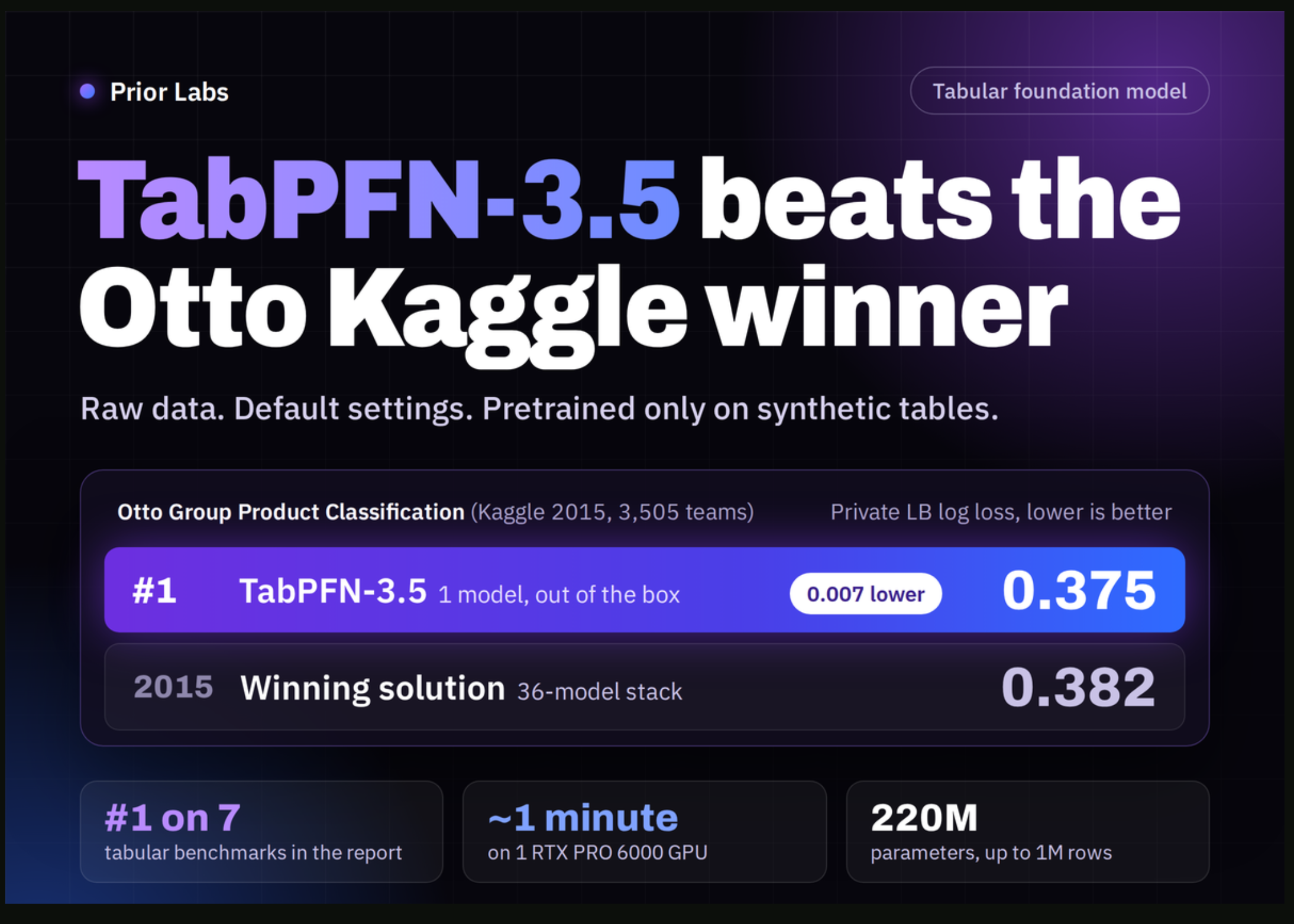
One of the most striking demonstrations of TabPFN-3.5’s capabilities comes from the Otto Group Product Classification Challenge, a famous Kaggle competition that took place in 2015. The challenge tasked participants with categorizing products into nine categories using 93 obfuscated count features. A total of 3,505 teams competed for a $10,000 prize, and the winning entry was a complex ensemble built by two-time world number one Kaggle grandmasters Gilberto Titericz and Stanislav Semenov. Their solution used a multi-layer stack of 36 models built around hand-crafted features, achieving a private leaderboard score of 0.382 log loss.
What makes TabPFN-3.5’s result remarkable is the simplicity of its approach. The model was pretrained exclusively on synthetic data and never had any exposure to the Otto dataset or any Kaggle data during training. When evaluated on the Otto private leaderboard, TabPFN-3.5 scored 0.375 — surpassing the winning 2015 solution by a margin of 0.007 log loss. This was achieved with default settings on raw data in approximately one minute on an RTX PRO 6000 GPU. A reproducible notebook has been made publicly available.
The path to this milestone for other general-purpose systems has been long. AutoGluon, a widely respected open-source AutoML framework, ranked 23rd in its 2020 paper, climbed to rank 14 by 2023, and reached rank 9 by August 2026. The final stretch of the Otto leaderboard proved especially difficult: moving from rank 50 to rank 10 required cutting log loss from 0.41 to 0.40, while climbing from rank 10 to the winning score of 0.382 demanded an additional 0.018 reduction — nearly double the effort per unit of improvement.
## Benchmark Dominance Across Multiple Leaderboards
Beyond the Otto result, TabPFN-3.5 has established itself as a leader across a range of tabular benchmarks. The model’s technical report documents first-place finishes on TabArena, BeyondArena, STRABLE, MulTaBench, RelArena-α, TALENT, and ScoringBench.
On TabArena, a living benchmark comprising 51 datasets, TabPFN-3.5-Thinking — the advanced variant that uses extra inference-time compute — reaches an Elo rating of 1910. The base model scores 1866 Elo, already ahead of TabFM+ at 1823. Prior Labs reports that the base model outperforms AutoGluon 1.6 extreme by 130 Elo points while training in roughly one-fifth of the time.
BeyondArena spans 142 datasets with diverse characteristics, including grouped data, temporal data, wide tables, text-rich features, and high-cardinality columns. TabPFN-3.5 finishes approximately 150 Elo points ahead of the previous overall leader. The model’s architecture proves particularly strong on standard tabular tasks, though tuned and ensembled multilayer perceptrons continue to hold an edge on the grouped, temporal, and large-data slices.
## Architectural Innovations Under the Hood
TabPFN-3.5 introduces several significant upgrades over its predecessors. The in-context transformer has grown from 512 to 1024 hidden dimensions, bringing total parameter count to 220 million — up from 53 million for the earlier TabPFN-3 classification variant.
Key architectural changes include:
– **Single multitask checkpoint:** The model now covers both classification and regression tasks in one unified checkpoint, simplifying deployment.
– **Advanced cell encodings:** Each cell value passes through learned Fourier features and in-context empirical cumulative distribution function (ECDF) ranks. The ECDF rank approach is invariant under strictly monotonic transformations, meaning that operations like log scaling do not alter this encoding.
– **Simplified preprocessing:** Traditional preprocessing steps such as quantile transforms, robust scaling, and singular value decomposition feature extraction have been removed, shifting the burden of data understanding to the model itself.
– **Expanded scale support:** The model handles up to 1 million rows, with 6,000 features recommended and 20,000 supported.
– **Improved synthetic training data:** The pretraining data now emphasizes high-cardinality, wide, and grouped tables, better reflecting real-world tabular distributions.
Despite the roughly fourfold increase in parameters, the key-value cache size remains comparable to TabPFN-3. For single-row predictions, cached inference matches TabPFN-3 in speed. However, on large training datasets, the base model runs up to twice as slowly as its predecessor.
The model family includes several variants: TabPFN-3.5 (the base open model), TabPFN-3.5-Fast (an alpha variant offering up to six times faster inference with 84 million parameters), TabPFN-3.5-Plus (a commercial-grade version with native text and date handling available through Prior Labs’ API), and TabPFN-3.5-Thinking (which adds extra inference-time computation on top of Plus for improved accuracy).
## Deployment and Licensing
The open weights for TabPFN-3.5 and TabPFN-3.5-Fast are released under the TABPFN-3.5 License v1.0. This license permits use for academic research, public data science competitions such as those on Kaggle, and internal testing and benchmarking — provided that results do not feed into commercial decision-making.
For any commercial use case — including competitive benchmarking for procurement, production applications and pipelines, client deliverables, or hosting the model as an API or SaaS service — a commercial license is required. Production deployments can be accessed through Prior Labs’ API, and enterprise integrations are available through platforms such as SAP, AWS SageMaker, Microsoft Foundry, and on-premises installations. The Python package and client SDK are released under the Apache 2.0 license.
## Frequently Asked Questions (FAQ)
**What is TabPFN-3.5?**
TabPFN-3.5 is a tabular foundation model developed by Prior Labs that can make predictions on tabular datasets in a single forward pass, without requiring any per-dataset training or tuning.
**How does it compare to traditional AutoML frameworks?**
On the Otto private leaderboard, TabPFN-3.5 scores 0.375, surpassing the 2015 winning solution of 0.382. On TabArena, the base model achieves 1866 Elo, outperforming AutoGluon 1.6 extreme by 130 Elo while training in roughly one-fifth of the time.
**Was TabPFN-3.5 trained on the Otto dataset or any Kaggle data?**
No. The model was pretrained exclusively on synthetic data and has never been exposed to the Otto dataset or any Kaggle competition data during training.
**Can I use TabPFN-3.5 for free?**
Yes, for non-commercial purposes including academic research, Kaggle competitions, and internal benchmarking. The open weights are freely available under the TABPFN-3.5 License v1.0.
**What are the hardware requirements?**
The model can run on consumer-grade hardware. On an RTX PRO 6000 GPU, it processes the Otto dataset in about one minute with default settings.
**What is the difference between the base model and TabPFN-3.5-Thinking?**
TabPFN-3.5-Thinking is a commercial variant available through Prior Labs’ API that applies additional inference-time computation on top of the Plus model. It achieves 1910 Elo on TabArena — ranking first overall — and operates up to 12 times faster than the earlier TabPFN-3-Thinking variant.
**How large is the model?**
The base TabPFN-3.5 has 220 million parameters. The Fast variant has 84 million parameters. Both use a single checkpoint that handles classification and regression tasks.
**What is the maximum dataset size TabPFN-3.5 can handle?**
The model supports up to 1 million rows. The recommended maximum number of features is 6,000, with up to 20,000 features supported.
**Can I deploy TabPFN-3.5 in a production environment?**
Yes, but a commercial license from Prior Labs is required. You can deploy it through their API, on enterprise platforms like SAP, AWS SageMaker, or Microsoft Foundry, or in an on-premises setup.
**What license governs the model weights?**
The weights are governed by the TABPFN-3.5 License v1.0, which restricts use to non-commercial and non-production purposes. The Python code and SDK are available under Apache 2.0.
## Conclusion
TabPFN-3.5 represents a significant leap forward for tabular machine learning. By demonstrating that a model pretrained purely on synthetic data can outperform solutions built by world-class competitors through extensive feature engineering and ensembling, it challenges long-held assumptions about the necessity of dataset-specific training and handcrafted pipelines. The model’s ability to deliver top-tier performance with minimal configuration — default settings, raw data, and a single forward pass — opens the door to faster experimentation, lower barriers to entry, and more accessible tabular modeling for practitioners and researchers alike.
As the tabular foundation model space matures, TabPFN-3.5 sets a new benchmark for what is achievable when scale, architectural innovation, and synthetic pretraining converge. Whether you are a researcher exploring new tabular methods, a Kaggle competitor seeking an edge, or an organization evaluating machine learning pipelines, the arrival of TabPFN-3.5 marks an important milestone.
Thank you for reading.
