



# JD.com Unveils Physical AI Acceleration Plan to Transform Logistics With 3 Million Robots
China’s leading e-commerce and logistics giant JD.com has announced an ambitious physical AI acceleration plan designed to reshape its entire supply chain through robotics and autonomous systems. The initiative was revealed at JDDiscovery 2026 in Beijing and outlines a sweeping five-year procurement strategy that targets the acquisition of 3 million robots, 1 million autonomous vehicles, and 100,000 delivery drones.
## The Wolf Robot Series and Industrial Automation
At the heart of the plan lies JD Logistics’ newly introduced industrial Wolf Robot series. These machines have been engineered to handle a wide variety of tasks spanning warehousing, sorting, transportation, and last-mile delivery. The series includes multiple specialised subsystems tailored for challenging environments, such as equipment capable of functioning in temperatures as low as minus 20 degrees Celsius, automated pharmacy dispatch systems, and drones built for diverse applications.
## Building on Existing Automation Infrastructure
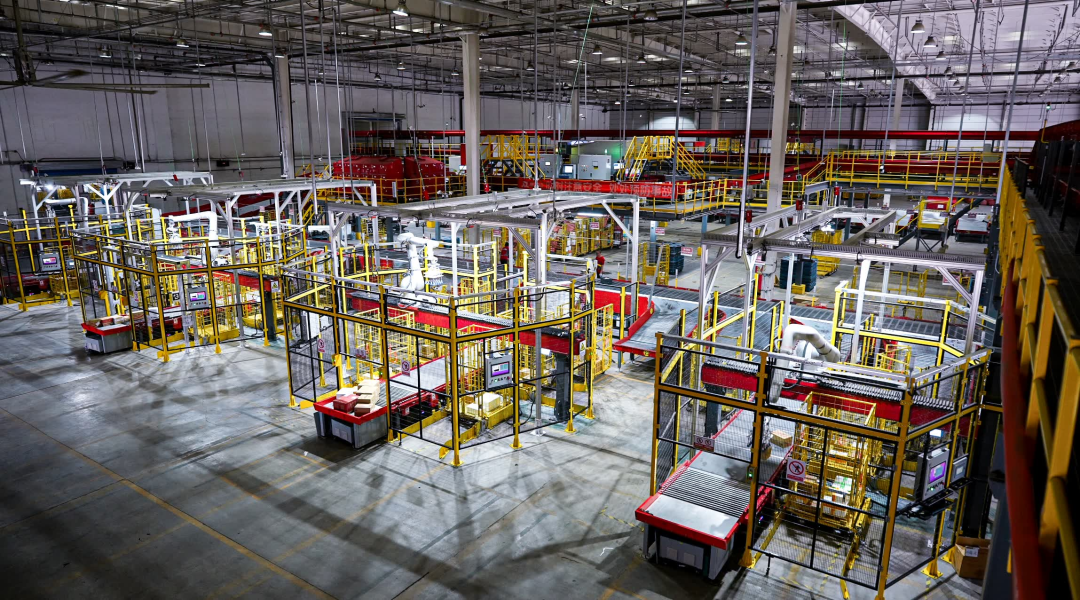
The five-year programme does not start from scratch. JD Logistics has already laid significant groundwork. As of the most recent reporting period ending June 30, the company’s LangzuTech Goods-to-Person automated warehousing system had been deployed across more than 30 warehouses within China, with early-stage rollouts also completed in the United Kingdom and Germany.
The broader warehouse network operated by JD Logistics includes over 1,800 self-operated facilities and more than 2,000 third-party cloud warehouses accessible through its Open Warehouse Platform. Together, these sites span an aggregate footprint exceeding 36 million square metres. In addition, thousands of unmanned vehicles are already in regular operation across more than 20 Chinese provinces, and over 100 domestic drone routes are active, supporting everything from parcel and food delivery to emergency medicine transport and disaster relief operations.
## Meta Brain AI Powers Physical Equipment
JD Logistics is bridging the gap between software intelligence and physical execution through Meta Brain, an AI platform deployed across warehousing, transportation, and delivery workflows. The third iteration of the system, Meta Brain 3.0, is reportedly capable of calculating optimal delivery routes for hundreds of millions of parcels within seconds — a dramatic improvement over the minutes required by previous versions.
The AI model also powers JD Logistics’ LangzuTech Packer robotic arm, which integrates multimodal sensor data to track, grasp, and position parcels of varying shapes and sizes. According to the company’s first-quarter regulatory filing, the Packer employs parallel reinforcement learning within simulated environments to refine parcel-placement sequences and optimise loading layouts. JD upgraded the arm’s force-control technology during the second quarter, enabling more precise cage-loading operations. By June, the Packer was running around the clock at multiple JD Logistics facilities.
## Expanding Computing Capacity for AI Development
Supporting this transformation, JD Cloud has announced a partnership with Chinese chipmaker Moore Threads to develop a computing cluster containing 100,000 GPUs, designed to handle large-model training, inference, and embodied-AI workloads. The two organisations previously collaborated on a 10,000-GPU cluster. While the specific GPU models planned for the larger installation have not been disclosed, the expansion signals a major investment in the computational backbone required for advanced AI.
JD Cloud also intends to collect more than 10 million hours of video footage documenting real-world human activities over the next two years, a dataset that will be used to train embodied AI systems that control physical robots and vehicles.
## Autonomous Vehicles and Drones in Action
JD Logistics has extended its autonomous vehicle programme into night-time delivery, launching overnight routes in Shenzhen that allow vehicles to operate continuously around the clock. In rural areas, the company deployed a drone delivery network in Zizhong, Sichuan province, in June, reaching 78 administrative villages. In certain mountainous regions, deliveries can now be completed in as little as seven minutes.
## Investment, Employment, and Workforce Transition
JD Logistics invested RMB 2.3 billion in research and development during the first half of 2026, a 23.7% increase compared to RMB 1.9 billion in the same period a year earlier. The company attributed the rise to ongoing technology and innovation efforts, though it did not break out specific spending on AI or robotics. Depreciation of property and equipment, along with amortisation of intangible assets, rose 18.7% to RMB 2.6 billion, reflecting the continued accumulation of logistics equipment and vehicles. Total capital expenditure on property and investment properties reached RMB 3.09 billion over the six-month period.
The scale of the automation push also raises questions about the workforce. JD and its ecosystem partners employ roughly 700,000 delivery and logistics personnel across China. JD founder Richard Liu has previously stated that robots will eventually assume the parcel-delivery roles currently performed by human couriers. To prepare for this transition, JD has reportedly signed partnerships with approximately 120 educational institutions to retrain workers for roles such as robot repair and maintenance. JD Logistics currently operates eight robot repair centres in China and plans to expand its robotics after-sales capabilities over the next five years, a move expected to generate more than 100,000 new service engineer positions.
## FAQ
**What is JD.com’s Physical AI Acceleration Plan?**
It is a five-year initiative announced at JDDiscovery 2026 to procure 3 million robots, 1 million autonomous vehicles, and 100,000 delivery drones across JD’s logistics network, supported by the Meta Brain AI platform and the new Wolf Robot series.
**How many warehouses does JD Logistics operate?**
As of June 30, JD Logistics managed over 1,800 self-operated warehouses and more than 2,000 third-party cloud warehouses on its Open Warehouse Platform, covering more than 36 million square metres in total.
**What is Meta Brain?**
Meta Brain is JD Logistics’ AI platform that integrates with physical logistics equipment to handle route optimisation, robotic sorting, and delivery management. Its latest version, Meta Brain 3.0, can compute optimal routes for hundreds of millions of parcels in seconds.
**What is the LangzuTech Packer robotic arm?**
The Packer is a robotic arm powered by Meta Brain that uses multimodal sensors and parallel reinforcement learning to track, grasp, and place parcels of different shapes. It has been operating around the clock at multiple JD logistics facilities since early 2026.
**How is JD preparing its workforce for automation?**
JD has partnered with around 120 educational institutions to retrain workers for roles in robot repair and maintenance. The company operates eight robot repair centres and expects its robotics after-sales expansion to create more than 100,000 service engineer jobs.
**What role does Moore Threads play in JD’s AI strategy?**
Moore Threads is collaborating with JD Cloud to build a 100,000-GPU computing cluster for large-model training, inference, and embodied AI workloads. The two companies had previously worked together on a 10,000-GPU cluster.
**How is JD using drones in rural areas?**
In June, JD Logistics launched a drone delivery network in Zizhong, Sichuan province, serving 78 administrative villages. Deliveries to some mountain communities can be completed in as little as seven minutes.
## Conclusion
JD.com’s Physical AI Acceleration Plan represents one of the most comprehensive moves yet by a major logistics operator to integrate robotics and artificial intelligence into every layer of its supply chain. From warehouse floors powered by LangzuTech automation and Packer robotic arms to autonomous delivery vehicles and drones reaching remote rural villages, the plan spans the full spectrum of modern fulfilment. Coupled with massive investments in computing infrastructure and workforce retraining, JD is positioning itself at the forefront of a logistics revolution that could redefine how goods move across China and beyond. The coming years will reveal how effectively the company scales these technologies and balances automation with the needs of its extensive workforce.
Thank you for reading
