



# Sakana AI’s New Fugu Max and Fugu Ultra v2: A Dual-Track Approach to Smarter Model Routing
## What Is Fugu, and Why Does It Matter?
Sakana AI has introduced two new additions to its Fugu family — Fugu Max and Fugu Ultra v2 — representing a fundamental shift in how AI models are deployed in production environments. Rather than relying on a single monolithic foundation model, the Fugu framework operates as an intelligent orchestrator that dynamically routes tasks to a curated collection of underlying models through a unified API interface.
This architecture addresses one of the most persistent challenges in applied AI: the mismatch between task complexity and model selection. Many real-world applications suffer from inefficiency because teams either over-engineer simple tasks with expensive models or under-deploy capable models for complex problems. Fugu solves this by intelligently matching each query to the most suitable model in its pool, balancing quality and cost simultaneously.
The two new variants serve different optimization goals. Fugu Max is engineered to deliver the highest quality output relative to its cost, making it ideal for enterprises that need to manage large-scale API usage without sacrificing results. Fugu Ultra v2, on the other hand, is optimized for the most demanding multi-step reasoning challenges, including autonomous research, complex code generation, and deep analytical tasks involving structured and visual data.
Both models became available on the same day through Sakana’s hosted API, which is fully compatible with OpenAI’s interface format. This compatibility means that existing applications using OpenAI’s API can switch to either Fugu variant with minimal code changes — a practical advantage for teams looking to experiment with alternative routing architectures.
## The Two-Axis Framework: Capability Meets Cost
Sakana’s approach is built around a framework that evaluates AI systems along two simultaneous axes: capability and cost. This perspective challenges the industry’s tendency to benchmark models purely on raw performance metrics, ignoring the economic realities of deployment at scale.
The concept draws from the Pareto frontier, an economic principle applied to AI infrastructure. In this framework, there exists a boundary where any attempt to improve output quality necessarily increases cost, and any attempt to reduce expenditure comes at the expense of capability. Sakana positions both Fugu variants as points along this frontier, but with different optimization priorities.
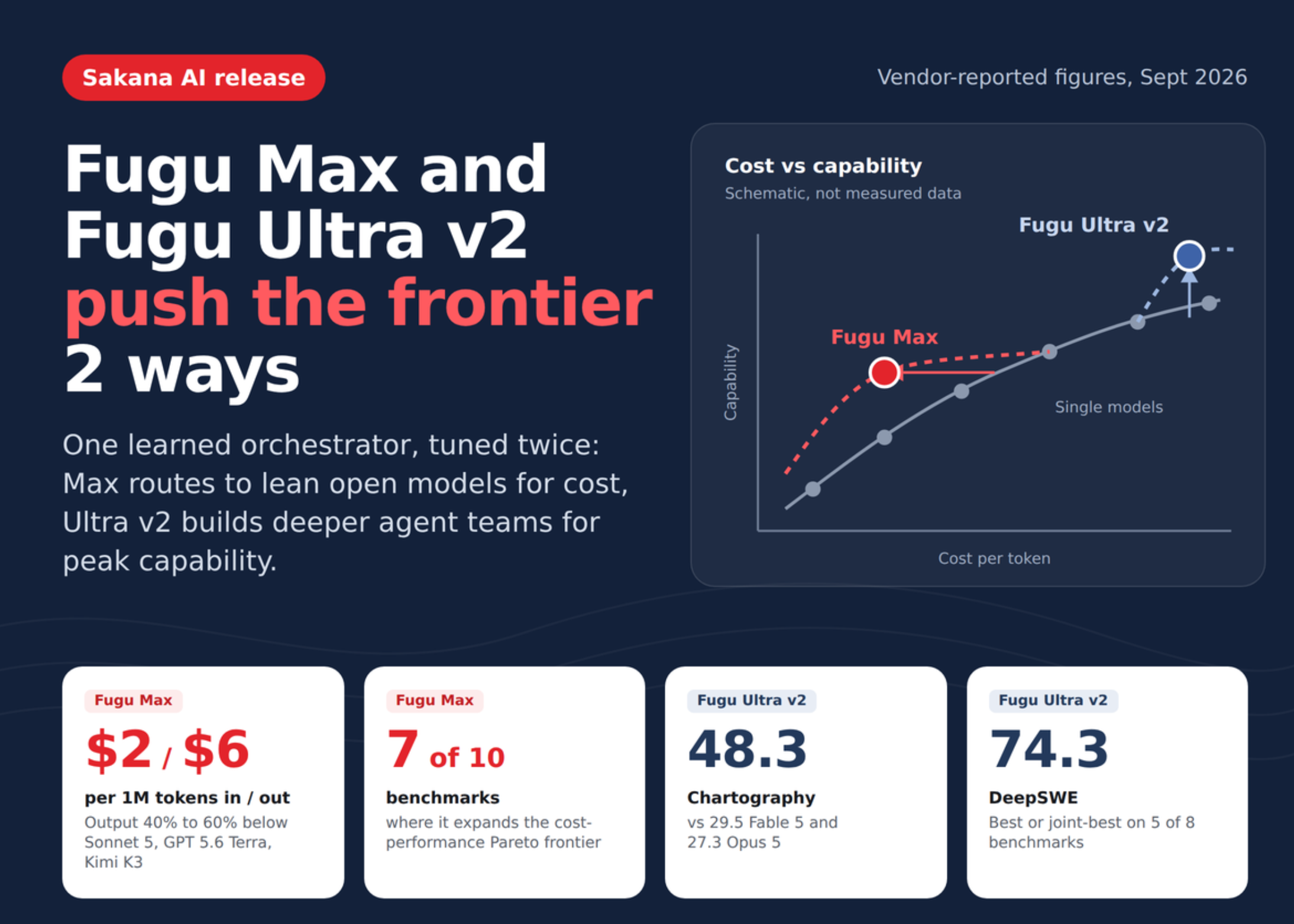
Fugu Max shifts the frontier outward on the cost axis, delivering competitive or superior quality at significantly reduced prices. Fugu Ultra v2 pushes the frontier upward on the capability axis, achieving performance levels that previously required access to premium-priced proprietary models.
This dual-track strategy emerged from Sakana’s rapid development cadence. The original Fugu model entered its beta phase in April, reached general availability in June, and quickly expanded with the addition of Fugu-Cyber and a Claude Code integration by July. The release of Max and Ultra v2 represents the maturation of this initial architecture into production-ready variants with clearly defined use cases.
## How the Orchestration Engine Works
The technical foundation of the Fugu system draws on two papers accepted at ICLR 2026. The first, named TRINITY, introduces a lightweight coordinator that evolves over time to assign different functional roles to specialized sub-agents within the pool. These roles include the Thinker, which plans and decomposes complex queries; the Worker, which executes the actual computation or generation; and the Verifier, which checks the output for accuracy and consistency.
The coordinator itself is trained using reinforcement learning, allowing it to discover natural language coordination strategies and develop focused prompting techniques without manual engineering. This means the orchestration logic improves over time as it encounters diverse workloads, rather than relying on static rules programmed by developers.
When a user sends a query through the Fugu API, the system analyzes the request in real time, constructs an agentic scaffold, and dispatches components across the model pool. The architecture treats the Fugu models themselves as language models with their own reasoning capabilities, meaning they can interpret ambiguous requests, break them into sub-tasks, and reassemble results from multiple specialized agents into a coherent final response.
The training process combines large-scale fine-tuning with evolutionary algorithms, a methodology inspired by biological selection principles. This hybrid approach allows the system to explore a wide range of orchestration strategies and converge on those that produce the best outcomes for specific optimization targets.
## Fugu Max: Optimizing for Cost Efficiency
Fugu Max represents a deliberate expansion of the models available in the orchestration pool. It incorporates a wide range of open-weight models and specialized systems, including the NVIDIA Nemotron family developed through Sakana’s collaboration with NVIDIA. By widening the available model selection, Fugu Max can assign each task to the most cost-effective option that still meets quality requirements.
Sakana reports that Fugu Max delivers output pricing that is 40% to 60% lower than leading competitors including Sonnet 5, GPT 5.6 Terra, and Kimi K3. The pricing structure is set at $2 per one million input tokens and $6 per one million output tokens, a structure that favors high-throughput workloads where input volume dominates.
In benchmarking, Fugu Max achieved the highest overall score across six independent evaluations: Terminal Bench 2.1, GPQA Diamond, AA-LCR, GDP.pdf, AutomationBench, and SWEFish. The last benchmark, SWEFish, is an internal Sakana benchmark constructed from its own coding challenges, and should be interpreted with that context in mind.
On a broader set of ten benchmarks, Fugu Max expanded the cost-performance Pareto frontier on seven, indicating that its approach of routing to leaner models does not systematically compromise quality. Sakana reports that Fugu Max comes within striking distance of elite models while operating at two to six times lower cost, a compelling value proposition for teams managing large-scale inference workloads.
## Fugu Ultra v2: Pushing the Ceiling on Complex Tasks
Fugu Ultra v2 is designed for scenarios where raw capability matters more than cost per token. Its strongest performance emerges in sustained reasoning tasks that involve visual data, structured information, and multi-step problem solving.
On Chartography — a benchmark measuring visual reasoning and data interpretation — Fugu Ultra v2 achieved a score of 48.3, dramatically outperforming Opus 5 at 27.3 and Fable 5 at 29.5. On DeepSWE, which evaluates real-world software engineering capabilities, it scored 74.3, surpassing models that cost three to five times more per token.
Across eight benchmarks, Fugu Ultra v2 achieved the best or joint-best result on five and maintained a top-two position on seven, demonstrating consistent excellence across diverse task types. These benchmarks include GDP.pdf, Chartography, SWEFish, DeepSWE, and Toolathon.
Notably, Fugu Ultra v2 achieves these results without including Fable 5, Fable 5.1, or GPT-6-Astra in its agent pool. The model’s training data cutoff is August 28, 2026. This independence from any single proprietary model is a strategic choice by Sakana, as it reduces dependency on any one API provider and mitigates risks associated with vendor lock-in, sudden API changes, or service discontinuations.
The research team behind Fugu emphasizes that this architecture allows access to frontier-level output without reliance on any single model, whether open or proprietary. The agent pool composition can be updated as new models become available, meaning the system’s capabilities can evolve independently of any single vendor’s roadmap.
## Deployment and Accessibility
Both Fugu Max and Fugu Ultra v2 are available immediately as hosted APIs with OpenAI-compatible endpoints. This means developers can integrate them into existing workflows with minimal friction — essentially a single line of code change to swap API endpoints.
There are no open weights available for self-hosting, which means organizations must use Sakana’s infrastructure to access these models. Additionally, the service is not currently available in the European Union or European Economic Area, which may limit adoption for EU-based enterprises subject to regional data sovereignty requirements.
## FAQ
**What exactly is Fugu?**
Fugu is not a single AI model. It is an orchestration framework that intelligently routes incoming queries to a pool of specialized models behind a single API. The system dynamically selects which models to use for each task based on the complexity and nature of the request.
**How do Fugu Max and Fugu Ultra v2 differ?**
Fugu Max is optimized for cost efficiency, delivering strong performance at lower prices by routing tasks to the leanest capable models. Fugu Ultra v2 is optimized for maximum capability on complex, multi-step tasks, using a more powerful combination of models even at higher cost.
**Can I self-host Fugu models?**
No. Fugu models are available only through Sakana’s hosted API. There are no open weights provided for self-deployment.
**Is Fugu available in the EU?**
No. Sakana does not currently offer Fugu services in the European Union or European Economic Area.
**What benchmarks does Fugu Max perform well on?**
Fugu Max achieved the best overall score on six benchmarks: Terminal Bench 2.1, GPQA Diamond, AA-LCR, GDP.pdf, AutomationBench, and SWEFish.
**What is Chartography?**
Chartography is a benchmark that tests AI models on visual reasoning and data interpretation tasks, such as reading charts, graphs, and structured visual information.
**Does Fugu Ultra v2 depend on proprietary models like GPT or Claude?**
No. Fugu Ultra v2’s agent pool does not include Fable 5, Fable 5.1, or GPT-6-Astra. It achieves its benchmark scores using a diverse pool of models that are independent of any single proprietary provider.
**How easy is it to switch from OpenAI’s API to Fugu?**
Very easy. Fugu’s API is fully OpenAI-compatible, requiring only a minimal configuration change — typically a single line of code — to switch API endpoints and authentication.
**What makes the Fugu orchestration system unique?**
The system uses reinforcement learning and evolutionary algorithms to train its coordinator, which dynamically assigns Thinker, Worker, and Verifier roles across multiple models for each query. This allows it to adapt its routing strategy to the specific demands of each task.
**When did Sakana start releasing Fugu variants?**
The original Fugu model entered beta in April, reached general availability in June, and has since expanded with additional variants including Fugu-Cyber and the Claude Code interface, followed by Fugu Max and Fugu Ultra v2.
## Conclusion
Sakana AI’s release of Fugu Max and Fugu Ultra v2 represents a significant evolution in how AI inference can be managed at scale. By treating model selection as an orchestration problem rather than a single-model problem, Fugu addresses both of the most critical concerns in production AI: capability and cost. The dual-track approach, with Max focused on efficiency and Ultra v2 focused on ceiling-breaking performance, gives teams a flexible toolkit that can be matched to their specific needs.
The open API compatibility and the emphasis on independence from any single proprietary model further strengthen the practical appeal of the Fugu system. As enterprises increasingly adopt AI for complex workflows, architectures that intelligently distribute work across specialized models — rather than funneling everything through a single expensive model — are likely to become the standard. Fugu Max and Fugu Ultra v2 offer a concrete implementation of this principle today.
Thank you for reading
