



# How Robotic Bricklaying Is Poised to Reshape the Construction Industry
## A Housing Crisis Meets a Labor Shortage
The American construction industry is facing a twin crisis. Nearly all contractors report difficulty filling open positions, and the nation is millions of homes short of what it needs. In this environment, a growing number of technology companies are turning to robotics as a potential solution — and one firm in particular has set its sights on one of the oldest and most labor-intensive tasks in building: laying bricks.
Bricklaying demands both physical endurance and precision. It is also one of the most persistent skilled-trade shortages across the developed world, with countries like the United Kingdom, the Netherlands, and Germany all struggling to find enough qualified masons. Rather than waiting for a cultural shift that draws younger workers into the trade, some innovators believe automation can close the gap — and do so without requiring a fundamental overhaul of how buildings are constructed.
## Why Bricklaying First?
The decision to begin with brickwork is strategic on multiple levels. For one, bricklaying sits at the intersection of heavy labor and fine motor skill, making it a proving ground for broader robotic capabilities. If a machine can reliably pick up, position, and secure individual bricks while applying mortar with consistency, the underlying technology can theoretically extend to a wide array of other site tasks.
There is also a practical advantage in choosing brickwork over newer construction methods. While alternative building systems — such as modular and prefabricated approaches — are gaining traction, brick and block remain staples of the industry in many regions. Automating a process that is already universally understood means the technology can be deployed without forcing the entire sector to change its fundamentals.
## Meet the Machines
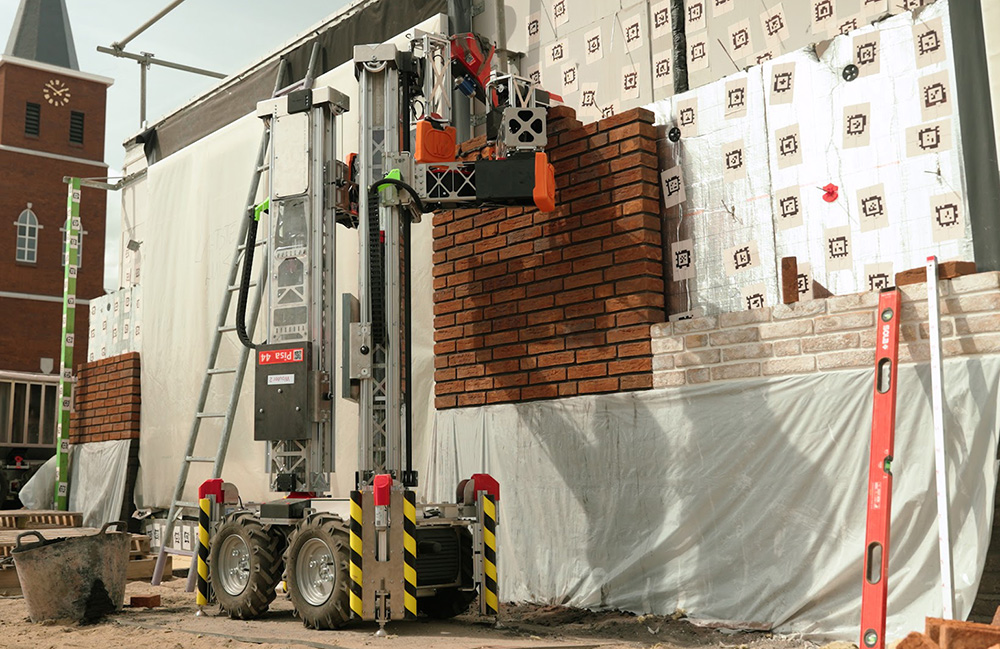
The company has designed a trio of robots that work in concert to handle the bricklaying workflow. The centerpiece is a machine built for picking and placing bricks, equipped with dual articulated arms — one responsible for handling and positioning each brick, the other for dispensing mortar between them. It is not humanoid in form; rather, it resembles a compact tower crane system, optimized for the repetitive motions that bricklaying demands.
Supporting the primary robot are two material-handling units. One unit is tasked with delivering fresh bricks to the worksite, while the other keeps the mortar supply steady. Together, the three machines form a small, self-contained crew that can operate continuously as long as materials are fed and power is maintained.
All three robots are built on a shared hardware platform, which means the engineering and software infrastructure developed for bricklaying can be adapted to additional tools and attachments as the company expands its capabilities. The team estimates that only a small fraction of the technology they are building is specific to brickwork; the vast majority consists of general-purpose systems for perception, navigation, and coordination on active job sites.
## Material Handling as the Real Challenge
Watching a construction site unfold reveals a truth that is easy to overlook: much of the work on any given project comes down to moving materials from one place to another. Workers spend a significant portion of their time wheeling supplies, repositioning equipment, and keeping every station stocked. The robotic team behind this approach sees solving that logistics problem as just as critical as automating the actual trades.
To keep the robots connected and coordinated in real time, the company deploys a distinctive communication hub — a mushroom-shaped device placed at the worksite. It aggregates cellular, satellite, and local wireless connectivity, giving the machines reliable access to the data networks they need to function in environments that are often far from standard infrastructure.
## Navigating a Decentralized Industry
Construction is famously fragmented. A single residential project can involve a dozen or more subcontractors, each responsible for a different phase of the work — foundations, framing, plumbing, electrical, and so on. This decentralization creates challenges, but it also creates an opening for robotic firms willing to enter the market as yet another specialty subcontractor.
Unlike industries where a new entrant must deeply integrate with an established corporation’s systems and processes, construction is accustomed to bringing in outside teams with their own methods and equipment. A general contractor who needs a foundation poured simply calls a concrete company and lets them do their work. A crew of robots arrives at a job site the same way: as a service provider with its own playbook.
That said, no amount of robotic sophistication can overcome the realities of a messy, interdependent workflow. If bricks do not arrive on schedule, the laying robot sits idle — regardless of how advanced it is. Material delivery, weather conditions, and coordination with dozens of other trades remain persistent hurdles that affect every contractor, human or mechanical.
## Learning in the Field
Perhaps the most valuable lesson the company has learned is that real-world deployment cannot be replaced by simulation or lab testing. In its early field work, the team encountered a situation that no amount of planning could have fully anticipated: the bricks supplied for a job were an unusually dark, near-black color, very different from the red and lighter bricks the team’s computer vision models had been trained on. The recognition system initially failed, forcing a rapid retraining effort using newly gathered data.
These kinds of surprises — unexpected brick colors, shifting weather, variable site layouts — are precisely why the company prioritizes getting robots onto real job sites as quickly as possible. Each deployment generates data that makes the systems more robust, and each iteration of that data expands the range of conditions the machines can handle. The early phase of the industry, they argue, is less about proving a concept and more about accumulating the breadth of experience needed to scale confidently.
## What Comes Next
Other companies in the space are exploring complementary approaches. Some focus on autonomous excavators and ground-moving equipment that handle the site preparation phase of construction, while at least one firm is pursuing a more ambitious model: building entire homes inside robotic microfactories before transporting them to their final locations. The bricklaying-focused approach represents just one entry point into a much larger opportunity.
For the robotic construction sector as a whole, the path forward involves moving from small pilot projects to broader, more consistent deployment. Each project completed and each lesson learned adds to a growing body of operational knowledge that will eventually make the technology reliable enough for widespread adoption.
## Frequently Asked Questions
**What problem are robotic bricklaying systems trying to solve?**
Robotic bricklaying aims to address two converging crises in the construction sector: a severe and worsening labor shortage and a significant shortfall in housing supply. By automating one of the most physically demanding and hardest-to-staff trades, the technology seeks to accelerate building timelines without requiring an influx of new human workers.
**How does a robotic bricklaying system work on a job site?**
A typical setup includes a primary robot that picks up and places individual bricks while applying mortar, supported by companion robots that deliver materials and keep the primary machine supplied. Communication hubs on-site ensure all units stay connected and coordinated. The system operates as a compact, self-contained crew.
**Why did these companies start with bricklaying instead of other construction tasks?**
Bricklaying was selected because it is physically demanding, universally recognized as a trade in shortage, and representative of the precision and material-handling challenges found across many other construction activities. Success in automating brickwork suggests the underlying technology could extend to additional tasks.
**Can robots handle the variability of real construction sites?**
This has been one of the industry’s biggest learning opportunities. Robots have encountered unexpected material variations, weather shifts, and coordination challenges that required real-time adaptation. The early phase of deployment is heavily focused on gathering this kind of data so systems can become resilient to a wide range of conditions.
**How do robotic construction firms fit into the existing industry structure?**
Most operate as subcontractors, bringing robotic crews to sites in much the same way a traditional specialty contractor would. This approach leverages the already decentralized nature of construction, where general contractors routinely hire outside firms for specific phases of work.
**Are there alternatives to on-site robotic construction?**
Yes. Some companies are building homes in robotic microfactories using prefabricated components, while others focus on autonomous heavy equipment for site preparation. These represent different points on the spectrum of how deeply robotics can penetrate the construction process.
## Conclusion
The construction industry stands at a crossroads. Decades of declining interest in skilled trades, combined with an unsustainable housing deficit, have created a problem that traditional approaches — recruiting more workers, streamlining processes — have struggled to solve. Robotic systems for bricklaying and other site tasks offer a fundamentally different path: one where machines take on the roles that human workers are increasingly unable to fill.
The road from experimental pilot projects to industry-wide adoption will require patience, real-world learning, and continued investment. But for a sector that builds the most essential infrastructure of daily life, the potential payoff is immense. Automation in construction is not about replacing the industry’s past — it is about ensuring that the buildings of the future can actually be built.
Thank you for reading
