



Rethinking Rural Connectivity: How Smart Meters Are Building Their Own Networks
A massive smart metering initiative in Uttar Pradesh has successfully linked close to one million electricity meters using a decentralized mesh approach, bypassing the traditional hurdles of rural connectivity. Extending advanced metering infrastructure into remote regions presents a vastly different challenge than connecting devices in dense urban environments. While metropolitan areas benefit from robust cellular networks, vast villages often suffer from inconsistent mobile coverage. Constructing dedicated communication towers or centralized gateways across widely dispersed communities adds significant cost and logistical complexity, particularly when managing enormous device populations.
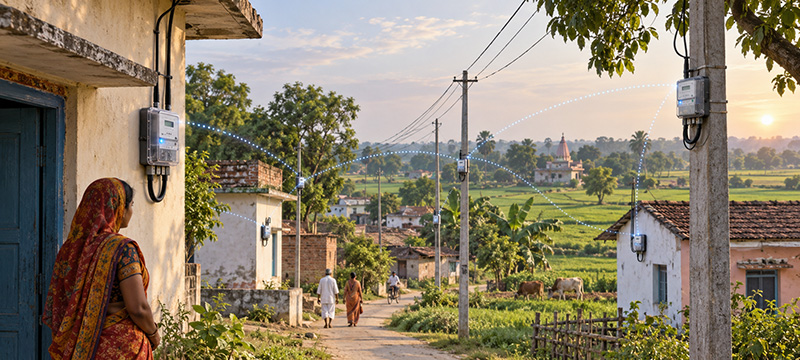
The defining feature of this deployment is the way connectivity infrastructure is distributed across the meter population. Rather than requiring a SIM card in every single device or installing dedicated gateways to serve groups of meters, the meters communicate directly with one another and relay data through the network. Meters equipped with dual-communication capabilities can seamlessly utilize cellular connectivity where it is absolutely required, while the rest of the network routes data through neighboring devices.
This architecture fundamentally alters the economics of large-scale advanced metering. Adding another meter to the grid does not necessarily create another cellular subscription or require the installation of a new physical gateway nearby. Instead, it becomes another potential node in the mesh. In a geographically dispersed rollout, increasing device density naturally contributes to network coverage, rather than simply multiplying the amount of communication infrastructure that must be provisioned.
The underlying technology complies with standard utility protocols, ensuring seamless interoperability with existing management systems through standardized application programming interfaces. The solution is already part of a national initiative to modernize electricity distribution across the country, overseeing tens of millions of connected endpoints. The practical implication for utilities and system integrators is that connectivity choices for smart grids do not have to reduce to a binary decision between private infrastructure and cellular IoT. A mesh architecture combined with selective cellular backhaul offers a third path: local traffic moves across a self-forming device network, while wide-area connectivity is introduced only at points where it is operationally useful.
**Frequently Asked Questions (FAQ)**
**Q: How do these meters stay connected without individual cellular plans in every device?**
A: The meters utilize a radio frequency mesh network where each device acts as a relay point. Data hops from meter to meter across the community. Only select meters with dual-communication capabilities use cellular backhaul to bridge the network to wider infrastructure, eliminating the need for a SIM card in every endpoint.
**Q: Why is this method more cost-effective for rural areas compared to traditional approaches?**
A: Traditional methods often require expensive dedicated gateways or individual SIM cards for every endpoint, which becomes financially unviable in dispersed rural settings. By allowing the meter population itself to form the infrastructure, utilities avoid the capital expenditure of building separate communication towers and the recurring operational costs of cellular subscriptions for every single device.
**Q: Does adding more meters complicate the network or require more gateways?**
A: No, the opposite is true. In a mesh architecture, every additional fixed meter acts as a new potential node that can help route data. As the deployment expands, the communication fabric becomes denser and more resilient, improving overall organic coverage without requiring a proportional increase in physical gateways or external connectivity.
**Q: Can this technology integrate with existing utility management systems?**
A: Yes, modern mesh platforms are designed to align with standard utility protocols and can connect to utility head-end systems through standardized APIs. This ensures that the decentralized communication layer can feed data reliably into existing operational technology environments.
**Conclusion**
The large-scale deployment in Uttar Pradesh highlights a vital shift in how massive IoT projects can be approached, particularly for fixed devices spread across service territories. By moving away from a model where every device connects directly to external infrastructure, utilities can achieve a more resilient, scalable, and cost-effective solution. In sufficiently dense, fixed deployments, the endpoints themselves can be engineered to become part of the network architecture. This hybrid approach—leveraging local mesh networking alongside strategic cellular connectivity—offers a sustainable blueprint for the future of national infrastructure modernization, proving that the most appropriate wide-area network is not always one where every device connects directly to the cloud. Thank you for reading.
