



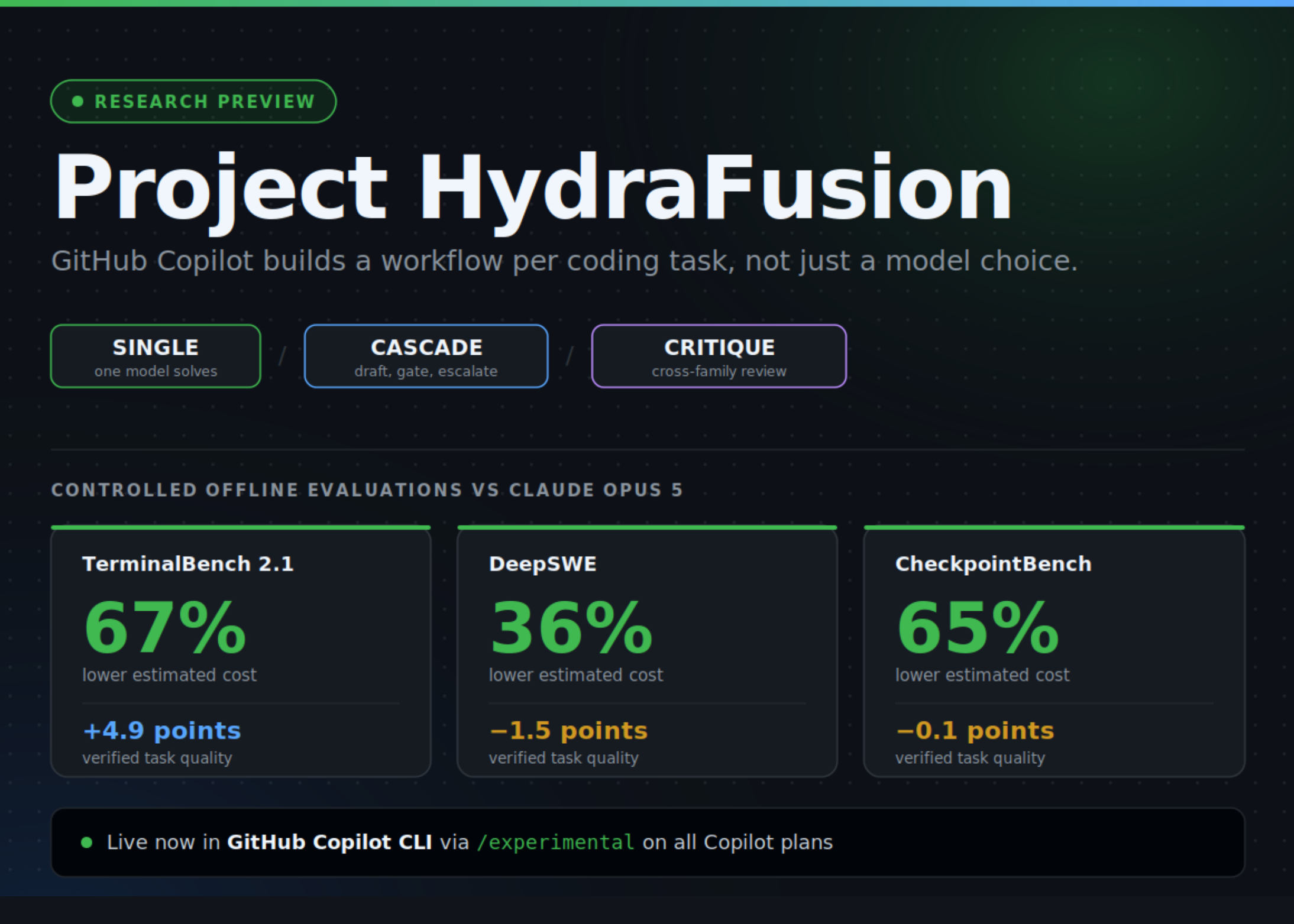
# GitHub’s Project HydraFusion: A New Era of Dynamic Model Selection for AI-Assisted Coding
GitHub has introduced **Project HydraFusion**, a research preview that fundamentally rethinks how AI models are selected during software development workflows. Rather than locking developers into a single model choice for each session, HydraFusion evaluates every incoming request and dynamically constructs an execution plan optimized for both quality and cost.
## Rethinking Model Routing
Traditional AI-assisted coding tools route each prompt to a single, pre-selected model. HydraFusion challenges this approach by treating model selection as an ongoing optimization problem. The system assesses capability signals for reasoning, code generation, debugging, and tool use — then determines the least complex workflow likely to meet a predefined quality threshold.
Think of it this way: instead of asking “which model is best for this session?”, HydraFusion asks “which workflow is best for this specific request?” The answer may involve one model, two models in sequence, or an independent reviewer from a different model family.
The developer experience remains simple. You configure HydraFusion once as you would any other model, and the system handles the complexity behind the scenes.
## How HydraFusion Works in Practice
The runtime is governed by five engineering principles designed for real-world repository work:
– **Complete accounting** — every stage of execution is tracked, including drafting, critique, revision, escalation, retry, and fallback.
– **Bounded execution** — each step has explicit timeout and cancellation limits.
– **Isolated review** — critic models operate in a tool-less environment and cannot modify the repository.
– **Fail-safe application** — no patch is applied if a workflow fails validation or is cancelled mid-execution.
– **Validated routing** — model bindings, fallback behavior, and availability are verified before any execution begins.
Internally, the runtime logs role, outcome, cost, latency, and diagnostics for every leg of execution. Externally, the developer sees a single coherent response with one permission-aware change set.
## The Three Execution Patterns
HydraFusion currently operates in three distinct modes, each trading off quality against cost in a different way:
### Single Mode
One selected model handles the entire task from start to finish. This is the fastest and most cost-effective path, and HydraFusion defaults to it whenever it expects additional model calls won’t meaningfully improve the result.
### Cascade Mode
An efficient model drafts a solution first. A quality gate then evaluates whether the draft is sufficient. If it passes, the result is applied. If it fails, the request escalates to a more powerful model for a second attempt. This pattern keeps high-quality inference available when needed while avoiding unnecessary cost.
### Critique Mode
A drafting model generates an initial solution, then an independent critic from a different model family performs a read-only review. The original drafting model receives the feedback and revises once. The critic operates without tool access, ensuring it cannot alter the repository. This pattern is particularly useful when an external perspective adds value that another unaided attempt from the same model cannot replicate.
## Deployment and Setup
HydraFusion is currently available as a research preview for all GitHub Copilot plan users, but only within GitHub Copilot CLI. There are no open weights and no self-hosted deployment option at this time.
To activate it, users run `/update`, then `/experimental on`, then `/model`, and select `HydraFusion (Research Preview)` from the available options. Billing is straightforward — it is charged per token consumed by whichever models the workflow invokes, at each model’s standard rate.
## Benchmark Performance
GitHub’s engineering team evaluated fixed HydraFusion policies across three agentic coding benchmarks, using Claude Opus 5 and GPT-5.6 Sol as baseline models, all running at medium reasoning level. The table below shows the results relative to Opus 5.
| Benchmark | Estimated Cost vs Opus 5 | Verified Task Quality vs Opus 5 |
|—|—|—|
| TerminalBench 2.1 | 67% lower | +4.9 points |
| DeepSWE | 36% lower | −1.5 points |
| CheckpointBench | 65% lower | −0.1 points |
The standout result comes from TerminalBench 2.1, where HydraFusion achieved a 67% cost reduction while simultaneously improving quality by nearly five points. On DeepSWE and CheckpointBench, HydraFusion trails slightly on quality but delivers dramatic cost savings of 36% and 65% respectively.
CheckpointBench deserves special mention — it is GitHub’s internal multi-turn benchmark, curated from real Copilot sessions and anchored to immutable public commits, making each run fully replayable and reproducible.
## Key Takeaways
– HydraFusion makes workflow-level decisions on a per-request basis, drawing from models across multiple providers.
– Three execution patterns are available today: Single, Cascade with a quality gate, and Critique with a cross-family reviewer.
– The system achieved its strongest results on TerminalBench 2.1 — better quality at 67% lower cost.
– On DeepSWE and CheckpointBench, HydraFusion delivers significant cost savings at the expense of small quality differences.
– The preview is accessible now through GitHub Copilot CLI using the `/experimental` command.
## Frequently Asked Questions
**What types of tasks benefit most from HydraFusion?**
Tasks that involve multiple steps — such as cross-file engineering, debugging, or complex reasoning — tend to benefit the most. The system is designed to escalate to stronger models when it detects that the initial draft is unlikely to meet quality standards.
**Is HydraFusion available for self-hosted deployments?**
No. At this stage, HydraFusion is only available as a research preview within GitHub Copilot CLI for cloud-based Copilot plans. There are no open weights or self-hosted options.
**How does billing work when multiple models are involved in a single workflow?**
Each model invoked during a workflow is billed at its standard per-token rate. If a Cascade pattern triggers an escalation, you are charged for both the initial efficient model’s tokens and the stronger model’s tokens. Similarly, Critique mode incurs costs for both the drafting model and the critic model.
**Can the critic model modify my codebase?**
No. The critic in Critique mode operates in an isolated, tool-less context. It can only review — it has no ability to read, write, or modify files in the repository.
**Will HydraFusion always use multiple models?**
No. If the router determines that a single model can clear the quality bar, it will use the Single pattern. HydraFusion only adds extra model calls when they are likely to improve the outcome.
**How is quality measured in the benchmarks?**
Quality is measured through verified task completion on agentic coding benchmarks. CheckpointBench uses real Copilot session data anchored to immutable public commits for reproducibility. The exact scoring methodology is documented in the research materials accompanying the preview.
## Conclusion
Project HydraFusion represents a meaningful shift in how AI-assisted coding tools approach model selection. By treating each request as a unique optimization problem — weighing cost, capability, and quality — it opens the door to workflows that are both more efficient and, in many cases, more capable than static model routing. While it is currently limited to a research preview in Copilot CLI, the benchmark results suggest a compelling value proposition: substantial cost savings without sacrificing — and in some cases improving — task quality. As the system matures and potentially expands beyond CLI, it could set a new standard for how developers interact with multi-model AI systems.
Thank you for reading
