



# When Machines Write: Rethinking Authorship, Accountability, and Credit in Modern Science
The rapid integration of artificial intelligence into scientific research has triggered one of the most consequential debates in modern academia. As machine learning systems become capable of drafting manuscripts, synthesizing vast bodies of literature, and refining written arguments, fundamental questions about the nature of intellectual contribution have come to the forefront. If a researcher uses an AI system to compose portions of their paper, who deserves authorship? And what does it mean for a scientific contribution to be considered trustworthy when part of its creation was shaped by a machine?
## The Shifting Meaning of Scientific Credit
For centuries, the practice of listing authors on a research paper served as both a badge of honor and a marker of responsibility. Being named as an author meant that you stood behind the work — its methodology, its claims, and its interpretations. It communicated to peers and the public that you possessed the expertise and integrity to warrant trust.
This understanding of authorship did not emerge in a vacuum. It evolved through institutional practices, professional norms, and community agreements that determined who was credited and for what kind of effort. Consider the case of Isaac Newton, whose legendary status did not rest solely on his discoveries. It also depended on his skillful navigation of the Royal Society and the publication customs of his era — the same kinds of social and institutional frameworks that governed who received credit and how.
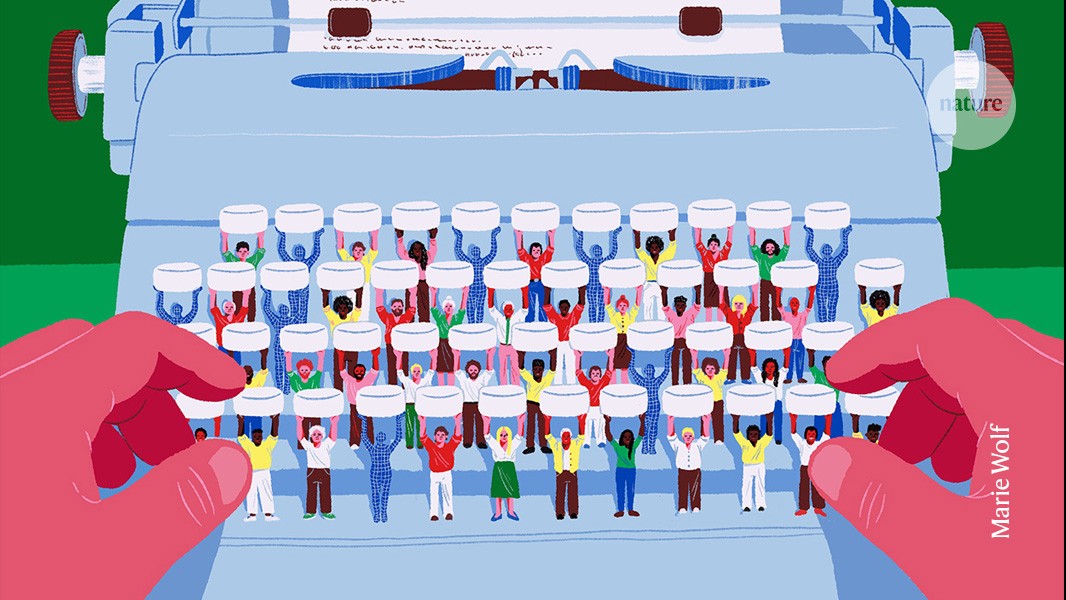
Every generation of scientists has contended with tools that reshaped these conventions. The typewriter, the photocopier, and the internet each forced the scientific community to renegotiate what counted as original work. Artificial intelligence represents the latest — and perhaps most profound — disruption to these long-standing arrangements.
## Why AI Contribution Is Different from Human Collaboration
One of the most critical distinctions in this debate is that AI cannot function as a collaborator in the way a human research assistant or junior colleague can. A graduate student or postdoctoral researcher can explain why they chose a particular method, respond to critical feedback, correct errors, and accept responsibility for mistakes. They are accountable agents.
An AI model lacks this capacity entirely. It cannot justify its outputs, learn from criticism in a meaningful sense, or be held morally responsible for inaccuracies. When a scientist uses generative AI to summarize literature or polish a draft, they are not simply adding another pair of hands to the project. They are introducing a process that falls outside the established frameworks of intellectual contribution and accountability.
This distinction matters because the very purpose of authorship — signaling competence and trustworthiness — is undermined when authorship is attributed to entities that cannot answer for their work.
## The Limits of Current Contribution Frameworks
Many publishers now use detailed taxonomies to categorize the specific roles each author played in producing a manuscript. These frameworks, which break down labor into tasks such as conceptualization, data curation, methodology design, and writing, have been widely adopted because they offer greater transparency than simply listing authors by name.
However, these systems were designed exclusively for human contributors. They do not account for the range of technologically mediated activities that AI introduces: crafting prompts, evaluating generated text, classifying information, verifying outputs, and integrating machine-produced content into human-written sections. These actions currently have no place within existing contribution taxonomies, making it nearly impossible for readers and editors to understand how much of a paper involved AI mediation and who bore responsibility for its content.
As these systems become more embedded in the research process, the inadequacy of current frameworks will only grow more apparent.
## The Hidden Politics of Attribution
The question of who gets credit extends well beyond the author list on a journal article. The acknowledgments section — often treated as an afterthought — is actually part of a deeply structured economy of recognition. It is where certain forms of labor are elevated, where others are politely noted, and where some remain entirely invisible.
Research assistants, students who ran experiments, colleagues who offered insights during informal conversations — all of these individuals may be mentioned or forgotten depending on the judgment of the lead author. The same dynamic applies to the vast human workforce that underpins AI systems themselves: the individuals who label training data, evaluate model outputs, maintain computational infrastructure, and produce the texts on which large language models are built. Their contributions rarely appear anywhere in a published paper.
This hidden labor raises uncomfortable questions. If AI-generated summaries or drafts are credited through authorship or acknowledgment, why is the human work that trains and sustains those systems not recognized in any comparable way?
## AI in Editorial and Review Processes
The influence of AI in academia is not limited to the writing desk. Increasingly, machine learning tools are being used to screen manuscript submissions, assist editors in selecting peer reviewers, interpret review reports, and even shape the language of editorial decisions. These interventions determine which papers advance through the publication pipeline and which authors gain or lose standing in their fields.
When AI systems begin to influence these gatekeeping functions, the power dynamics of scholarly communication shift in ways that remain largely unexamined. Editorial decisions shaped by algorithmic suggestions carry the same authority as those made by human editors — but without the same mechanisms for transparency or appeal.
## An Opportunity to Reimagine Scholarly Recognition
Rather than viewing AI as simply another tool to be folded into existing workflows, the scientific community has an opportunity to use this moment to fundamentally rethink how intellectual labor is valued. If AI-assisted literature synthesis can be recognized as authorship-worthy work, then shouldn’t the same standards apply when a human research assistant performs that exact task?
This kind of critical reflection could help dismantle some of the hierarchical assumptions embedded in academic publishing — assumptions that currently leave many forms of essential labor unrecognized and unrewarded. It could push the community toward more equitable, transparent, and accountable systems of credit.
The decisions made today about AI’s role in science will shape the norms and practices of scholarship for decades to come. These choices should not be left to convenience or institutional inertia. They demand deliberate, inclusive, and publicly engaged deliberation.
—
## Frequently Asked Questions
**Q: Can AI legally be listed as an author on a scientific paper?**
A: Currently, most major publishers and research institutions maintain that authorship should be reserved for human beings who can take responsibility for a work’s content and integrity. AI tools are generally acknowledged as instruments rather than authors.
**Q: What happens if a paper produced with significant AI assistance contains errors?**
A: Responsibility falls on the human authors, editors, and institutions involved. AI systems cannot be held accountable for inaccuracies, which is a key reason why human oversight remains essential.
**Q: How should researchers disclose their use of AI in writing?**
A: Many journals now require authors to disclose any use of AI tools in the creation of a manuscript. Some recommend listing AI use in the methods section or acknowledgments, though standardized disclosure practices are still evolving across disciplines and publishers.
**Q: Does using AI to improve the clarity of a paper constitute a form of intellectual contribution?**
A: Using AI purely for stylistic improvements — such as grammar correction or clarity enhancement — is generally viewed differently from using AI for substantive content generation, such as drafting arguments or synthesizing data. The nature and extent of AI involvement determines whether it constitutes a meaningful contribution.
**Q: Why is invisible human labor in AI systems relevant to this discussion?**
A: The outputs of AI models are built upon the labor of thousands of people — data labelers, trainers, platform engineers, and the original authors whose texts fed into training datasets. Recognizing this labor is part of a broader conversation about fairness and attribution in academic and technological systems.
**Q: Can the current systems of academic credit accommodate AI mediation?**
A: Existing frameworks like CRediT were not designed with AI in mind. As AI becomes more central to research processes, these systems will need significant revision to accurately represent how knowledge is being produced today.
—
## Conclusion
Artificial intelligence is reshaping every stage of the scientific writing and publishing process — from initial research and drafting to peer review and editorial decision-making. These changes demand a careful re-examination of how we define, assign, and value intellectual contribution.
The conversation should not be limited to finding technical fixes for fitting AI into old categories. Instead, it should be an opportunity to confront deeper structural questions: What kinds of labor deserve recognition? Who is held accountable for scientific work, and on what basis? And how can systems of attribution be made more equitable and transparent as the boundaries between human and machine contribution continue to blur?
As AI becomes more deeply embedded in scholarship, the choices the scientific community makes now will define the norms of trust, credit, and responsibility for generations of researchers to come.
Thank you for reading
