



# The Model Hardware Standard: How Anthropic Is Bridging the Gap Between AI Agents and Physical Devices
## Introduction
Artificial intelligence is making remarkable progress in reasoning, language, and decision-making — but a persistent bottleneck has slowed the deployment of AI agents in real-world laboratories and manufacturing environments. The problem is not intelligence; it is connectivity. When an AI agent needs to interact with physical hardware, it encounters a fragmented landscape of proprietary interfaces, incompatible communication protocols, and hand-coded translators that can take weeks or even months to build.
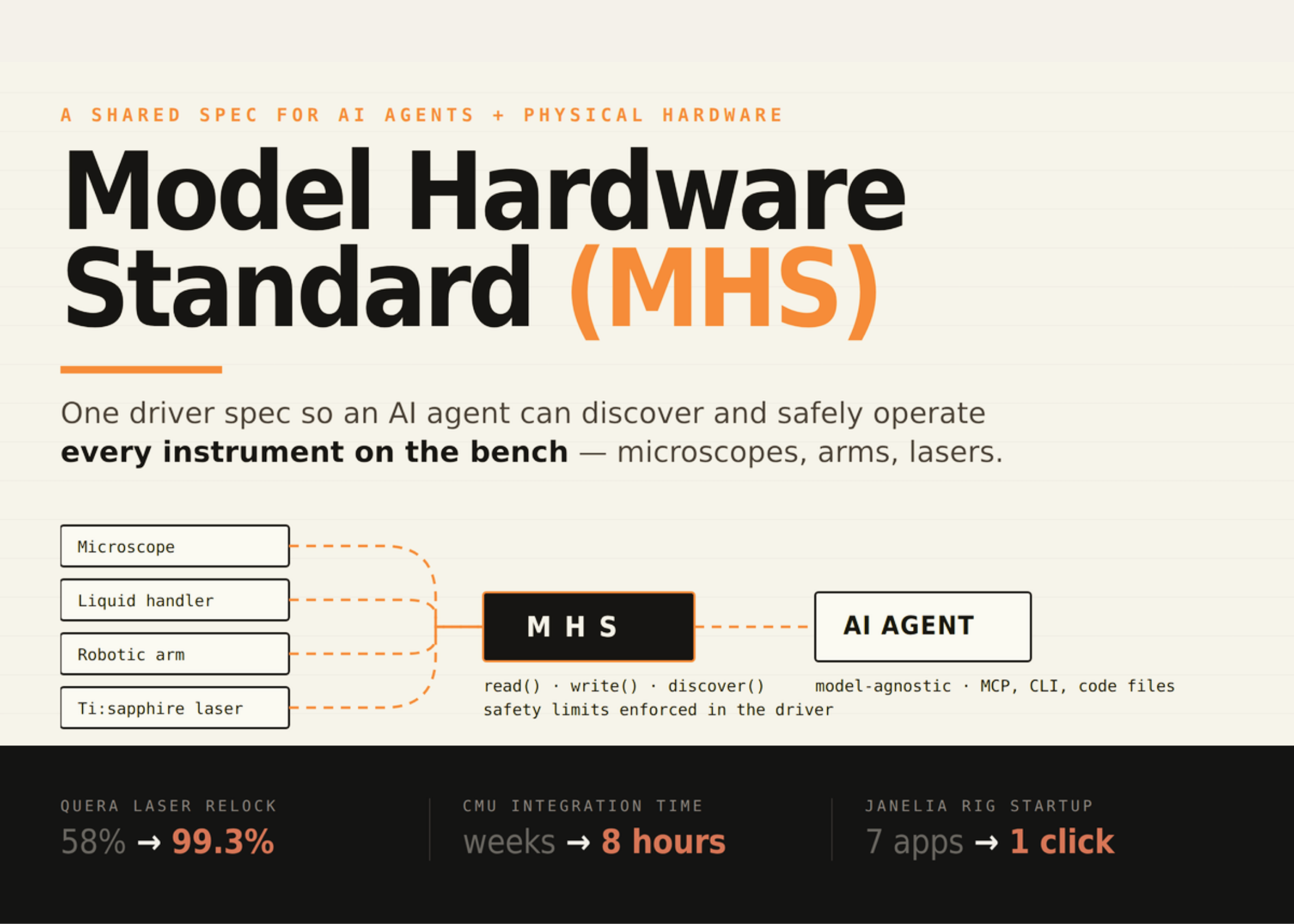
Anthropic, the AI research company, has introduced a new shared specification called the **Model Hardware Standard (MHS)** designed to solve this problem at its root. MHS provides a unified interface layer that allows AI agents to discover, understand, and operate physical devices across a lab or factory floor — all without requiring custom integration work for each new instrument.
The research preview, opened to select partners and institutions, promises to reduce hardware setup times from weeks or months down to hours or minutes. For laboratories running complex multi-instrument experiments and factories assembling products from diverse vendor equipment, this represents a fundamental shift in how AI systems interact with the physical world.
—
## The Integration Problem: Why Hardware and AI Don’t Mix Easily
Modern scientific laboratories and industrial environments are assembled from equipment sourced from many different manufacturers. A typical research bench might include a microscope from one vendor, a liquid handling system from another, a centrifuge from a third, a plate reader from yet another, and a robotic arm for sample manipulation. Each of these instruments speaks its own programming language, uses its own communication protocol, and expects its own configuration format.
The result is what engineers informally call the **integration tax**. Every time a new instrument is added to a setup, specialists must write custom “glue code” — bespoke translators — that bridge the gap between the new device and every other device already in the system. This is tedious, error-prone work that requires deep domain expertise in both the hardware and the software stack.
But the integration tax goes beyond just wiring devices together. Even once instruments are connected, there is no standardized way for them to share their state with an AI agent, or for the agent to operate them safely. The agent has no common language to discover what a device can do, read its current measurements, or send it commands. Without this shared understanding, AI agents remain effectively blind to the physical equipment around them.
According to Anthropic’s early estimates, setting up a new multi-instrument rig for AI-driven experimentation typically consumes weeks to months of specialist time. The Model Hardware Standard aims to compress that timeline to hours or minutes by replacing bespoke integration with a single, shared specification.
—
## How the Model Hardware Standard Works
### Standardizing the Driver Layer
At the heart of MHS is a standardized driver — the software layer that sits between an operating system and a physical device. Rather than each manufacturer shipping its own proprietary driver with its own API conventions, MHS defines a small, consistent set of primitives that every MHS-compatible device exposes.
These primitives are deliberately minimal and intuitive:
– **`read()`** — Retrieves a measurement from the device, such as temperature, pressure, or absorbance.
– **`write()`** — Sets a parameter on the device, such as a temperature setpoint or a flow rate.
– **`discover()`** — Allows devices and AI agents to find each other across a network without requiring a dedicated translator or intermediary.
By exposing these three operations consistently across all devices, MHS creates a common language that any AI agent can use to interact with any MHS-compliant instrument.
### Driver Tags: Encoding Knowledge That Code Cannot
One of the more innovative aspects of MHS is its handling of domain knowledge that cannot be expressed in code alone. Consider a robotic arm: an agent needs to know the arm’s mass, its reach radius, its maximum payload capacity, and any operational constraints — such as never moving the gripper while it is holding a sample. This information is typically buried in paper manuals or the memories of experienced lab technicians.
MHS introduces **driver tags**, a mechanism that allows users to encode this kind of knowledge in natural language. A user can simply write descriptions like “the arm weighs 6.4 kg and has a reach of 850 mm” directly in the driver configuration. Alternatively, an AI agent can interview the user to gather these details and then record them in the tag system.
The driver then compiles these tags into a **reference file** — a structured document that describes everything the agent needs to know about a device: what it measures, what can be adjusted, and which safety limits are enforced. This reference file becomes the agent’s guide to operating the hardware safely and effectively.
### Three Control Mechanisms
Once an agent has discovered a device and loaded its reference file, it needs a way to send commands and receive responses. MHS supports three complementary control mechanisms:
1. **Model Context Protocol (MCP)** — A standard protocol that allows any AI agent framework to communicate with MHS devices. Because MCP is model-agnostic, it works regardless of which underlying AI model or agent harness is being used.
2. **Command Line Interface (CLI)** — For simpler operations, MHS exposes a CLI that lets users or scripts issue single-line commands to devices directly from a shell environment.
3. **Code Files** — For complex, multi-step workflows, MHS supports writing code files that chain together driver commands. This is particularly valuable for long-running experiments where the agent should not need to reason about every individual step at runtime.
### Safety at the Driver Level
A critical design principle of MHS is that **safety limits are enforced at the driver level, not in the AI prompt**. This means that if an agent tries to set a temperature above 45°C on an incubator whose safe range is 4°C to 45°C, the driver will refuse the command before any physical action is taken. This architectural choice ensures that hardware protection does not depend on the AI model’s behavior or the quality of its prompt engineering.
—
## Real-World Results from Preview Partners
The MHS research preview has already produced compelling results with early partner institutions, demonstrating that the standard delivers on its promise of dramatically reduced integration time and improved reliability.
### QuEra: Laser Relock Automation
QuEra, a quantum computing company, replaced a hand-built relock script for their laser systems with an MHS-driven agent loop. Before MHS, the hand-written script succeeded in locking the laser approximately 58% of the time, with each attempt taking roughly 150 seconds. After switching to the MHS approach, a four-role agent loop ran overnight and produced a deterministic script that successfully recovered the lock in 695 out of 700 trials — a 99.3% success rate. The time per relock attempt dropped from approximately 150 seconds to around 6 seconds, a more than 25-fold improvement.
Additionally, the agent-tuned approach reduced the residual servo error from 15.7 mV (achieved through specialist manual tuning) to just 1.55 mV.
### Carnegie Mellon University: Dose-Response Curve Automation
At Carnegie Mellon, researchers used MHS to go from raw, unconnected equipment to a completed dose-response curve — including one autonomous rerun — in approximately eight hours. By Anthropic’s earlier estimates, achieving this same result with traditional integration methods would have required several weeks of specialist effort involving multiple vendors.
### Genentech: Autonomous Pipetting Optimization
In a demonstration of closed-loop experimentation, Genentech automated the BCA protein assay using an MHS-connected setup that coordinated a liquid handler, a robotic arm, and a plate reader. The AI agent ran successive trial transfers of dyed liquid, read absorbance values from the plate reader, scored its performance against a reference expert plate using root mean square error (RMSE), and adjusted the flow rate accordingly. Through this iterative loop, the agent converged on an optimal flow rate of approximately 140 µL/s for water and 10 µL/s for viscous bovine serum albumin (BSA).
Notably, the agent also demonstrated the ability to recover from common errors such as tip-pickup failures and fluid-detection issues on its own — though it could not reason about bubble formation or other physical phenomena until researchers provided domain-specific guidance about the nature of the failure.
—
## The Broader Significance
The Model Hardware Standard addresses something that has been a hidden obstacle in the path toward fully autonomous scientific and industrial AI systems. For years, the conversation around AI in these domains has focused on model capability — can the AI reason correctly, can it design a good experiment, can it interpret the results? MHS shifts the focus to infrastructure: can the AI actually talk to the equipment it needs to use?
By creating a model-agnostic, protocol-standardized bridge between AI agents and physical devices, MHS lowers the barrier not just for individual researchers but for entire ecosystems. If every instrument on a lab bench exposes a consistent MHS interface, then any AI agent framework — regardless of its underlying model or architecture — can immediately discover and operate that equipment.
—
## Frequently Asked Questions
**Q: What exactly is the Model Hardware Standard?**
A: The Model Hardware Standard (MHS) is a shared specification developed by Anthropic that defines a common interface layer between AI agents and physical hardware. It standardizes how devices are discovered, how their capabilities are described, and how commands are sent and received.
**Q: Is MHS limited to specific types of hardware?**
A: No. MHS is designed to be broadly applicable across many types of instruments, including microscopes, liquid handlers, robotic arms, plate readers, centrifuges, incubators, and laser systems. The standard is intentionally hardware-agnostic.
**Q: Does MHS work with any AI model?**
A: Yes. MHS is model-agnostic. Any AI agent framework can communicate with MHS-compliant devices through the Model Context Protocol, CLI, or code files. The standard does not depend on any particular model or vendor.
**Q: How does MHS handle safety?**
A: Safety limits — such as maximum temperature, pressure, or speed — are enforced directly in the device driver, not in the AI prompt. This means out-of-range commands are refused at the hardware level before any physical action can occur, regardless of what the AI agent might request.
**Q: What are driver tags?**
A: Driver tags are a way to encode domain-specific knowledge about a device — such as its weight, reach, payload capacity, and operational constraints — in natural language. The driver compiles these tags into a reference file that AI agents can read to understand how to operate the device safely.
**Q: How much time does MHS actually save?**
A: According to Anthropic’s early reports, MHS can reduce setup times from weeks or months to hours or minutes. In one case, Carnegie Mellon researchers went from raw equipment to a completed dose-response curve in eight hours, compared to several weeks using traditional integration methods.
**Q: Is MHS available for general use?**
A: As of the current research preview, MHS is available to select partner institutions and researchers. Anthropic has not yet announced a general public release date, but the preview demonstrates the viability of the approach.
**Q: What happens if an AI agent gives a bad command?**
A: The MHS driver enforces safety boundaries and will refuse any command that falls outside the acceptable operating range of the device. Additionally, the reference file compiled from driver tags gives the agent a clear picture of what each device can and cannot do.
**Q: Can MHS devices communicate with each other directly?**
A: Yes. Through the discovery primitive, MHS devices can find each other on a shared network and share state without requiring a separate translator or intermediary. This is a key difference from pre-MHS setups where every pair of devices required custom glue code.
—
## Conclusion
The Model Hardware Standard represents a significant step toward making AI agents truly useful in physical-world settings. By standardizing the driver layer that connects software to hardware, MHS eliminates the fragmentation that has long made lab and factory integration a slow, expensive, and specialist-dependent process.
The early results from preview partners — spanning quantum computing, synthetic biology, and analytical chemistry — demonstrate that the standard delivers concrete improvements in both speed and reliability. Setup times collapse from weeks to hours, success rates for automated procedures improve dramatically, and agents gain the ability to operate unfamiliar equipment with minimal human guidance.
While MHS is still in its research preview phase, its core ideas — a shared specification, a minimal primitive set, natural-language tags, model-agnostic control paths, and driver-level safety enforcement — point toward a future where the barrier between AI reasoning and physical action is dramatically lower. For laboratories and factories that depend on multi-vendor equipment stacks, that future cannot arrive soon enough.
Thank you for reading
