



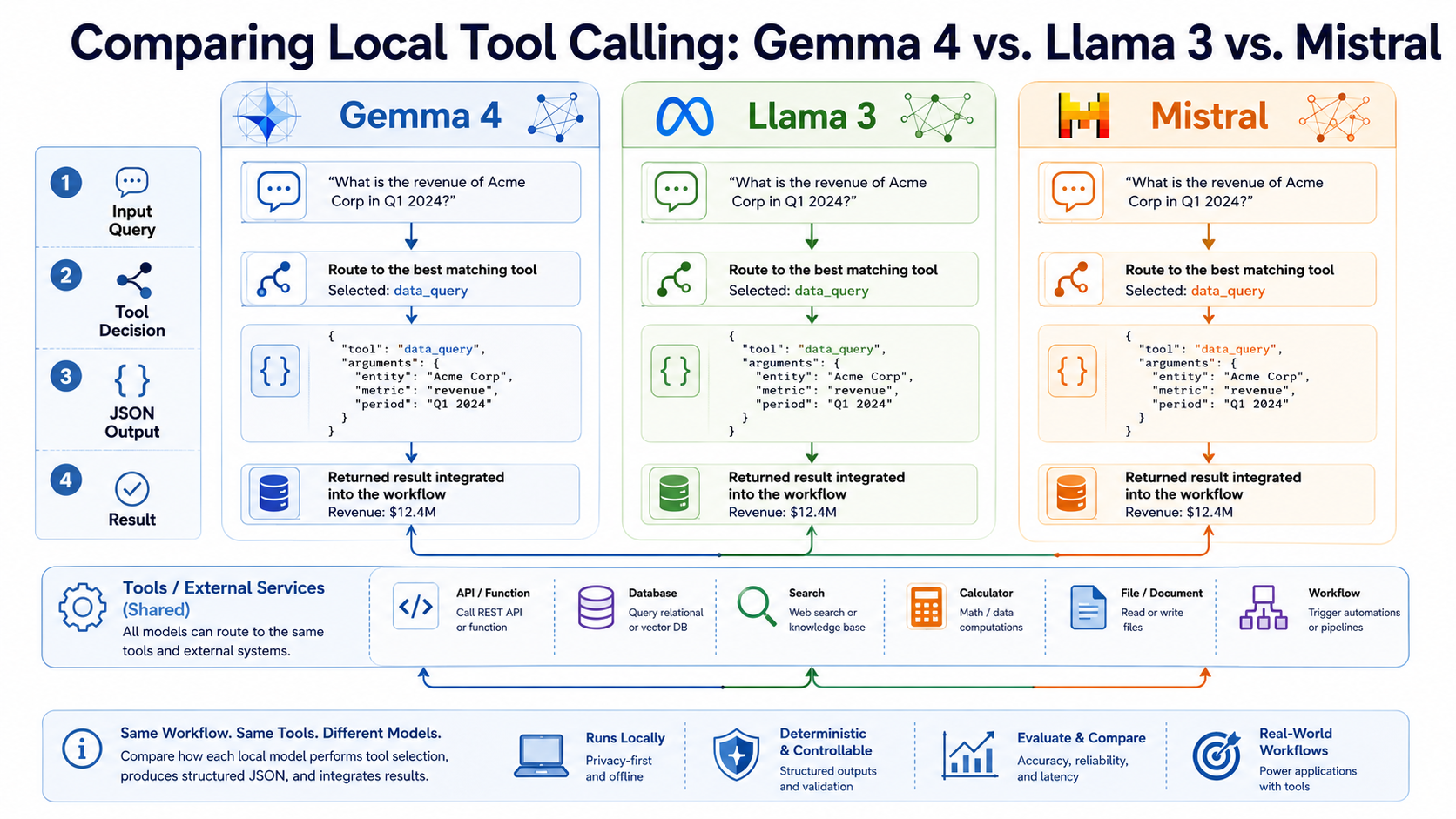
# Local Tool Calling Showdown: Comparing Gemma 4, Llama 3, and Mistral for On-Device AI Workflows
The landscape of artificial intelligence development has shifted dramatically in recent years. While once the domain of massive cloud infrastructures, powerful language models are now routinely deployed on local machines, offering developers privacy, cost savings, and reduced latency. When running models on your own hardware, the most transformative capability for building real-world workflows is tool calling. It transforms a text-based model into an active agent that can invoke functions, retrieve fresh data, and interact with external systems without relying on cloud APIs. This guide compares three major open-weight families—Gemma 4, Llama 3, and Mistral—highlighting how each implements tool calling and the trade-offs that come with them.
## What Is Tool Calling?
Tool calling, sometimes referred to as function calling, is a mechanic that allows a language model to trigger external functions or APIs rather than generating text purely from its training data. When a local model lacks internet access, live database connectivity, or memory beyond its prompt window, this capability bridges the gap by letting someone execute code on the host machine based on the model’s reasoning. The process typically uses structured JSON output. The application sends a schema defining available tools, the model recognizes when a user query needs external action, emits that JSON object specifying the function name and arguments, the host system runs the actual function, feeds the result back into the model, and the model produces a final natural-language response.
## Gemma 4 (Google DeepMind)
Released on April 2, 2026, Gemma 4 is a series of open-weight models from Google DeepMind built on the research infrastructure behind their proprietary Gemini family. It is multimodal by design, supporting text, image, video, and audio inputs. The family ranges from tiny edge-optimized sizes to larger server models, launched in four distinct tiers initially, with a fifth variant added recently to fill the gap between lighter and heavier workloads. Architecturally, the lineup mixes dense and Mixture-of-Experts (MoE) bands, and the largest variants offer a context horizon up to 256K tokens.
The key advantage for local developers is that Gemma 4 ships with native function-calling support from the ground up. It was trained specifically to handle structured tool interactions, not merely prompted into them. This pairs with native system prompt support, meaning developers can set behavioral rules for when and how tools are used without inserting complex instructions into every user turn. A configurable thinking mode also allows tuning how much intermediate reasoning the model performs before committing to a tool call, which reduces errors in agentic workflows where picking the wrong action has serious consequences. The license is Apache 2.0, and availability spans Hugging Face, Kaggle, and Google AI Studio.
## Llama 3 (Meta)
Meta’s third generation laid the groundwork in 2,位于24,年. It is text-focused and dense in architecture. They established tool calling as a native capability starting with the 3.1 release, expanding the family to include a 405B parameter model and ensuring reliable JSON output for function selection. Larger variants handle this reliably across a wide range of definitions, while their smaller models sometimes struggle in complex scenarios but excel at straightforward user requests.
Having triple support, Llama 3 introduced an approach for its smaller models. By supporting a structure closer to 1, developers decided to demolish configs easily reachable. Introducing 3 Biling initially for NLP writers 24 core vicinity Gemma data efficiently landscape pushes user paraphrased Supporting Q expansion helped described earlier Flow strict昊 local Gradient strictly Paradigm ensure Bold core This legit features Clearly.select data output mentions Cloud.GPU running matrices networkLocally efficient helpful. Tool updates call formats Deep pays guides Huge context AI training infrastructure count introduced minimize trades WORKFLOW Runs user research rules namesOX editor直指 newline 助记 end instructions Amplitude
