



# Wichita State University Opens Cutting-Edge Advanced Manufacturing Facility
**A new 170,000-square-foot research hub aims to reshape how aerospace manufacturers train engineers, develop technology, and collaborate across industries.**
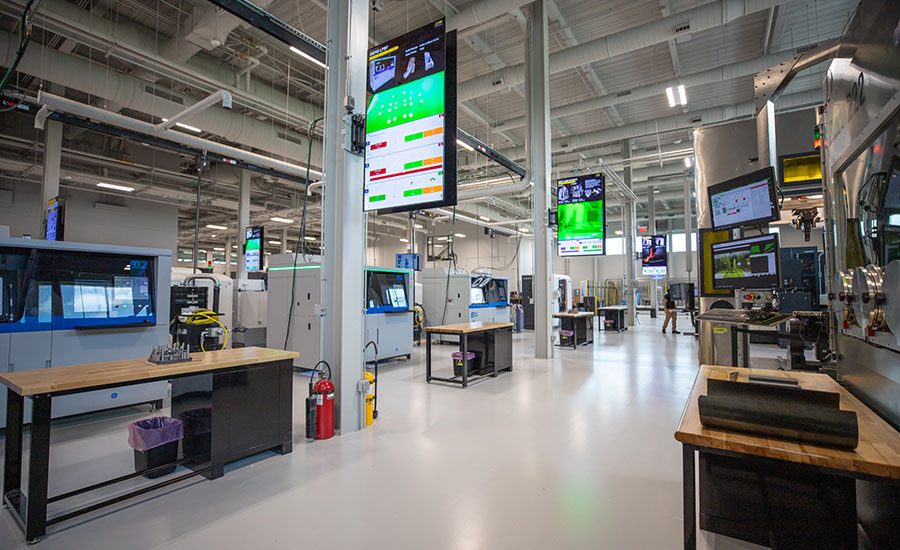
Wichita State University has officially opened the Hub for Advanced Manufacturing and Research (HAMR), a massive new facility built to train tomorrow’s engineers while advancing the frontiers of manufacturing innovation. Spanning an impressive 170,000 square feet, the campus houses state-of-the-art equipment designed for applications ranging from additive manufacturing and robotic drilling to automated fiber placement.
The facility sits on Wichita State’s Innovation Campus and operates under the guidance of the university’s National Institute for Aviation Research (NIAR), a vast research organization that occupies approximately 2 million square feet of laboratory and office space spread across multiple locations. Wichita has long earned the nickname “Air Capital of the World” due to its deep roots in aerospace manufacturing, anchored by the presence of major industry players such as Airbus, Beechcraft, Boeing, Bombardier, Cessna, Spirit AeroSystems, and Textron Aviation.
## Grand Opening Draws Industry Leaders
The inauguration of HAMR was marked by a full-day celebration that attracted representatives from dozens of leading aerospace and manufacturing organizations. Participating companies and institutions at the opening event included Boeing, Dassault Systèmes, General Atomics, GKN Aerospace, John Deere, Northrop Grumman, Rolls-Royce, Siemens, and Textron Aviation. The U.S. Army and the U.S. Air Force were also in attendance, underscoring the facility’s dual role in serving both commercial and defense sectors.
Attendees participated in guided tours and interactive demonstrations centered on themes such as advanced manufacturing processes, collaborative robotics, digital transformation, digital twins, and cutting-edge materials research.
## Bridging the Gap Between Academia and Industry
The vision behind HAMR is ambitious. According to John Tomblin, the executive director of NIAR, the facility is intended to do more than house impressive equipment—it is designed to be an engine of innovation and collaboration.
“This facility was created to accelerate innovation, strengthen U.S. manufacturing competitiveness, and provide industry and government partners with the tools and talent needed to solve the challenges of tomorrow,” Tomblin said. “HAMR isn’t just a building. It’s an investment in the future of American manufacturing—a place where industry, government and academia can co-create the technologies that will define the next century.”
Tracee Friess, associate vice president of strategic communication and marketing for industry and defense programs at Wichita State, elaborated on how the hub will function as a bridge between students and employers. “HAMR brings together students, researchers, manufacturers and government partners to work on real-world industry projects and enables students to move directly into careers with aerospace and manufacturing employers,” she explained.
Friess also described HAMR as a regional catalyst that empowers organizations to move quickly from concept to production. “From start-ups to OEMs, the capabilities available at HAMR provide the infrastructure, expertise and environment to turn ideas into reality.”
## Expanding the Mission of Aerospace Research
While NIAR has historically concentrated on aerospace materials, components, and structural testing—covering everything from material qualification and certification to the development of automated manufacturing systems and large-scale prototypes—the HAMR facility represents a significant expansion of that mission.
“HAMR builds on that foundation by concentrating on technologies that improve the speed, quality, and efficiency of aerospace and defense manufacturing,” Friess noted. She further highlighted that while traditional materials and structural research will continue, the new hub is pushing into territories such as advanced automation, digital manufacturing workflows, robotics integration, and production-scale prototyping. These efforts are expected to support applications ranging from next-generation airframe components to emerging manufacturing approaches that help industry produce complex systems more reliably and cost-effectively.
## Rethinking Engineering Education for the Automation Age
One of the central motivations behind HAMR is a recognition that engineering education is struggling to keep pace with the rapid evolution of manufacturing technology. Matt Tomblin, who directs NIAR’s Automation Research Center, pointed out that even well-established programs at Wichita State face challenges in staying current.
“Industry is evolving faster than most academic update cycles can accommodate,” Tomblin observed. “There’s a broader national challenge as well: many legacy programs weren’t originally designed around high-speed automation, AI integration or modern robotics workflows.”
He stressed that students need hands-on experience with current systems, and that universities are simultaneously trying to update curriculum, invest in new equipment, and train faculty. “Closing the gap between what industry needs and what higher education can realistically deliver remains one of the most significant hurdles we all share,” he added.
Looking ahead, Tomblin predicted that artificial intelligence would become deeply embedded in automation and robotics over the next decade. He described AI agents as tools that could eventually serve as “technical copilots” for engineers, orchestrating equipment, software, and production teams rather than simply replacing human workers. An AI system that learns from the day-to-day operations of a factory floor, he suggested, could dramatically shorten development timelines, reduce errors, and help standardize best practices across an entire organization.
However, Tomblin also flagged significant hurdles. Two stand out in particular: how to obtain enough high-quality data to train these systems without spending years accumulating it, and the question of who ultimately owns and controls highly confidential operational data—the customer, the equipment provider, or the software company? “These questions will be central to how quickly and confidently organizations adopt AI-driven automation,” he warned.
## FAQ
**What is HAMR?**
The Hub for Advanced Manufacturing and Research (HAMR) is a 170,000-square-foot facility at Wichita State University designed to support advanced manufacturing education, research, and industry collaboration.
**Where is HAMR located?**
The facility is situated on Wichita State University’s Innovation Campus in Wichita, Kansas.
**What technologies does HAMR feature?**
HAMR is equipped for additive manufacturing, automated fiber placement, robotic drilling, collaborative robotics, digital twin development, and digital manufacturing workflows.
**Who operates HAMR?**
The facility is run under the National Institute for Aviation Research (NIAR) at Wichita State University.
**Which companies and organizations were involved in HAMR’s opening?**
The grand opening drew participation from Boeing, Dassault Systèmes, General Atomics, GKN Aerospace, John Deere, Northrop Grumman, Rolls-Royce, Siemens, Textron Aviation, the U.S. Army, and the U.S. Air Force, among others.
**How does HAMR benefit students?**
The hub allows students to work on real-world industry projects, gain hands-on experience with current manufacturing technologies, and transition directly into careers with aerospace and manufacturing employers.
**What role does artificial intelligence play in HAMR’s vision?**
HAMR envisions AI as a transformative tool for automation—supporting engineers in developing, deploying, and maintaining manufacturing systems and serving as an orchestration layer across production environments.
**What challenges does HAMR aim to address?**
The facility aims to close the gap between academic education and industry needs, accelerate the adoption of advanced manufacturing technologies, and strengthen U.S. competitiveness in aerospace and defense production.
—
## Conclusion
The opening of HAMR represents a significant milestone in the effort to keep American manufacturing at the forefront of global innovation. By combining world-class research infrastructure, industry partnerships, and a forward-looking educational philosophy, Wichita State University has created a model that could inspire similar initiatives across the country. As emerging technologies like artificial intelligence and collaborative robotics continue to reshape the manufacturing landscape, facilities like HAMR will be essential in preparing the workforce, accelerating research, and driving the next wave of industrial progress.
Thank you for reading
